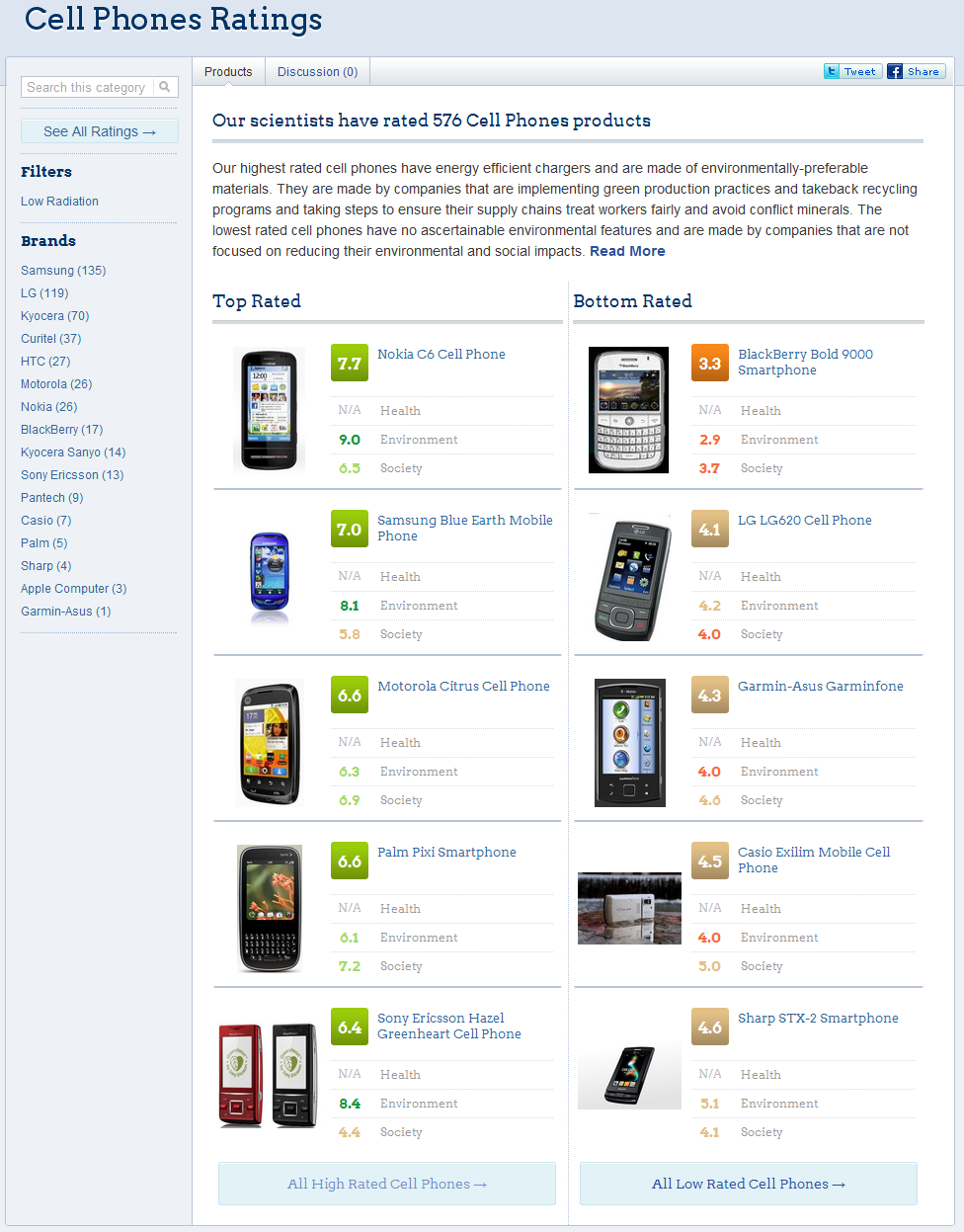
 Click image, right, to enlarge.
Today, GoodGuide (a TechCrunch50 alumni company) added mobile phone rankings to their comprehensive database that ranks the environmental and social performance of products, and the companies that make them.
In its new mobile phone category, the San Francisco startup ranked 576 different handsets and chargers from 16 top mobile phone makers in the U.S. market. GoodGuide assessed everything from the “ingredients” that go into the phones, to each device’s energy efficiency, recyclable qualities, and manufacturers’ willingness to disclose details about its supply chain, materials and more.
For environmental performance and impact of the companies overall: RIM came in dead last, Nokia topped the GoodGuide environmental chart, and Apple stood at third place.
No Apple iPhone cracked the top fifteen GoodGuide list of the most environmentally friendly devices, despite the company’s strong overall showing. The Nokia C6 Cell Phone took top honors, followed closely by Samsung’s Blue EarthMobile Phone. RIM’s Blackberry Bold 9000 Smartphone was the worst-rated handset. [Ed’s note: See screenshot above, for further ratings.]
GoodGuide founder Dara O’Rourke explained why Apple was viewed favorably as a company, but its phones were not rated as environmentally friendly:
“Apple released a new supplier responsibility report this week, which won the company points.
Until this year, though, Apple could not even tell you what metals or minerals were in their phones, or where they came from…Along with other mobile manufacturers, their stance had been: we can’t tell you whether conflict minerals are in our phones, and we can’t tell you who manufactured a sub-component of what’s in there — it’s proprietary, competitive, or not something we know.
Now, it’s 2011. The industry is playing catch up on all of this. Consumers are demanding to know more. There are still a lot of details that Apple hasn’t disclosed about their iPhones though. A lack of transparency on each product keeps the iPhone — and the Blackberry — lower in the product rankings.”
The Dodd-Frank Wall Street Reform and Consumer Protection Act may soon require phone manufacturers to disclose such details.
The scientist who led the mobile phone research for GoodGuide, Pedro Vieira, said that to derive its product-scores, the company licenses and compiles studies from government, academic, business and independent research organizations, adding some of their own proprietary data to the mix. The company assigns a weight to each study so that a company-provided claim about its own product will be worth less than an independent, scientific lab’s research into the same item.
Unlike other sustainability reports on mobile phones — like the O2 Ecoratings in the U.K. market, or Greenpeace’s Guide to Greener Electronics — GoodGuide reported environmental and social impact as separate scores, offered company and product-level scores, and provided information about phones’ radiation levels (not counted in their scores) for consumers who believe this could pose a health risk.
O’Rourke noted that ultimately, his company aims to help people find brands and products that align with their own social, health and environmental concerns, but doesn’t want to advocate what those values should be, or which brands they should choose. He doesn’t believe that GoodGuide scores would convince even the most tree-hugging, granola-eating Apple fan to switch to a Nokia. He hopes that such ratings will, however, give consumers motivation to pressure companies they buy from to be as transparent as possible, though, and to improve the sustainability of their products and operations.
GoodGuide’s top ten list of the most environmentally sensible phone manufacturers included:
1.Nokia
2.Sony Ericsson
3.Apple
4.Pantech
5.Palm
6.Kyocera Sanyo
7.Motorola
8.HTC
9.Samsung
10.Curitel