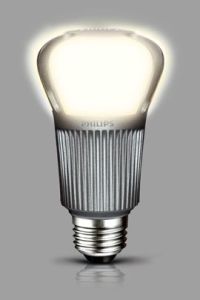
 Today, Philips announced that their Philips Ambient LED 12.5 watt light bulb — which gives off as much light as incandescent 60 watt bulbs, using less energy — attained Energy Star qualifications. It’s the first LED light bulb of this type to gain approval in the U.S. Environmental Protection Agency sponsored program. Energy Star sanctioned products are usually eligible for utility rebate programs that can lower the cost of a product for consumers, while allowing a company to keep their margins strong.
According to Philips, its bulb lasts 25 times longer and uses 80 percent less energy than the 60 watt incandescent bulb it was designed to replace. A company press statement reported that in order to obtain the Energy Star label, its LED bulb had to demonstrate a minimum light output of 800 lumens, a color temperature of 2700K (for soft white light), color rendering index (CRI) of 80 and a minimum three-year warranty; it actually offers 806 lumens, 2700K, a CRI of 80 and a six-year warranty. The bulbs are currently selling at Home Depot for $39.97.
A Philips company representative told TechCrunch the bulbs are also recyclable. The lighting corporation wasn’t issuing predictions about how much the Energy Star qualification would drive sales of its Ambient 12.5 watt bulbs. More macroscopically, however, Philips predicts LEDs will take 50 percent of the residential lighting market by 2015.
Other companies are sure to follow in Philips’ footsteps, from large and medium-sized businesses like Cree (NASDAQ: CREE) and the Lighting Science Group Corporation (OTCB: LSCG) to younger startups like Bridgelux.
The Durham, N.C.-based Cree now has a demonstration 60 watt incandescent replacement LED bulb — the TrueWhite Light — that the company claims is the industry’s brightest and most efficient, and meets Energy Star performance criteria. A company spokesperson said Tuesday that Cree submitted it to an independent testing facility, with testing on track to be completed by the fall. (Energy Star doesn’t test bulbs for certification.)
Meanwhile, LSCG has an Energy Star approved line, called DEFINITY. Bulbs in this line, the company announced today, have been installed in Yankee Candle Stores throughout New England. LSCG claims these are approximately 80% more efficient than the halogen bulbs that they replace, are “dimmable,” contain no mercury, and are completely recyclable. Yankee Candle received rebates from National Grid and Western Mass Electric Company through the Mass Save program, and other electric utility companies throughout New England.