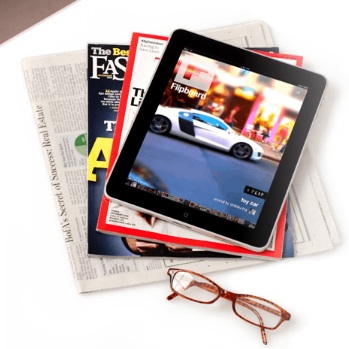
Ever since the iPad came out, print media companies have been feeling their way in this new medium, but so far they’ve just been stumbling over themselves.
They are latching onto the iPad as a new walled garden where people will somehow magically pay for articles they can get for free in their browsers. But if they want people to pay, the experience has to be better than on the Web, and usually it’s not.
This sorry state of affairs is true for both magazines and newspapers. The New York Times iPad app, for instance, is gorgeous but crippled. All the links are stripped out of the articles, even from the blogs. Meanwhile, most iPad magazines are little more than PDFs of the print issues with some photo slideshows and videos thrown in. They end up being huge files—I recently downloaded a single issue that was 350 MB, some issues of Wired are 500 MB—with the same stale articles as in the print version. Replicating a dead-tree publishing model on a touchscreen is a recipe for obsolescence.
Despite the poor reviews and uninspiring number of downloads, media companies sold millions of dollars worth of advertising last year for their iPad apps because advertisers want to be associated with anything shiny and new. Make no mistake: advertising dollars are driving media companies to embrace the iPad, not readers. The same is true for the upcoming launch this week of News Corp’s iPad-only newspaper, The Daily, but at least it will be built from the ground-up for the iPad. I suspect it will take a while for it to reach its true potential—it’s hard enough to launch a new publication as it is without reinventing the reading experience—but I am curious to see where it goes.
However, I am not holding my breath. I’ve already written my thoughts on what The Daily should look like.
From a reader’s perspective, the optimal iPad newspaper should be three things:
- Social: It should show you what your friends and the people you trust are reading and passing around, both within that publication and elsewhere on the Web.
- Realtime: News breaks every second, and publications need to be as realtime as possible to keep up. A “daily” already sounds too slow.
- Local: The device knows where you are and should serve up news and information accordingly, including, weather, local news and reviews.
At the very least, Apple should fix the subscription problem in iTunes. Right now, each new issue of a paid magazine or newspaper must be bought separately as an in-app purchase. But subscriptions are not going to save the media companies. In fact, they’d be smarter to give the apps away for free and make more money from the advertisers, who want to reach as many people as possible. The ads should also be worth more because they just look better in an app where they look more like a magazine ad and can take over the whole screen when tapped on.
But making these media apps social and realtime is the key. It should be constantly updated like a blog or Twitter. And it should be social like Flipboard in that it shows me what people I follow are reading and retweeting elsewhere by unpacking their links into full articles, images, and videos.
More so than iPad newspapers, iPad magazines have a real opportunity to break the mold, but they can’t do that if they are just trying to repurpose their print publications. Starting from scratch like The Daily is the right idea. But what magazines are better at than newspapers is really packaging the news, distilling big ideas, and presenting stories in a narrative arc that sticks in readers’ minds.
If I were creating an iPad mag it wouldn’t look like a magazine at all. It would look more like a media app, and there wouldn’t be any subscription or even distinct issues. New content would appear every time you opened it up, just like when you visit TechCrunch or launch Flipboard or the Pulse News Reader. In order to make it addictive, it would have to be realtime. But it would also be more selective than simply reading everything that anyone links to in your Twitter or Facebook streams.
Instead, it would present readers with a continuum from original articles and videos to curated streams by topic. The curated streams would combine Tweets from the staff writers and editors with those of other journalists, entrepreneurs, and experts for any given topic or section. These streams would be unpacked Flipboard-style into a magazine-like layout, but with more filters to show trending stories and highlight the ones which are getting the most buzz.
At the same time, there would be a view showing only the articles from that publication. And there would be other ways to navigate the app than just a reverse-chronological stream of the latest posts. In addition to the hourly drumbeat of breaking news and analysis, there would be longer narratives. These would not necessarily be 10,000-word articles (although those could be part of it), but rather taking readers through a series of experiences to tell a story.
Maybe you start with an article, followed by a video interview with the subject, an interactive infographic, and then wrap up with a selected Tweet stream about the topic. At every point, the reader would be led by the hand from one experience to another, coming away with a fuller understanding of the topic. Supplemental images and data should always be at her fingertips. And, of course, the reader could dive right in by commenting, Tweeting, sharing, taking opinion polls and all the rest.
A digital magazine or newspaper should feel like a media app, not like a PDF viewer. It needs to take advantage of technology to tell better stories. These include both presentation technologies (immersive panoramic photos, interactive charts) and data-sifting technologies to filter the news from outside sources.
What do you want to see in a media app that you are not getting today?