Inspired by the recent Tunisian demonstrations against corruption, protesters are filling the streets of Cairo. And like the protests in Tunisia, the Egyptian ones were partly organized on Facebook and Twitter. And now Twitter appears to be blocked in Egypt, according to various Tweets and tips we’ve received. However, so far only the Twitter website itself is blocked (including the mobile site), but people in Cairo are still using Twitter third-party clients to keep on Tweeting. There are also reports of the entire mobile Web being blocked through mobile carriers, but at least one carrier, Vodafone Egypt, denies that it is blocking Twitter, attributing the problem to overloaded networks instead. Update: one tipster says Twitter apps are blocked as well and that the only way to Tweet is by using Web proxies. Update 2: Asked to confirm that Twitter is blocked in Egypt, Google PR points to this Herdict Report, which indicates that it is in fact inaccessible in that country.
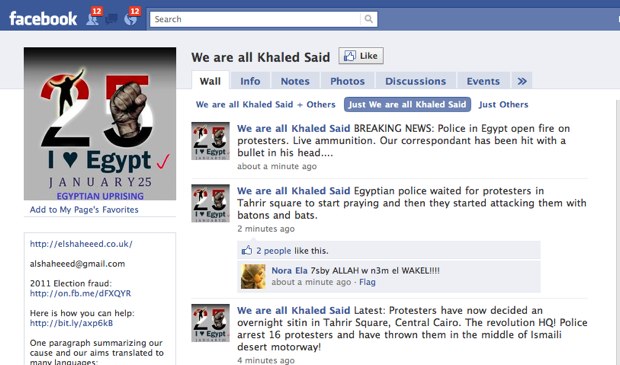
Facebook is also being used to organize the demonstrations, with groups also popping up around the world to document the uprising and lend its support. For instance, one Facebook Group called We Are All Khaled Said, features up-to-the-minute updates on the protests and photos from the scene. Khaled Said was “a young man brutally tortured and killed by police in Alexandria,” explains Blake Hounshell on the Foreign Policy blog, and his death has become a rallying point for the demonstrations which fall on “Police Day,” a national holiday in Egypt.
Update: The Facebook Group is reporting that the police are firing at the protestors with rubber bullets.
Increasingly, social media is playing an important role in organizing and broadcasting protests against governments around the world. Unlike television or newspapers, Twitter and Facebook are not so easy to control other than blocking them entirely because of their distributed nature. By the time a regime realizes its only option is to block a service like Twitter, the protests are usually already well under way. And reports keep coming out via these channels anyway, making them the most immediate way to watch the protests (and sometimes subsequent uprisings) unfold. The reports may not always be accurate right away (confusing rubber bullets for “live ammunition,” for instance, but they tend to self-correct quickly.
Update: Twitter Confirms That They’re Being Blocked In Egypt
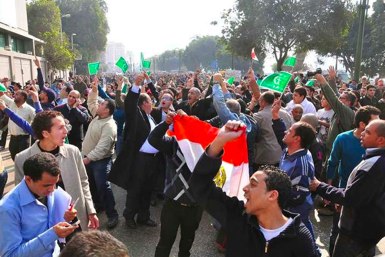
Photo via Facebook
http://twitter.com/#!/ircpresident/status/29916644545396736
http://twitter.com/#!/NasmaBar/status/29921235479568384
http://twitter.com/#!/MideastYouth/status/29920901017370624
http://twitter.com/#!/VodafoneEgypt/status/29927017323433984