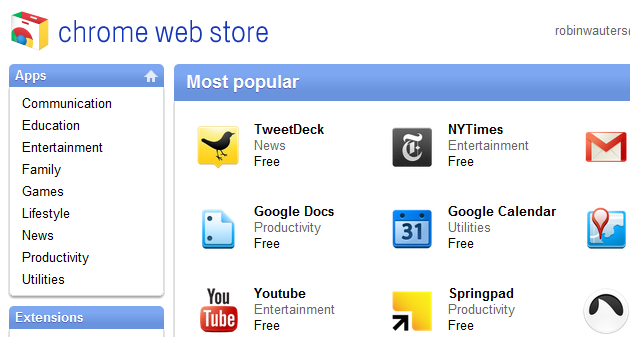
Google publicly unveiled the Chrome Web Store a week ago. Looking at the most popular apps in the U.S. by weekly install numbers, it looks like TweetDeck has fast risen to the most prominent spot on the list, as relayed by the startup’s founder Iain Dodsworth earlier today.
With about 102,500 weekly installs at the time of writing, TweetDeck thus beats NYTimes, whose app has seen approximately 87,700 weekly installs to date, roughly seven days in.
So where are the Google services? Right behind the TweetDeck and the NY Times, it appears.
The list of top 10 most popular apps on the Chrome Web Store includes Google Calendar, Google Books, Google Docs, Google Reader, Gmail, Google Maps and YouTube.
Granted, most of Google’s ‘apps’ are mere links to the respective Web-based services, whereas ‘ChromeDeck’ is an actual app, but still.
Springpad rounds out the list of the ten most popular apps on the store as the third non-Google service to make the list after TweetDeck and NY Times, with about 35,000 weekly installs (almost a third of TweetDeck’s install numbers).
Obviously, it’s far too soon to draw any conclusions, but it’s certainly a testament to TweetDeck’s huge popularity to see it leading the most popular Chrome apps list, considering the company is primarily regarded as a desktop and mobile client software developer.
For your information, rivals HootSuite (16,000 weekly installs), eBuddy Web Messenger (13,9200 weekly installs) and Seesmic (5,442 weekly installs) are trailing far behind.
TweetDeck is a Twitter client for desktop, web, and mobile devices. TweetDeck was originally an Adobe Air desktop application, designed with a unique columned user interface. Its goal was to be a realtime application that allowed users to monitor that information in a single concise view. TweetDeck integrated services from Twitter, Twitscoop, 12seconds, Stocktwits and Facebook. In 2011, Twitter acquired TweetDeck and rebuilt the application in HTML5.
Google Chrome is an based on the open source web browser Chromium which is based on Webkit. It was accidentally announced prematurely on September 1, 2008 and slated for release the following day. It premiered originally on Windows only, with Mac OS and Linux versions released in early 2010. Features include: Tabbed browsing where each tab gets its own process, leading to faster and more stable browsing. If one tab crashes, the whole browser doesn’t go down with it A...
Google provides search and advertising services, which together aim to organize and monetize the world’s information. In addition to its dominant search engine, it offers a plethora of online tools and platforms including: Gmail, Maps, YouTube, and Google+, the company’s extension into the social space. Most of its Web-based products are free, funded by Google’s highly integrated online advertising platforms AdWords and AdSense. Google promotes the idea that advertising should be highly targeted and relevant to users thus providing...
Austin, TX
Seattle, WA
San Diego, CA
Menlo Park, CA
Berlin, Germany
Boston, MA