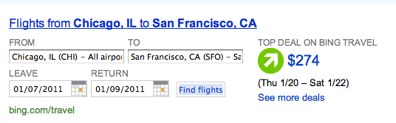
 Bing has just made a small improvement to travel search, adding the ability to add natural language queries to flight search. So instead of selecting your airport, destination, dates or other options to conduct a flight search, you can type in your parameters in the search box to retrieve results.
For example, you could enter a search for “Flights from Chicago to SFO in January.” In the results, Bing will include a pre-set Flight search section with possible dates, fare predictions, cheapest fares and more.
While the feature isn’t monumental, it does represent Microsoft’s improvement of flight search ahead of Google’s possible improvements to its own flight search technologies via the acquisition of ITA Software. The Justice Department is currently investigating the deal for possible anti-competitive practices. Many online travel search companies including Expedia, Kayak, Travelocity, and TripAdvisor are also lobbying the government entity to block the deal on antitrust grounds. Of course, unsurprisingly Microsoft also opposes the deal.
While Google has said that it would use ITA’s software to add new flight search features, Bing (which received some of its flight and fare data from ITA) has long offered a more comprehensive search experience for travel. For example, Bing offers comparison prices for the same flight from different travel engines, as well as predictive charts and graphs from Farecast (which was acquired by Microsoft for $115 million in 2008).