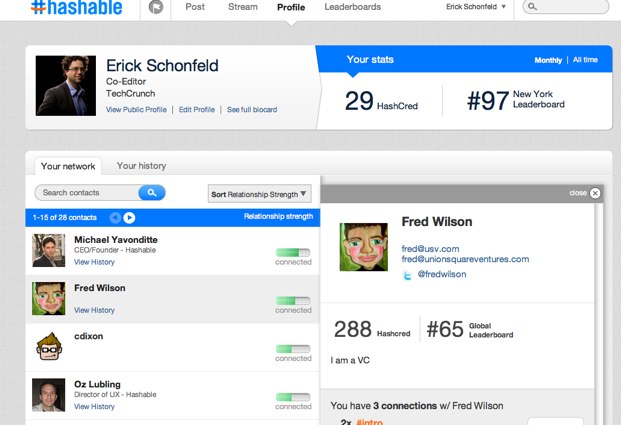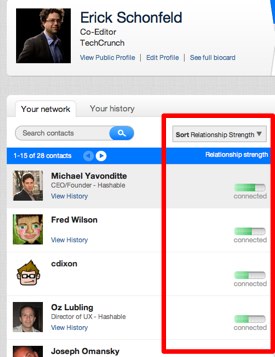
Last night, social introduction service Hashable rolled out a new site design to members. While the site is still semi-closed (you need an invite or introduction from an existing member to get in—the first 500 readers to follow @hashable on Twitter will get one), it is playing with some very interesting ways to rank your online social connections. One of the new features on the site allows you to see your contacts by the strength of your relationship on Hashable. The more interactions you have with that person, and whether or not they reciprocate, determines whether you are “tight,”, “connected,” or merely “acquainted.”
Hashable is taking on LinkedIn in a very lightweight way. Instead of static degrees of separation, you can see exactly who you are connected with has the strongest connection to someone else you might be seeking an introduction to. Hashable is also now starting to show “hashbits” whenever you post a connection. A hashbit is just a serendipitous bit of information showing how one person you know is also connected to someone else you know.
You can connect with people on Hashable either through Twitter or email, and it serves as both a business introduction service and a souped-up online address book. CEO Michael Yavonditte calls it a “relationship book” because it tracks your business relationships over time. It starts out with a simple #intro (you introduce people by using the hashtag “#intro” in a Tweet and their Twitter handles), but early users are also recording when they #justmet someone, or go out for #drinks, #lunch, or #dinner. You can use Hashable to publicly #thank someone, or make up your own hashes. I use it to record when a startup founder gives me a #demo. These descriptive tags make those hashbits more interesting because they flesh out how people are related. Imagine when people start hashing their dates on this service.
The more you use Hashable, the more points, or Hashcred, you get. Every city has a leaderboard, and soon there wil be leaderboards by industry and profession. So people will be competing to be the startup lawyer with the most Hashcred. It’s a way to measure status for super-networkers.
But even if you are not into the competitive aspect of the service, you can use it just as a simple way to keep track of the people you meet and write notes about those meetings either to yourself in private or publicly. Then later on if you are going to meet that person again you can see your history, or you can search by hashtag to see all the #demos you’ve gotten or people you have #justmet. And the more you interact with any given person, the stronger your connection strength becomes.
Once Hashable opens up more publicly in the coming weeks, we’ll see if this new form of business networking catches on. Yavonditte quit LinkedIn a few days ago, and he no doubt hopes you will too.
Here’s a video interview I did with him last October: