Search engines like Bing and Google will swear up and down that their natural search results are determined by one thing and one thing only: the all-knowing, all-powerful Algorithm. Sure, paid results might pop up at the top or to the side, but they are always highlighted as such. But sometimes the temptation is too great and the natural search results, which are supposed to be sacrosanct, are used to promote a product or service owned by the same company that operates the search engine.
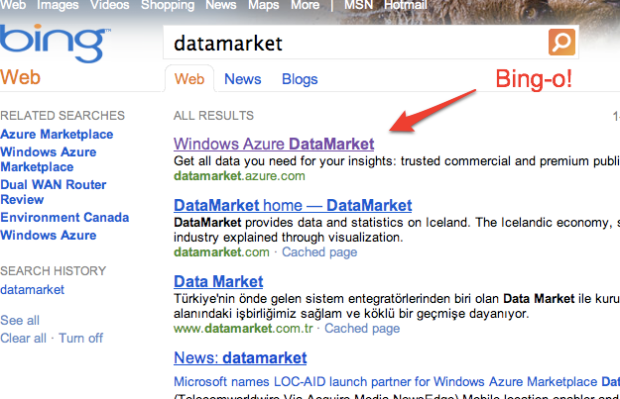
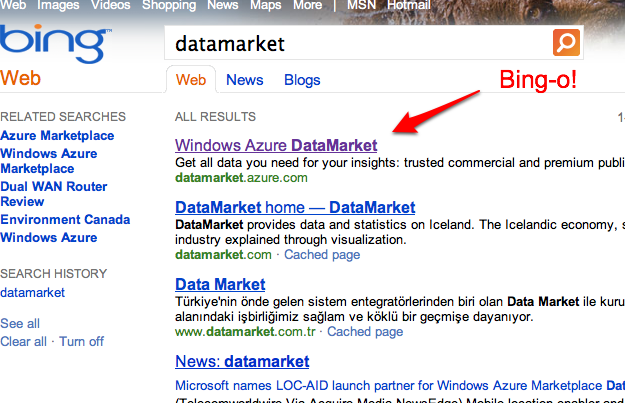
That certainly appears to be what is happening on Bing right now if you do a search for the term “datamarket.” The top result is for Windows Azure DataMarket, a product which just launched a couple days ago. Don’t get me wrong. It sounds like a cool product. It is a cloud-based service where people can upload and sell data in a consistent way.
But in terms of link juice, you’ve got to wonder whether Datamarket.com, the second result on Bing, is getting a raw deal. The Azure DataMarket result appears as a natural result, not a sponsored link (which both Microsoft and Google do for their own products but highlight them as such, see “Azure”).
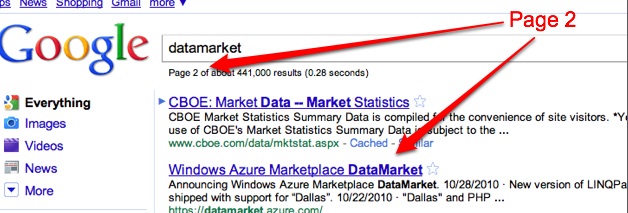
If you do the same search for “datamarket” on Google, Datamarket.com is the top result, and the Microsoft site is nowhere to be found on the first page of results, which is also suspiciously convenient. It is pushed all the way to the second page. Are Google and Bing allowing their algorithms to do their magic, or is something else going on here?
And if you think that Google never promotes its own products, just search for any place such as the “Gramercy Park Hotel.” The second result is a module with a map, links, and data from Google’s Places. Google shows these kinds of Onebox results for many types of search, but in this case the most prominent link goes to a Google Places page.