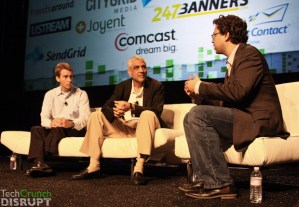
Clean Tech Investor Vinod Khosla: "Environmentalists Get In The Way"

Wednesday, September 29th, 2010

Lora Kolodny began reporting on business, technology and entertainment in 2002. She has worked as greentech writer and editor at TechCrunch, and as a staff reporter for Inc. magazine and The Hollywood Reporter. Her New York Times blog, “The Prize,” covered the winners, losers, innovation and deal-making of business competitions. → Learn More

we have our next speaker coming out. So I think we're just gonna go with what we have here. We're very privileged to have Vinod Khosla and Kevin Where do you want us to sit?

Wherever you'd like to.

This one. Well, thank you very much for joining us here.

Great to be here. You know, we've been talking about mostly web page technologies for the past two days. A lot of founders in the room here, people starting web start-ups and they're sort of traditional information technology companies.

But wanted to take this opportunity to really talk about, you know sort of seems like the other of Silicon Valley these days, the other half what's really interesting, which is Green Tech. And you are very unique and that you've really Imagine these two worlds you know, usually you have people who are investors in o ne area or another area and you know, you.. it seems to me that you're passionate about both areas. So, would you tell us a little bit about, you know, w hen did you really start focusing on this, you know, intently and where are we today in terms of, yo u know, I wanna get both of your views on this on the different sectors that could educate us on...what are the the sort of hot sectors in Green Tech that you are very excited about right now in the next, you know, 12 to 18 months.

Well, the first thing I'd say is I like Disruption. It seems to be just like a fun game to play. So, when you're done with everything else you'd like to play a fun game saying Disruption is just a fun game. Let me be clear. We still Doing a lot of internet and information technology stuff by just looking this year in terms of the number of investments, it's probably 50-50 you know, just in the last 3 weeks, we've done probably 3 internet investments in the last three weeks so we're very, very active in the space this audience operates , but there's also sort of this other playing field that's very exciting.

I see a lot of analogies between the 2 spaces in everything can be reinvented in every area all the time , around people say it came it's just a failure of imagination. My view is very simple everything you see you know, we invested analyst this little job on company. It's becoming a variable computing company. a lot more exciting than just a headset and that's what we do. How develop take things to much more exciting companies. The investors in Keith...Keith was here. The investor in Square. Really exciting. You think those things are pretty stayed tried and true areas, but no you can makes them exciting.

The sames happening in energy. Our range is so wide. We've invested in nuclear reactor design of all things with Bill Gates. Very, very interesting fundamental and maybe it's 10-years to liquid EO something. But there's plenty of other startup. But it takes ten years.

I thought we figured that out already.

The results the problem of nuclear give a lot of credit to Nathan Maurold and Gates for coming up with some fundamental problems and reinventing. We have done that at one end. We've done three dollars outside fuel cells for the person in Kenya who has a cellphone, but doesn't have electricity to charge a cellphone bar. These are honest to god $3 cellphones you can throw in to your cooking cell. We've done precision agriculture, we've done all sorts of interesting things you can't imagine. Right. Well, it's interesting you mentioned Nathan Myhrvold, he argues that Silicon Valley is no longer solving hard problems. Do you agree with that?

I generally agree with that. Silicon Valley is doing roughly the poor length off the Microsoft talk earlier. Good talk on IE9. But to me, having your Window Scroll in the Menu Lock on top, it's a nice feature, it's nice user interface, but doesn't deserve to be in a Conference Call Disrupt, all right. Do you agree with me everybody?

Yeah. You know, you wanna hear about interesting radical new ideas Very few people are doing that because they're afraid. I think Nathan would say we are doing pretty unusual things. Okay, so.

I would say that although [sp?] some unusual things too. We want to hear about all, as many ideas as we can pack into this 25 minutes that we have stage here, and I really want people to leave this room looking up all the different technologies and companies that you guys talked about. Kevin, tell us a little bit about, you basically run venture investing for GE, for energy?

Yes. And tell us, how long is GE been doing venture investing?

GE was active in the 90's in kind of the big way, but from you know, say in '93 to the early 2000. And we really started back up, and he had gotten out of that in early 2003. And so we really were the first new kind of venture capital type of activity within GE for several years at that point.

We started in 2005 and so I run a group that GE does investment in the venture capital in the energy sector for people that aren't this familiar, you know, a third of the world's powers produced on GE equipment. GE is one of the major suppliers of oil and gas equipment.

We're the biggest renewables company in the world with wind turbines and some of the solar things we do. So, GE is essential to the future of the energy industry, right.

So what we started to see was a lot of interesting business plans. Some of them back by the note. They didn't have a home in our business that were pretty interesting.

Right.

And you look at the scale of the change that's occurring and, you know, we talked about kind of big opportunities despite this recession that kinda kicked in. You know, we have done some analysis a few years back and and so we're saying what are the billion dollar markets?

So one of the things that interest the senior leadership in GE is, you know, what's interesting about venture capital is you can see the next billion dollar markets. So, we started developing throughout some of them, what are those billion dollar kinda markets and we came to a list of 25, 30 different things and I think it's probably longer than that, right, in the energy sector.

Right. What's your --

Well, it's a very broad, kind of very significant opportunities, the biggest, you know, growth market in the world in my view.
The reason I wanted to have both of you together is because I'm very interested on what your list is and what your list is, and I think your list is very different than your list or is it?

What are the top 5, you know, billion, multi-billion dollar market -- Actually, the Europe folks are on right now, and then I'd like you to tell me what are the top 5 investment areas that you're focused on or top 3, you pick it.

Goodness. There's a lot. So, and just for the context, we are having the most active corporate investor in emerging energy companies in the last 5 years.

I mean, the numbers aren't perfect but we're -- So, the most minimal active were amongst the most active too, so our interests are pretty broad. Clearly, there's something around fuels and to go back to kind of, you know, the oil price even in the recession is above $70, right. The rule, my, you know, a lot of my career was in the oil and gas industry, was that if you got about $40 oil, a lot of stuff kicked in and I think, you know, when we get the $70 oil in a recession environment, there's a lot of technologies I kicked in this kind of opportunities. So, that's Bio-fuels, that's electrifying vehicles, right? And there's a lot of debate about what's the taste of vehicle adoption by consumers but we start talking about electrifying vehicles heavy duty track sinks, the economics work at $10 to $20 for barrel oil, right? You start looking at the Smart Grid, and energy efficiency technologies. You know where there's just tremendous opportunity for you know kind of our view would probably 20% load reduction if people really got serious about doing something on kind of energy efficiency in Smart Grid. Y ou know these opportunity. So those are 3.


Okay, those are 3 are those that you would name or

So my view is very, very different.
You know, and I think your Tech Crunch audience would identify with this. I'm not smart enough to know what are big categories. My general view is, when the exports. Do a forecast and I can prove this statistically they're about as good as God fearing Monkeys, right? That's experts forecast markets, where they are going, and screw up the internet companies, it screw up energy companies, it screw up silicon semi conductor internet systems. Throw away the experts, take a swing at a plate If you strike out take another swing, if you hit a home run great. So my view is don't extrapolate the past invent the future. Allan K. said this a long time ago. I think it's more applicable today.

So fuels maybe an uninteresting market with corn ethanol, but Amira is one of our companies that the IPO debuted yesterday. Those guys came to me wanting to do anti malarial drugs. Literally 6 months later we start playing around they were producing jet field. That this zero comnality between jet fields on the one hand get anti-malarial drugs on the other.

How did that happen?

Okay, I suggested they try something , they make bugs, genetically engineered bugs that produce stock. They were producing adromicine and adromicine [??], and I said, what don't you try produce Alkanes, they did and it worked. Some it makes for an interesting company company $780,000,000 market cap yesterday.

Congratulations.

Four years ago it was 15 people, so thanks but that's how you invent the future. It's not to take some endless forecast and this happens over and over again.

So, is it about betting on the team or is it about you know, what is your, w hat's the approach here and I'm also sort of very interested there, been a debate here the first day about j ust how Capital itself is being kind of disrupted at least in, for software and internet space where capital itself isn't the primary, you know, value that the venture capitals brings to the table. I was thinking Green Tech capital is very important. It's more...

I would sugges ts that whether it's internet or energy, capital is the least important thing venture capital brings.
So if you look at our website, my daughter's here. She's trying to do her own start-up in internet stuff. W e did our website together when I was starting the firm and it says Venture Assistance. It doesn't talk about financing. I t talks about assisting entrepreneurs. With Ventures, it d oesn't matter whether it's internet or Green Tech.

I think this is really, really important because the choice of partner you make and it is almost like a co-founder is far more important. And this debate about angel and VC's is sort or irrelevant. It's who the person specifically who's helping you, h ow many billion dollar companies have they created and can they help you think through creating a new platform or a new business, as the same number of which area. The advice you get is much more important than the capital. And labels like Angels or VC, it doesn't matter.

There's lots of good VC's, and lots of bad VC's. Lots of good Angels and lots of bad Angels.

And you see, greed and all respect. Some are passionate about your business, pick one who is passionate.

Right. But, this is what matters. Not...

A capital is an interesting thing.
I believe if you're clever. CleanTech can be low capital, I can tell you that genuinely all companies have taken 20% of the capital in the same area using the same technology than many of other VC's who funded companies in the area. Because we've start brainstorming with them, clever ways, you know, Science or Solar company . What solar cell company we have. Cash [xx] asking for about the same thing, money would take to start a chip company while they compare this like Nanosolar and Solyndra have 500 million dollars. We got 350 megawatts or a million dollars worth of free capacity from a partner. Why? Because we cut a clever structural deal. Do you agree, do you think capital's that important?

Oh, I think, from my perspective, companies that I agree what Leno says and I would echo that from our perspective, company's want us on their team.

Right.

If they want the money. Money is helpful. You need money to build businesses but you want people that are gonna be positive partners in developing you know, kind of the world class companies. And I think that's how we focused our activities. That's how are we, kind of a world class partner. Our argue has been GE is as good as anybody who have taken a business for 100 million dollars and scaling it to a billion, 2 billion kind of revenue business.

Right.

And what we're trying to do is to be the world class partner from a big company perspective.

But yeah, but if you look at the average size of a idea is really big and you go across you know and you compare you know Clean Tech versus, well definitely versus an internet or software that it's much bigger. So, but you would say it's more

It's not true, so let's not.

It is true. It is.

If I look at all our Clean Tech investments our average series of investment, or I should say a median see these days investment is probably $3 million.

3 million, okay.

Okay? Is that typical of Clean Tech or use.

I don't care what other VC's are doing.

Right.

I'm just telling you the facts in our business. What rental capital the way we practice, it does. Because we are hoping these entrepreneurs build business, experiment with technology, take crazy bags and learn how to create a position were the capital becomes irrelevant, lot's of capital.

I think, one thing, I want some point to add is that your want things is different versus some of the I.T. businesses is a life cycle of some these assests. So, if I'm coming out with another building technology some kind of another wind turbine right?

The economics of the investments generally require that these assets thrive for 10, 20, 30 years right. So, the reliability comes it's a really a more technical innovation activity than a business model kind of an innovation.

It's definitely a business model coming in. The foundation in most of this stuff is technical innovation in nature. And so when you start looking at the stamp that a utility. A power utility wants to do business with the smaller company. They need that kind of comfort level .

So when I look at one of the things that we bring for example back up value the partners is a stamp of approval and what changes after you made an investment if you don't need investment diligence is kind of a comfort level on all those isn't really gonna work.

Is the time...

Let me just comment because I had to disagree with Kevin just a little bit here.
For a small class of clean tech this is what Kevin said is true. If you're selling power plants to utility's absolutely but you can be very clever. We're reinventing air-conditioning 75% less energy if it works , always a big hit. But, it would probably take 10 million dollars to prove out whether it works or not to re-invent the air conditioning. I t'll take 18 months to 2 years to be in the market place from starting the company. And now, we're, you know, waiting around business mall. Why should I sell air conditioner? Why don't I sell kilowatts of cooling because I can take half electricity saving and make much more money than selling them an air-conditioner. And what's the company?

It's a small company called Kayden.

Kayden. All right? We're inventing LED lights, right? If I can sell you a light bulb that saves more dollars in the first year, t hen it cost you in electricity to run one of these incandescent lamps, it deserves new technology but it also deserves a new b usiness model and we are awaiting around that. But isn't it hard enough just to invent a new technology? I mean, people are used to buying Think life holds in a certain way.

That's it, you know this is too much conventional wisdom, right? Let me give you an example. When Larry and Serge was starting Google. There were old sorts of discussions and you were never at computer science department at Standford. And its a funny story because they were willing to sell the company for under a million dollars and the company I was on the board of Excite and didn't wanna buy it. But there was a lot of innovation in their search technology.

But what really happened w as when they decided that Overture had a nice advertising model of auctioning lakes? It was a business model innovation that created the brand new market. Suddenly if my advertising budget was $2000, because I was so lumps in rugs or I could now advertise without and hiring an advertising agency or having this complex ad chain, right?

Right.

I could just propose something up, a link and advertise. That innovation made Google what it is. Not the search engine innovation so I think, non-linearly placed no matter you're doing. So, what was your recommendation to the board of its site? That they should buy it or they should not?

About five times.

Yeah. You know and now they're telling me I should have forced them since I was the largest share holder. I tried. I argued but I don't try and force people to do what I say.

Right. Well, give us some of these examples of, you know reinventing energy, or air conditioning or daily lights. I mean can you maybe pick, you know, two or three of the companies in your portfolio that you're very excited about that you think, you know, the audience at large should know more about that you think are really. What are the three most disruptive companies in your portfolio?

I'll tell us one of you and tell us whether the note has this.

What do we do to a three and how do we do a three.

Okay. So I'll give you an example and it's the one as profound. This is some of that, it's a no brainer, when you look at.

So we invest it in a company that out in North Carolina. The company is called Consert. So in the Consert. And there, we're invested with Verizon. We're invested Corcom. It was one of the large US power companies .

And what they're doing is an essence using the advanced wireless networks. Sort of 3G and 4G networks, that in essence make what's in a home or a small business, in the sum of that, resembles a power plant.

So, if you had your water heat in your house, or you know, for those who got a few in his house, I got one in my house. And that, I can no longer, I don't need to be running that at the same as you are running yours, right?

If I've got , I can like distributed software base control system that has the latency of this real time networks, that is tremendously valuable from a the managing the grid perspective.

You go to India. You go to places where the grid doesn't operate. by people. We take our electricity for granted.

There's big chunks of the world that won't have this network . They don't have the grid reliability and so what they're doing is, in essence, becoming a power plant through this distributed, you know, asset model, very scale a little bit, you know. It works and it's powerful. So, that's one. Now, it's your turn again.

So, you know, let me talk about a few. I was talking about the air conditioning in Caden, 75% less energy. We just invented a brand new thermodynamic cycle nobody's ever used before.

A practical thermodynamic cycle hasn't happened in 50 years, not one that's been, in fact, commercialized, a brand new idea probably 4 million or 5 million to prove the technology out than we had done to the technology, 75% less energy.

So, when you go to Walmart and buy a light bulb screw in to your existing socket, not something new, you are saving more money than you paid for buying it, less than 12 months payback. We're doing engines far more practical than electric vehicles that cost less, and a 50% more efficient, and I think they'll get to a 100% more efficient. Drop the price of oil. Dramatically a 5% change on all oil demands . Change the price of oil from a $140 in July of 08 to $40 in December of 08, 5% change. This could apply to all internal combustion engines, and drop consumption by 30 to 50 percent.

What company is that?

It's EcoMotors.

EcoMotors.

Yeah. Bill Gates saw it, and said, boy this is impressive. It took him a week to make an investment in it. He just sort of said my god says this is perfect. I'll give you another example. So, transportation, lighting each way. What more is there life, that's 80% of the problem. The other company called [xx] you put wood chips at one end, one second later, you get crude oil at the other in a simple step. It's a processed oil industry had used before with a magic catalyst.

Now, you got a different view of fire fuels. It's crude oil we're producing. We are competing with Hugo Chavez, and I'm a nut job, or whatever this is I am enticed called. Right? Those are just a few examples. Colora is one of my favorites. They take carbon dioxide, which everybody thinks is a problem, and most of your techies will know, CO2 is not that different than CO3. Calcium Carbonate is limestone, so they're turning carbon dioxide into building materials.


In fact they are doing a really interesting... No, I was about to mention it. So one of the areas I believe that you will encounter over ten or twenty years, it'll be a no brainer, is the intersection of biology and energy right over your IT [xx]. So, we have a company called Serious Energy out of Denver.

Really exciting company I call it GCC Genuine Clean Coal

And so they have the ability to produce methane into convert coal which occurs naturally, biologically is yeah that's what's making the methane that comes out of coal now, but it occurs on a hundred-million year cycle.

What was the name of that company?

Sirius.

Sirius. So that's Latin for transfer.

On one that each invested in.

And so you look at that and they are basically accelerate what's already happening naturally by orders in magnitude.

Right.

And by doing they make the conversion of coal into natural gas highly economic. That type of activity and that and so they are just, regarding in the energy business about 20 years now.

Can we talk Sirius just a little bit more?

Yeah

I'll tell you this is how you should think none linearly If you are a coal miner your biggest enemy is methane because it builds up naturally, bugs can form in to methane.
The canary in the coal mine is used to detect the presence of methane. because it causes explosion. For most people, methane and coal mines is a problem, this company said, "why don't we keep...accelerate the conversion, just tap the methane, right"? So, they turn the problem just like a little [xx] and carbon dioxide into carbonates, they turn the problem which is methane in the coal mine into an opportunity a nd made coal really clean. That's what's exciting about in a way...

And I would say...

What did they do with the Methane?
Did they produce something else? ...you can run a gas fired coal plant which is much cleaner operation...

Right.

...but you are really running is as coal. Y ou're just converting natural leadings, natural bacteria converted into...

... and that's why we go back to what you had asked before about the revolutionary type things, right?
M y view, just given the scale of the energy business globally, is that the level of innovation we see is amazing. The entrepreneurial response to kind of the p rice signal has been unbelievable. There's so much talent, so much you know, horsepower... Is it the price signal that's unleashing this talent or are there technolo...new technologies that are making some.

Both.

Possible.

Both. It's both but I really think what is, is focusing on it. When I started cost of ventures, if I went to MIT and give a talk on energy nobody showed up. I'd literally have 10 people show up.

And I made it my job to go to every the university and talks on revolution and innovation in energy. And suddenly you know the PhD's that were going into nanotechnology, a biotechnology or computer science, or materials started being interested in energy.

Right.

Once we get that kind of talent working on it the innovations will flow. If anyone has questions, we're gonna take some questions now. Is that okay?

Sure.

You can line up. There is the 2 mics right there and I'll call you. One thing that sort of came up in my mind, as you're going through all of the the examples, especially With the engine company set things it's better than electric. Isn't it one of the goals to try in for alternative energy to get off carbon-based fuels? See, that's conventional linear thinking.

Yeah. You're trying to get the low carbon cars. Like low carbon cars and low carbon electricity is the goal. If not some specific thing like an EV at some environmentalist has identified. I actually think our environmentalist today are doing more damage than they are helping us transition because they are prescribing solutions without having a clue how expensive they are.

Yeah.

What I wish and I go back, I come from more long term energy background. I think that the - I wish government will get in to, you know, trying to get back to policies that are low cost clean energy. And for example utility incentives. If utilities were really properly incentivise to go drive low deduction, you know, we pay hundreds of billions of dollars here in energy cost for a power, right. It's a tax. We want our power, we are going to use it. So, what do I do with this taxes is to drive this low cost efficiency technologies a big way. The only way to make that happen is to send device utilities to bey on the team. In fuel, right? The oil is 70 dollars. A few percent load reduction, a few percent demand reduction in fuel takes the pricing power out of the oil market, right. So our objective should be clean but also things that actually bring the prices into [xx] taxes.

Why is a super efficient combustion engine better than an all-electric vehicle? For the following reason: and all electric vehicle in the US, in Europe, in China, in India, is a coal-powered car because that's how most of the electricity is generated. Okay?

You can come up with theoretical scenarios that is solar powered but, you take a call that cost 3 times as much, and then, you see the electricity that cost 3 times as much, it's great for some idealized environmentalist, it doesn't work in practice.

But, t he twenty-five hundred dollar Tata Nano had more orders on the first day that the GM wanted expected to sell by 2012. More orders on the first day. You can feel good about the GM were I actually think it's a really good car. But the practical fact is most of the new cars being sold are in India and China and they want cheap, just like everybody else. So unless we dual-up technologies that achieve un-subsidized market competitiveness, this won't work. Good news is, if you stop believing the environmentalist and start believing the innovator, the scientist, and the technologist who inventing new things, the innovator, the scientist, and the technologist who inventing new things, we build that technologies that are cheaper. This engine you talked about has far more formation than the Prius.

Let me do the simple fact with many of You probably, going from San Franciso, own a Prius. Owning a Prius is far more expensive way to reduce carbon. You can reduce more carbon by painting your roof white than you can by buying a Prius.

Simple fact, one cost $100, one cost an additional 5 grand over what the car would normally cost you, and you reduce more carbon by painting your roof white.

I think that you don't own a Tesla, either. I don't own a Tesla, but I think I'll buy a Tesla because it's a cool car.

Yeah, it's cool.

Not because. Let's go to questions. I know people really want to ask you questions. Right there. Hi, Mr. Khosla. This question is for you. My name is Ananda Kumar, and at the moment, I'm a nobody. You're a future somebody.

Is that your question? What's the question?

The question is, why has it taken so long for a disruption to happen in the transportation industry And what is is your opinion on the future of electric cars? I know you are not really a big fan of electrical cars. I know you are trying to create an innovation of different sort of energy forms with transportation and, what is your opinion on it? Thank you.

So, I'm actually not optimistic on Lithium ion batteries as traditionally built. S o we are building a different kind of lithium ion battery, like a solid-state one. My view is very simple. If something drops the cost of lithium ion batteries by 5 to 10 X, electric cars are irrelevant in terms of adaption. Right?

So we are investing in the technologies that are most likely to fail. A ll rather have a 90 percent probability of failure. But if I succeed, that 10 percent that I have a material break-through.

T hen the other way around, we arrive at 90 percent chance of incremental seek change So we look for things that are radical maybe very high risk. I think a battery like that is needed before electric cars become real and those are the only kinds of batteries investing in South to 3 up in Michigan , CO here. You're doing a Magnesium Ion battery because it's a lot cheaper. I'll be trying some really weird stuff in batteries. But it's gonna be something we can't imagine today that will change the future of electric cars.

Let's go to the next question right there. Hi, my name is Harry. Peter Thiel, mentioned here on Monday that he doesn't invest alternative energy because right now the economics aren't there compared to oil. Do you think that thinking is just wrong or do you think we need more big investors to just investing things that mainly really not work or where do you see that going in the future?

That thinking is plain wrong.

I agree. It is true of the things the environmentalists are pushing, this is why I think environmentalists just get in the way. If you're creative non-linear thinkers that is plain wrong. That's about as true as saying all innovation in media will come from NBC.

Well, that's obviously is not true. Do you have.

I totally agree, I mean, if you're in the flow and you understand the quality of the opportunities they are competitive, I mean they are really, you know t he economics work. This is not an environmental thing, it's an economic thing ultimately.

Right. Okay.

My name is Sean Clark. One of my questions is one of the naps against CleanTech, an energy investment in general is the roles that governments around the world not just the US play in the energy sector and in oil and other in translation, et cetera.

What do you think are they things the governments are doing that are supportive of innovation and what do you think are the things that governments are doing or could be doing that are negative.

What was it? I try to mention that before, I have seen Jeff Kimble came out last Thursday kind of saying the US government policy is stupid right now and I think if you went to this crisis on what is US policy, and energy. All right, is somebody may have an answer, but I don't, I don't have one. I don't know what it is, right and I think it does stimulates some activity. But when you look at the significance of this to our economy , and I go back to this economic competitors of high oil price environment, you know, importing ten million barrels a day of oil, of, you know the inefficiencies we have in our electric system.

The insets of structure they can create to bring those down that are very beneficial for our economy and consumers, or keeping more dollars in their own wallets, it is tremendous.

I don't see those policies in place at all that are driving really at...

What do you think about just the tax subsidies that a lot of this, a lot of alternative energy, you know, technology.
They don't become economical without the subsidies.

Is it government's role to kind of you know, give sort of a kick-start through subsidies? Or is that just keeping, you know.

I think the art of defined technology neutral stance, so We shouldn't have a renewable portfolio standard for electricity. We should have a low-carbon electricity standard. Simple. We shouldn't have a biofuel standard. We should as California has already done, a local carbon fuel stance. Like California has actually done this.

Europeans don't define their cars electric or oil. They say grams of carbon emission per mile driven, end of story. That's the technology neutral goal. That's the right way paid to do it.

Now, subsidies can help technology gets started but at least we don't invest in anything that can't achieve un-subsidized market comparativeness within five years of getting started.

When you get started your scale is really small but within 5 years you should be able to achieved what I call the [xx] price. The price at which the good will sell in India and China, which has no subsidies OK. Couple more questions.

Yeah. I had A question about policies again. You mentioned that the existing policies driven by environmentalists are stupid. Can you...and you were suggesting some policies which might be better. Can you suggest how these policies might be driven through a government which is run by lobbyists who don't want any policies? Just a lot of activism. The problem is, on the one end or the lobbyist who have special interests and often pragmatic concerns from companies and in the other end is an extreme environmentalists who are idealists, I'd like to say I'm not an ideal environmentalist, I'm a pragmentalist. I don't know. There's no magic toward... it's just hard work.

Two more quick questions and then we'll break for lunch.

Hi. Do you...are you developing any technologies FI energy densities approach ing out of bio fuels?

We are attempting to look at things that are radical improvements . Let me just say that there are lots of possibility and we probably explode 10% of the possibilities that exists today.

Thank you. Final question?

Hi, m y question is with regards to the consumer awareness and the changes, you know, behavior. You mentioned about...

Could you speak up a little bit?

Yes, my question about the consumer awareness, that you've given example about painting the roof white is being more efficient than running an electric car. S o there seems to be a real, you know, lack of awareness among people what, I mean, everybody wants to do something, but they don't know what is more efficient. So is it the job of the government or corporations to can educate the consumers to bring about that knowledge.

Sounds like a business opportunity, to me. And that was [xx] I was trying to make, so I'll give you a story right, like Sacramento. So, Sacramento is not too far away right? I think Sacramento and Paris have the most trees in their metropolitan area than any other place in the world. Why is that Sacramento, is because back 20 years ago they voted to shut down the nuclear plant that was supplying their city and they start to say, "well I have to do other things to decrease demand to kinda manage the load.

Right.

And my point about kind of, you know, so I think it's both consumers and the governments, but fundamentally it's an incentive structure, it's kind of an agnostic incentive structure that says we really want to do these things. These aren't easy issues because fundamentally you're trying to drive to a transition which involves people spending less money on energy, so some people aren't gonna benefit from that and there's a transition that needs to be kind of balanced across the parties, but the point that and there's a transition that needs to be kind of balanced across the parties, but the point is that if you decide that you want to go do some things you want to spur nuclear power in the country, you want to spur wind power, there's things the government can do that its not doing right now but there are also incentives that are very beneficial for I'm in it in a US macro-economic perspective that we could be talking about that would, you know, decrease demand in very positive ways.

So one final question. Are there any problems that, if you saw a start up that solved that problem, and it's probably something that you're already seeing people trying to solve these problems in various ways, but nobody has quite gotten it, that you would invest, immediately?

So if I'm a startup, cause I'm a founder out here. I'm thinking, you know, what area to look at. What would be a good problem that if somebody could convince you that they could solve it, you would invest?

You pick one and I'll pick one. Go ahead. Bio fuel at $20 a barrel oil price.

You can pick a lot. Well, I think one of the larger problems is chemical intensive agriculture. I think there's solutions, there's creative solutions. I'm spending an awful lot of time looking at agriculture technology, which seem like Oxymoron's next to each other. Precision agriculture is an area I'm digging deep in to, and if somebody solved chemical intensive agricultural problem, I'll be all for it. Okay. Well there you go. Please give our guest a big round of applause.

Thank you everybody! Thank you so much, that was terrific. And so we're gonna break

“Environmentalists get in the way…and do more damage than they know,” said Vinod Khosla, one of the world’s leading clean tech investors, today at the TechCrunch Disrupt conference in San Francisco. Why? Self-described environmentalists demand or adopt technology that sounds promising without a sense of its true cost or impact to the environment. “Painting your roof white is better for the environment than driving a Prius or similar vehicle,” Khosla pointed out.

The green movement contrarian famously invested in a business that aims to make coal power cleaner (Calera) with carbon sequestration. The very notion displeases environmentalists who are concerned about the way coal is mined, as well as emissions from coal-burning plants.

Today, Khosla Ventures joined Sigma Partners investing a $13.7 million round in PVTSolar, a company that puts a new spin on solar power generation for home and light commercial use. PVT’s Echo system supplements typical photovoltaic solar panels with technology that captures the heat they generate to supply additional power.

Earlier in the week, a Khosla Ventures portfolio company Amyris — makers of non-petroleum fuels and chemicals — raised $85 million through an initial public offering (according to Fortune).

Khosla noted that Amyris came to him wanting to produce anti-malarial drugs. Six months later, after “playing around” with the company’s biotechnology, they were producing jet fuels. His fund made a $15.59 million investment in the business that’s now worth about $65.36 million.

The amounts of venture capital invested by Khosla may sound high to the uninitiated. But relative to clean tech deals struck by other funds, Khosla said his were 20% lower: “Our median series A investment is around $3 million. I don’t care what other VCs are doing. I’m telling you the facts of our business. The way we practice venture capital, we help entrepreneurs experiment with technology, take their crazy ideas, their best ideas, and then create a position where capital to get started becomes irrelevant.”
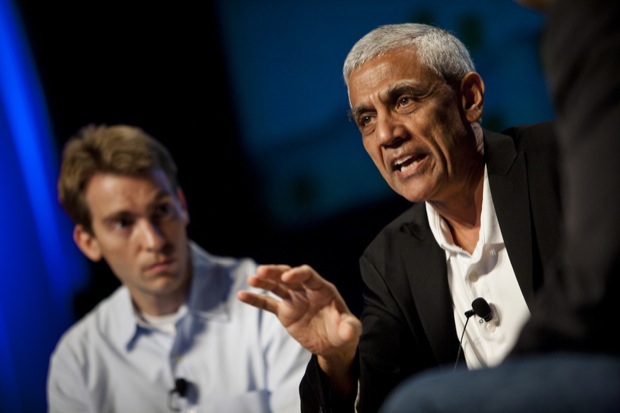
Joining Khosla on stage was General Electric’s Kevin Skillern, who heads up GE’s venture capital investments in clean energy. Skillern told TechCrunch immediately following the talk that GE is focused as much on creating and commercializing new technology, as it is on making installed, legacy systems more efficient. GE equipment produces 1/3 of the world’s power, and much of what’s already installed will be operating for more than another 10 years, he noted.

In contrast to Khosla, he believes that some clean tech startups — like those seeking large utilities as customers, and those who want to gain scale as quickly as possible to take advantage of government subsidies — simply do require more capital than startups in other sectors, like consumer web and entertainment, to get started. Khosla made the case that clean tech firms don’t have to be capital intensive compared to other tech startups.

Khosla Ventures invests in companies whose well-being is not dependent on government subsidies over time. “Subsidies can help technologies get started. But I don’t invest in anything that can’t achieve market competitiveness in five years. You should be able to achieve the price for a good that will sell in India or China without a subsidy in that time.”

Skillern and Khosla both called on Silicon Valley and corporate venture capitalists to think less about what Khosla called “nice features,” and more about truly disruptive businesses that will solve the world’s problems.

Sponsored Ads

blog comments powered by Disqus

Sponsored Ads

Sponsored Ads

Upcoming Events

SXSW 2012

Austin, Texas

Disrupt NY 2012

New York City

Disrupt SF 2012

San Francisco, CA