Yesterday, the New York Times published a story that detailed an agreement in the works between Verizon and Google that would effectively kill off net neutrality by allowing “Verizon to speed some online content to Internet users more quickly if the content’s creators are willing to pay for the privilege”. The news sparked outrage in the tech community, because Google has a long history of advocating net neutrality. Now both Google and Verizon are coming out to claim that the New York Times story is incorrect.
A report in The Guardian cites a Google spokesperson as saying ” “The New York Times is quite simply wrong. We have not had any conversations with Verizon about paying for carriage of Google traffic. We remain as committed as we always have been to an open internet.”
Verizon’s policy blog has posted a statement as well:
“The NYT article regarding conversations between Google and Verizon is mistaken. It fundamentally misunderstands our purpose. As we said in our earlier FCC filing, our goal is an Internet policy framework that ensures openness and accountability, and incorporates specific FCC authority, while maintaining investment and innovation. To suggest this is a business arrangement between our companies is entirely incorrect.”
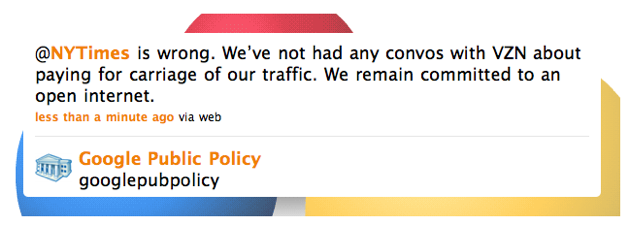
Google’s own public policy blog doesn’t have anything on the story yet, but its Twitter account did comment on the matter:
“@NYTimes is wrong. We’ve not had any convos with VZN about paying for carriage of our traffic. We remain committed to an open internet.”
Obviously Verizon and Google are talking to each other about how best to deal with the backlash, and Google is making it clear that it’s still an ardent supporter of net neutrality. Still, it’s a bit odd that it took so long for Google to respond to this in any way (the NYT article came out last night, and literally dozens of stories were written about it before Google tweeted about it).
Bloomberg has published a related story that says Verizon and Google have reached an agreement, but that it only allows Verizon to selectively slow mobile traffic:
“The compromise as described would restrict Verizon from selectively slowing Internet content that travels over its wires, but wouldn’t apply such limits to Internet use on mobile phones, according to the people, who spoke yesterday and asked not to be identified before an announcement.”
Don’t be surprised if we see a lengthy explanation/rebuttal from Google on one of their official blogs later today.