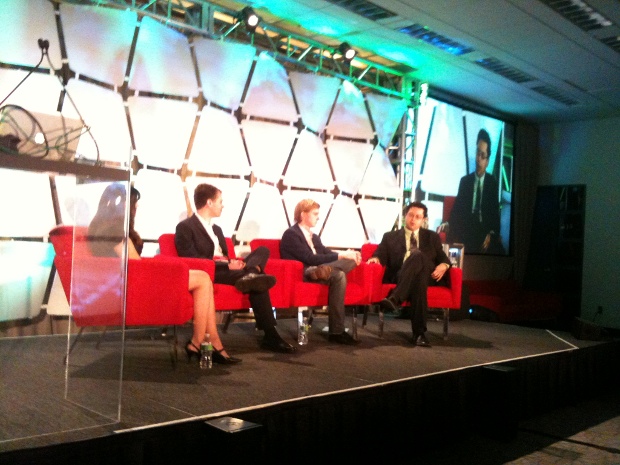
As digital tools create communities, how will they meet society and the larger world? That’s the question that an interesting trio tried to answer at the TechCrunch Disrupt conference.
This is what Scott Heiferman (CEO of Meetup), Chris Hughes (co-founder of Facebook and now Executive Director at Jumo) and Reshma Saujani, Congressional Candidate for the 14th district in New York, had to say on the topic.
Erick Schonfeld: Chris, you were the developer of President Obama’s campaign website and social media campaign for the 2008 Presidential election. Can you talk a little bit about that?
Chris: It was all about creating a culture of sharing, of which social networks like Facebook were really only one piece of the puzzle. We tried to empower people to speak up using their favorite online services and build relationships on the Web and beyond. It’s also what we’re trying to do with Jumo, for non-profits specifically.
Erick: How do you use the Web to engage citizens beyond giving money?
Chris: Giving money is really what happens last – the first two pieces are helping people understand why an entity is important, and keeping up with it through email, Facebook, MySpace. You have to get in front of people as often as possible, foster relationships, build understanding. It’s not just about donation.
Erick: Reshma, what did you learn from the Obama campaign, and how are you using the Web for yours?
Reshma: First of all, Scott and Chris have really been trailblazers, they changed the process. As for me: I knew I was running against incumbents, and I realize that technology has the ability to disrupt establishment. It’s harder for an outsider like me to run against these embedded heavyweights, and digital tools helps me out a lot. We knew we needed 30k votes to win, so we had to build our own machine for that. We asked ourselves how we could get people engaged, not just through Facebook and Twitter. So we use a platform called pro.act.ly to keep track of supporters, to find out where they are, what they’re doing for us, you know, basically measure the intensity of commitment.
Erick: So it’s like a dashboard for your campaign managers?
Reshma: And other people, but yes.
Chris: In my opinion, this is what campaigning is all about.
Erick: Pro-act-ly looks a lot like marketing campaign tools used by advertisers online.
Reshma: Yes, we’re constantly engaging with and monitoring the movement.
Erick: Scott, can you talk about how you think the online and offline world are converging? How do you see that accelerating?
Scott: In my view, social change goes way beyond politics. Using the Internet to get off the Internet is a larger notion. You know, how is it that people are more powerful, beyond being consumers or a passive audience, getting involved in something?
Scott on stage also introduced Meetup Everywhere.
Scott: we have nearly 50k meetups a week, only 1% of which i tech related. Everywhere is a brand new platform, an easy way for any organization to spark meetups everywhere, about them. It’s about turning followers into a movement. Seth Godin is an early adopter.
Scott: Meetup Everywhere lets you sort meetups by number of people attending, location and date. It’s basically an easy way to connect people (and more powerful than the iPad, too). Early users are Foursquare, Groupon, fred Wilson, The Huffington Post and … TechCrunch (more about that here).
Erick: Chris, what could you have done with this?
Chris: I think it’s great. It’s the type of thing that holds more potential for smaller, more agile campaigns.
Reshma: We’re absolutely going to use this.
Chris: If I may … the big question of this panel is: how can technology accelerate and impact social change? With existing networks and startups, it’s easier to build movement, but I’m focused on how do you make sure that energy turns into practice and action. At Jumo, we’re thinking about how individuals can more easily connect to their supporters, and building the infrastructure for all types of organizations to benefit from this.
Erick: What do you think the next presidential election campaign’s going to be like?
Chris: I think we’re going to see what we saw with the Obama campaign, but amplified. You’ll see a lot more people putting budget into these tools, more data mining efforts, more attention paid to relationship-building. I’m sure Facebook Connect will play a big role there.
Erick: Reshma, what’s the most effective way to engage people online in your view?
Reshma: I talk to a lot of people who tell me: “Washington is not listening to me” – they have a sense of not being part of the government. So we’re going to change that by having things like online office hours, reach out to people proactively, crowd-source ideas, making accountability a key part of the whole thing.
Erick: Do you see online tools also being used to govern rather than get someone in office?
Chris: Well, what’s happened at the federal level recently is pretty impressive, opening the data sets, provide more oversight, etcetera. I think this would not have happened under another administration, they’re moving really fast. But I acknowledge that some people are a bit disappointed in technology’s ability to sustain movements. Technology can’t do it on its own, it’s all about creating this culture of sharing.
Scott: I think the 2012 election campaigns will look a lot more like the tea party movement (which uses Meetup). You’ll see a lot more depth at the local organization levels.