Facebook’s Disconnect: Open Doors, Closed Exits
Guest Author
May 7, 2010

This guest post was written by Rohit Khare, an expert in internet standards, he is the co-founder of Ångströ and KnowNow.

Several of my friends recently quit using Facebook, drawing a line at the latest in a long line of changes to their privacy policy. That doesn’t mean they quit using the social Web: they are still using a slew of different services that specialize in sharing photos, links, events, resumes, and updates. What it meant for me is merely that Facebook quit connecting me to their life online — but I can always re-connect to those friends myself, thanks to the Open Web.

Why would I think that the Web is more “Open” than any of the “Closed” social networks within it? As a developer, my loyalty to the Web as a whole rests upon the legitimacy of the institutions that govern it: there are ways to voice my concerns effectively, and there are ways to “agree to disagree” by exiting a debate and building my own Web site with my own policies in place.

My reasons are hardly original: that insight is due to Exit, Voice and Loyalty: Responses to Decline in Firms, Organizations and States,” an influential treatise by the arguably Nobel-worthy economist Albert Hirschmann. In it, he explained how consumers ‘teach’ producers what to sell and how, by choosing to complain or switch. Competition — the existence of a viable exit — can actually amplify the impact of “voice” and increase loyalty. Or, as Tyler Cowen put it: “HBO is more responsive than was East Germany.”

According to this model, my friends who chose to cope with their dissatisfaction by deciding to exit by opting-out were also implicitly deciding that Facebook’s official channels for voice were insufficient, such as the conversation on site governance or voting on the new Terms of Service (and, with a turnout of only 0.32%, they might even be right).

External voices can also be effective. Almost immediately after the Open Graph API was announced, Ka-Ping Yee wrote a browser app to view information it made publicly available. It attracted mainstream news media attention to an unpleasant surprise: that public events have public invitation lists. That triggered changes to a policy implication that was latent in the Facebook data model for quite some time, demonstrating how a program can sometimes be as persuasive as petitions, press, or politicians.

Instead, the most powerful constraint on my friends’ loyalty was the data they had contributed to Facebook over the years. Hearing them make plans to quit but wanting their data back inspired us to write a new app for that over the weekend, but even so, it begs the question: Where can folks restore that backup of their posts, photos, statuses, and comments elsewhere onto the Web?

Green Safe transfers your personally identifying information (PII) from Facebook’s profile into its own app (running on top of Facebook’s platform). In practice, that’s an effective form of protest against targeted advertising; but in theory, switching to a different trusted-third-party makes no difference at all.

SocialSafe’s marketing message highlights a related trust and reputation risk: Facebook’s policies for suspending or canceling accounts for abuse or victims of identity theft (far more likely than catastrophic data loss). As far as being an option for “exit,” however, the primary recovery mechanism one can envision appears to be… creating a brand-new Facebook account by hand. The Facebook API makes it easy to download some bits of history, but not to replay it.

Give Me My Data has a more open-ended design that supports exploration and experimentation, in part because it sports an impressive array of formats to download your friend lists and other information for use in other projects such as visualization and charting. Owen Mundy at Florida State originally developed it for his own use, but “this week it kind of exploded because of the interface changes.” That could either be a sign of broader awareness of how much data users share with Facebook; or it could be the acute interest users have in putting profile data that Facebook “lost” right back onto Facebook (a feature that may be coming soon).

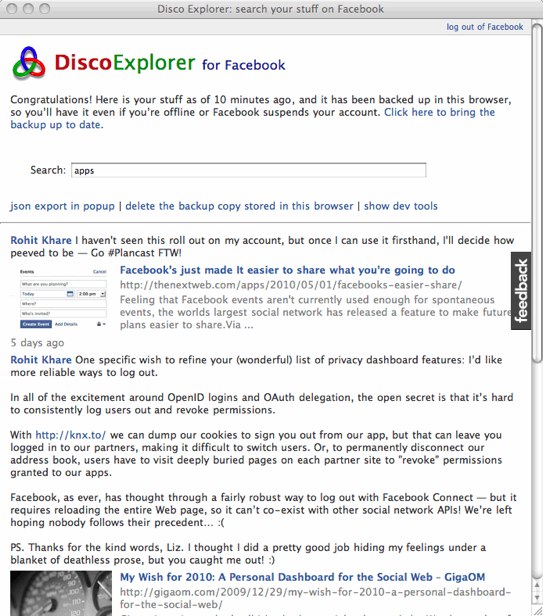
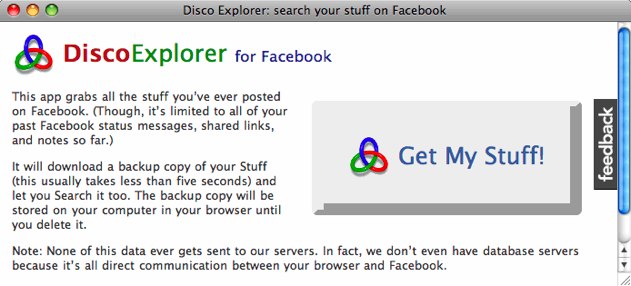
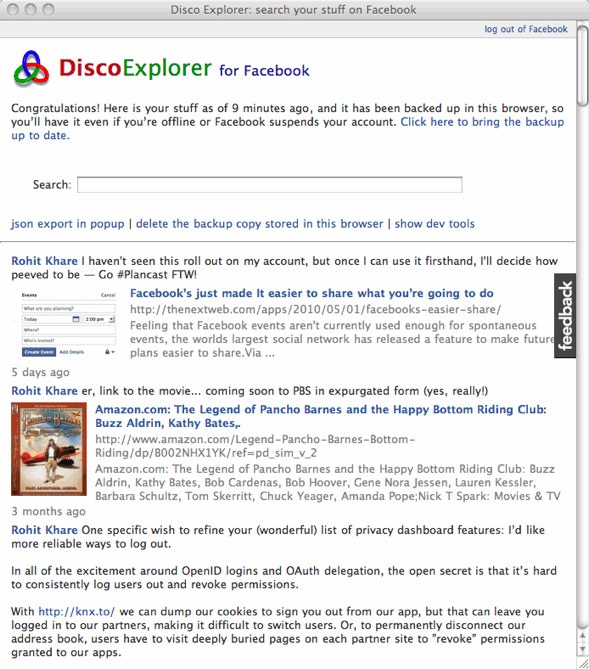
Our tool, Disco Explorer, is designed to explore everything you’ve ever posted to Facebook with instant, private search (well, some of it, so far; voice your opinion on what’s next!). The technology is unique in that we never keep any of your data on our servers at any point. It’s free (as in $0) because it’s 100% browser-based and downloads your data to your computer using HTML5’s localStorage. You can see how it works by using ‘View Source…,’ and because we’re releasing it freely under the GPLv3 Open Source License today, you can even get your own Facebook API key to use it

I admire Facebook for their innovative Platform, and I respect them for making as much information available to their users as they do through that API. I can see why they choose some of the policies they have to try balancing the interests of the small numbers of people quitting Facebook against the larger risks of automated abuse and harvesting.

It’s also fair to say that for a company growing as rapidly as they are — with aspirations as audacious as supporting over a million users per engineer — an ‘Open Door’ policy for hearing out every last complaint is quite impractical. But their latest (and debatable) definition of “Open,” rolled out at the f8 developer conference last month, affects larger organizations even more than individuals: Facebook now offers an Open Door for importing data collected about their users from any partner site on the Web.

Entrusting Facebook to faithfully store all of my personal Likes and download them later on is one thing. Outsourcing the same responsibility on behalf of a corporation is another. Sites that drop in the social plugin for Likes should ask some subtle fiduciary questions before subrogating their rights to Facebook for the social gestures within their site.. This isn’t about the ordinary quality-of-service risks of cloud computing such as downtime; these are user experience risks of relying on external policies and practices that could be considered censorship or inappropriate aggregation with data from sites you haven’t even heard of. The legal questions around entangling terms of service are unsettled enough that Facebook itself is trying to criminalize ToS violations for getting your own data out.

With social plugins, Facebook can now track user behavior just like many other ad networks or analytics tool. They are no more or less powerful than any other 3rd-party widget. Unlike those predecessors, though, Facebook has real users on their own site who are entitled to believe that Facebook only watches every move they make while they stay on Facebook.com — and who could be justifiably upset when they find out the full extent of it.

Here’s the crux of the matter: if “exit” is an only-barely-sorta-possible option for superstar developers, advocates of open culture, or early adopters, is that really an option at all? Or has Facebook checked in a mile down the road from its HQ at the Hotel California? “You can check out any time you like / but you can never leave…”
Advertisement
  • Related Topics
Advertisement
  • Counsel

    Why not write a spider/app that will convey facebook posts to wordpress or other 'open' blog software ang get folks to buy their own domain?

    This guarantees people have their own privacy.

    Then we can TAP other people's sites wig a super aggregation program…

  • Somebody

    Please include more inline links.

  • DNA

    "Facebook has real users on their own site who are entitled to believe that Facebook only watches every move they make while they stay on Facebook.com — and who could be justifiably upset when they find out the full extent of it."

    Even now, they only show Facebook Likes, Shares, Comments on other sites right? Its not like they are tracking what links you click on other websites. Its still facebook activity, which anyway goes to your friends' news feed. I don't get your point on this.

  • http://www.kokomobeach.com/news/facebook-locking-down-leaving-or/ Facebook: Locking down, leaving, or | Kokomo Beach

    [...] [For an interesting take on the nuclear option, as well as tools to capture your stuff before you leave, see the TechCrunch piece here.] [...]

  • Addison

    I decided to quit Facebook, but I relied so much on it for contact information, its going to take me a couple days to find ways to export all the information (the more I think about all the hoops they’re making me jump through to export my contact information, the more I know I’m doing the right thing.)
    Please, if there is anyone out there reading this with the knowhow to make a program or a Greasemonkey script or that will collect all your friends contact information from facebook and drop it into a standard .CSV file, you would be amazing.

  • Jason

    My goodness there are a lot of links in this post.

  • http://infopolitics.net/2010/05/exit-and-voice-on-facebook/ infopolitics » Blog Archive » Exit and Voice on Facebook

    [...] TechCrunch, Rohit Khare examines the blowback from Facebook’s OpenGraph issue in the classic exit, voice, and loyalty [...]

  • Picrad

    Isn't it easier not to enter ANY personal information into Facebook?

    We are not required to be truthful about the schools we studied or the jobs we are holding, we don't have to give it all of our addresses or interests. If a person's whole objective is just to connect with their friends, then their friends would know them well enough already and any new people they meet, they can divulge this information through private messages or through other means of messaging.

  • http://twitter.com/madhukaraphatak @madhukaraphatak

    great tool

  • http://dailyomg.com Derek

    I recently rolled out a basic site using a few of the social plugins, I am still trying to figure out how to get the information back so I can do something useful with it (such as display a list of most liked videos in the last week) but so far have had a really hard time.

    It is great for the viral features but I haven't yet decided if it is worth the sacrifices.

  • http://intensedebate.com/profiles/pankitp pankit

    Your AVATAR teaches you… the interenet (Read: Facebook) takeover…

    If you’re reading this blog, more likely than not…you do have an online presence. You may be a facebook person, an myspace person, a twitter person…or even…what’s that new thing that won’t be so new by the time you finish reading this blog…oh yes…a foursquare person.
    Continue onhttp://wp.me/pT2nK-1o

  • josh

    So…I have it locally…now what?

  • http://gengblogger.com kong

    interesting article

  • http://dailyomg.com Derek

    I recently rolled out a basic site using a few of the social plugins, I am still trying to figure out how to get the information back so I can do something useful with it (such as display a list of most liked videos in the last week) but so far have had a really hard time.

  • http://www.factoetum.com bruce wayne

    Very good article….I m very pleased that people are trying to give users back control of their data…..One of the issues that needs to also be addressed is what happend to ex Facebook members data when they deactivate or delete their Facebook accounts ?…..I also have to say that to me Openid should have been the way forward as far as identity and control of content….We can point our fingers all we want at Mark Zuckerberg for his attempts to close off the internet and to crush any semblance of privacy rights for members….but for me the elephant in the room is the "fact" that developers helped Mr. Zuckerberg build "His" machine…..I'am a developer and I have worked developers for more than 20 years….I know that more than likely each developer that is coding away at Facebook understands the implications for what they are building…….
    http://www.factoetum.com/factoetum/List_of_Techno...

  • dave

    everyone's got an opinion on everything. the world is a large place and make your own choices on what you feel is open vs closed, good vs evil. so many so-called "experts" write articles saying this is good or bad for you. TC readers aren't THAT naive to ever follow these articles like lemmings. point taken. nothing to see here. carry on.

  • Chris

    Beware, Snapshots attack!

  • http://www.fbprivacynow.com/2010/05/07/explore-your-facebook-data-and-other-insights/ Explore your Facebook Data and other insights

    [...] it out   Facebook Data, Privacy, and Backlash var addthis_language = 'en'; [...]

  • http://blueskycollaborative.com/bscv2/Main/SWEET/Pricing/Default.aspx SWEET Fundraising

    more bad news for orgs that flocked to FB for Fan and Cause pages. Nonprofits should be sure that their privacy policies are not undermined by FB's

  • Janey

    The thing is.. the number of people that "quit Facebook" over this will be a drop in the bucket. It'll hardly make a dent in the userbase.

  • Nobody

    A true dick comment. Not that I didn't laugh, but man.

  • http://twitter.com/tsancio @tsancio

    I clicked on the black text thinking that they were links and the green text was the normal part.

  • steve

    Rohit,

    Lighten up on the links. I read a paragraph or two then gave up since the article was just unreadable.

  • http://knx.to/dc Rohit Khare

    You suck :)

    No, seriously, it's a parody of a style popularized by the Web 0.0 gossip column at Suck.com. Of course, if using hypertext to actually link to supporting sources and arguments isn't your cup of tea, I apologize…

  • Premet

    Hi, I found this article very useful:http://theharmonyguy.com/2010/03/13/updated-guide...

    Using FQL queries you can easily backup your FB profile to JSON or XML (that can be converted to desired CSV, etc.)

    For example, you can get all of your friends` phone numbers in JSON format by accessing this link: http://www.facebook.com/friends/ajax/superfriends...

  • Brian Canton

    I know it could be, but I did not understand anything the author is trying to say? What is the subject of this article and what is the question/problem it is trying to address?

  • http://www.virtualhomes.com Fred Doleac

    The privacy issue is the reason for us using Facebook on a professional (public level) only.

  • Ben

    This post is a fascinating study in the importance of good typography. I was physically uncomfortable as I read this because of the combination of inline-link quantity and the ridiculous typographical style that TC uses for inline links (bright green, bold, and that absurd snapshot icon).

    Either one alone would have been bearable but together they make the article unreadable. Reminds me of the time I read a horribly-typeset edition of King Lear, with totally wrecked punctuation, and I didn't know what the hell I had just read when I got to the end. Shakespeare (and tech prognostication) is hard enough to read when it's typeset well, sheesh.

  • http://www.facebook.com/brent Brent Goldman

    There is no such thing as the Open Graph API. There is the Graph API (http://developers.facebook.com/docs/api) and the Open Graph Protocol (http://opengraphprotocol.org/), but they are two completely separate things.

  • Arun

    Just don't post anything that you'll regret later. FB is only for publicly consumable information

  • Rusty

    I can't see Zuck being happy about this!!!!! I wonder how long it will be engages in another untoward act to to stop Rohit Khare. Be careful mate, his shareholders are Russian Mafia…. I mean Investors.

  • http://intensedebate.com/profiles/decisionz decisionz

    If you like thinking things through click on some of those links.

    There's really good stuff in there.

    (I didn't know that some people were working on "my ideas" like that.)
    Thanks Rohit.

  • http://www.creditwritedowns.com/2010/05/links-2010-05-08-fat-fingers-and-fdic-friday-four.html Links: 2010-05-08 Fat Fingers and FDIC Friday Four – Credit Writedowns

    [...] Roger Lowenstein – Bloomberg.comThe Run on the Shadow Liquidity System – Paul KedroskyFacebook’s Disconnect: Open Doors, Closed Exits – Tech CrunchRead more: http://www.creditwritedowns.com/news-feed#ixzz0nMk2qZVYShareVN:F [1.8.9_1076]please [...]

  • http://www.yesdancan.com Dan Lovejoy

    I appreciate your enthusiasm for hypertext and sourcing, but the number of links coupled with TC's horrific link typography and the silly snapshot makes the actual text almost unreadable. A traditional text with that many footnotes would be distracting — so much worse in hypertext.

  • http://blog.broadbandmechanics.com/2010/05/09/blogging-1st-week-of-may-10/ Marc’s Voice » Blogging – 1st week of May ‘10

    [...] Its great to see everyone wake up to Facebook’s strategy and a whole new generation of ‘… What were these people thinking 5 years ago when I pitched this to them (the inevitable takeover of the web?)  Why do they think people will pay for these kind of services – now? [...]

  • henchan

    This is a good post and the many links in it are appreciated by those of us who'd like to read up on the topic.
    Since it is just a personal store, the browser does seem to be a suitable venue for ongoing skirmishes over data ownership. The Disco tool is fit for purpose, and it could be much more if a broad developer community extends it. Is there a public project to which we may contribute code ?

  • http://knx.to/dc Rohit Khare

    I'm sorry, but it appears my earlier response to this comment didn't make it through.

    To be clear, Facebook's own FAQ points out that no information moves TO the partner site. However, there's a lot more information that can move FROM the partner site than just the clicks or gestures.

    Think of it as no more or less powerful than, say, AdSense or Google Analytics. Inserting 3rd-party codes onto a publishers' site can instruct visitors' browsers to send information to those those 3rd-parties: how often a page is loaded, repeat visits, and (thanks to the unique URL parameters for the object being like'd) the page itself — information that's gathered every time a social plugin is displayed, whether it's used or not.

  • http://knx.to/dc Rohit Khare

    Yes, I agree the TechCrunch stylesheet does make it a lot less appealing than some other formats. On our own site, we use a less intense color palette, and would definitely avoid the icons.

  • John

    haha was thnking the exact same

  • john

    hi premet, that superfriends link is good, but there's no names, just phone numbers.

  • john

    dave, don't be a dick. thats like saying that the people in china had a choice as whether or not to follow their leaders and shouldn't listen to any 'dissenters'. Well, its too late now.

  • http://mediaemerging.com/2010/05/10/we-are-facebooks-product-not-its-customers/ We Are Facebook’s Product, Not Its Customers » Media Emerging | Scott Hepburn

    [...] Facebook’s policy changes cause a walkout (they won’t), it doesn’t mean Facebook has lost customers. It means the product has [...]

  • http://annares.wordpress.com/2010/05/11/facebook-the-good-the-bad-and-the-update/ Facebook – The Good, The Bad and The Update « the bad days will end

    [...] Facebook’s Disconnect: Open Doors, Closed Exits: “This guest post was written by Rohit Khare, an expert in internet standards, he is the co-founder of Ångströ and KnowNow. [...]

  • http://newsit.es/will-facebook-be-tomorrow%e2%80%99s-google-and-google-tomorrow%e2%80%99s-microsoft/ Will Facebook Be Tomorrow’s Google, and Google Tomorrow’s Microsoft? | Startup Websites

    [...] Facebook, which constantly makes drastic changes to it’s core product, even at the risk of annoying some of it’s users, Google’s strategy on core apps such as Search and Gmail [...]

  • http://reviewsmanual.com/will-facebook-be-tomorrow%e2%80%99s-google-and-google-tomorrow%e2%80%99s-microsoft.html Will Facebook Be Tomorrow’s Google, and Google Tomorrow’s Microsoft? | Reviews Manual

    [...] Facebook, which constantly makes drastic changes to it’s set product, modify at the risk of annoying whatever of it’s users, Google’s strategy on set apps such as Search and [...]

  • http://socialshoppingnews.landheremedia.com/2010/05/15/will-facebook-be-tomorrow%e2%80%99s-google-and-google-tomorrow%e2%80%99s-microsoft/ Will Facebook Be Tomorrow’s Google, and Google Tomorrow’s Microsoft? | Social Shopping News

    [...] Facebook, which constantly makes drastic changes to it’s core product, even at the risk of annoying some of it’s users, Google’s strategy on core apps such as Search and Gmail [...]

  • http://techcritique.com/2010/05/16/are-you-willing-to-share/ TechCritique – Critique the Web » Blog Archive » Are You Willing To Share?

    [...] or concerns. Just in the past few weeks we’ve heard stories from Blippy’s data slip to Facebook’s privacy issues. But from all of this hype over social networks, the real question people should be [...]

  • http://www.cloakguard.com David Prentice

    One approach to protect the privacy of your Facebook postings is with the free CloakGuard AddOn for Firefox. http://www.cloakguard.com/index.php
    It encrypts your posting with BlowFish and a private keyword you pick. Facebook is not impacted and you use it, just as you do today. But once the content is CLOAKed, only those who you're shared your Keyword with can read the posting.
    (It also works with Google Mail, Twitter and other browser based apps).

blog comments powered by Disqus
Advertisement
Got a tip? Building a startup? Tell us