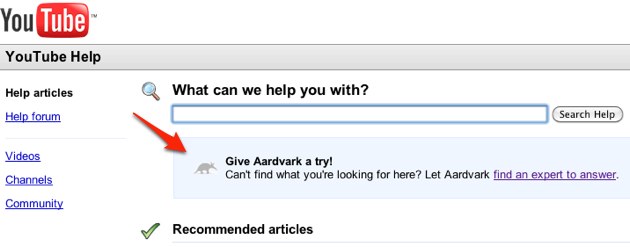
 Two months ago, Google acquired promising social search startup Aardvark for around $50 million. The service allows you to ask questions and get responses almost immediately from other users who are knowledgeable about the topic at hand. Usually it takes Google many months (or longer) before it starts putting its acquisitions to work, but we’ve already come across what may be Google’s first use of Aardvark in the wild: Help support.
Visit the YouTube Help page and you’ll notice a prominent link prompting users to “give Aardvark a try!”. Click that link, and you’re taken to the Aardvark homepage. Google has put an identical message on the Help page for Google Toolbar. No, it isn’t exactly deep integration, but it’s still an interesting move by Google, which has never been known for its customer support.
Most Google services offer Help guides, but there’s almost never a phone number or email address to contact an actual human (which isn’t surprising given that most of these services are free). Aardvark could serve as a good compromise for Google, adding a human touch without the need to set up phone banks of support personnel. Aardvark isn’t yet featured on all Google Help pages, but I suspect we’ll see more of these links if it performs well.
I decided to put Aardvark to the test with a basic (but probably common) YouTube support question: “What file formats does YouTube support, and will WMV work?”. I had my answer, complete with a link to the appropriate help article on YouTube, within around five minutes.