Search Growth Slows In The U.S.
Erick Schonfeld
Apr 9, 2010

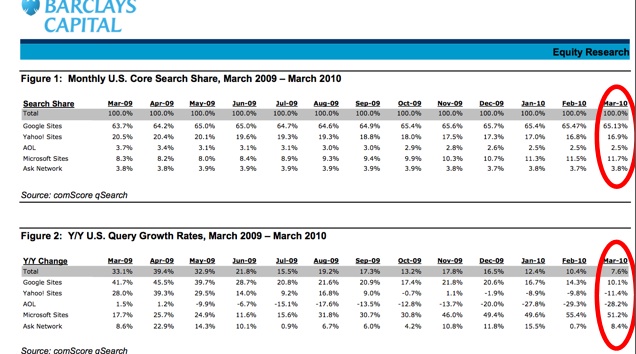
Are the search industry’s best days behind it?  The growth in the number of U.S. search queries is slowing down dramatically.  According to the latest numbers from comScore’s qSearch estimates, overall search volume growth slowed down to 7.6 percent in March, 2010 from 10.4 percent growth in February, 2010 and 33.1 percent growth in March, 2009.

Part of the reason for the slowdown is “partly due to challenging comps” which will continue through May, writes Barclays Capital Internet analyst Douglas Anmuth. But the slowdown may also be an indication that the search industry is maturing, and the next leg of growth may not kick in until people start searching on their mobile phones in a significant way (Steve Jobs says that won’t happen) or something else gives people a reason to search even more than they already do. There are only so many searches you can do in a day, and many people are already hitting their saturation point.

Here are the annual growth rates for select months going back a year, which really shows the drop-off:

March, 2009: 33.1%
June, 2009: 21.8%
September, 2009: 17.3%
December, 2009: 16.5%
January, 2010: 12.4%
February, 2010: 10.4%
March, 2010: 7.6%

Even though overall search growth is declining, Bing is still the fastest-growing search engine, with 51 percent growth in March, followed by Google with 10 percent growth. Both our outpacing the market. Yahoo, on the other hand, saw search volume decline 11 percent annually, although it did gain a tenth of a percent share since February. So its declines may be stabilizing.

The table below shows the market share for each of the five largest search engines in the U.S., along with their monthe-over-month and year-over-year changes. Google actually dropped 0.3 percent from February, 2010, while Bing and Yahoo together gained as much.

U.S. Core Search Share, March 2010 (Source: comScore qSearch)

Google 65.1% -0.3% m/m +1.4% y/y
Yahoo 16.9% +0.1% m/m -3.6% y/y
Microsoft 11.7% +0.2% m/m +3.4% y/y
Ask 3.8% +0.1% m/m +0.0% y/y
AOL 2.5% 0.0% m/m -1.2% y/y

Photo credit: Flickr/Robert Thomson

Advertisement
  • Related Topics
Advertisement
  • http://www.vikitech.com Viki

    Are the search industry’s best days behind it? – Not really.

    Its kinda early to say that search is maturing, since the focus of this report was just on US traffic, and Internet is just gaining traction in other countries. Internet is an International entity, hence just including the US traffic would be a constrained view.

    Search has tremendous growth potential as more and more people start using the internet.

    Other reason is many other niche search engines and social networking sites provide most of the information one looks for, thus reducing the number of searches performed in a day by any individual.

  • http://www.cdnpal.com Christopher

    I attribute the reason for the slowdown to this:

    Most people, not doing commercial or educational research will research the same topic over and over again as they forget it.

    Thanks to a combination of Google and WIkipedia, those people have seen the research enough that they no longer need to search it. Pehaps they have bookmarks directly to the content.

    I think that now, Google is being used more as a directory to website pages, than a research tool used to mine new information. And that is the result of a search engine mature audience.

    Google could probably

    A. back this up with it’s own Analytics research

    B. surprise users with new and compelling search results making them want to use Google for more than a directory.

    Collecta and other services which provide real time search of micro blogs like Twitter are not taking off very well.

    I discussed this with partners and we came to the conclusion that what most people say on Twitter is complete crap. And hash tagging that crap and making it available in real time is not useful to most people.

    About __TOPIC__ sites like demand media which spam Google P1 results with articles that their own metrics tell them is searched frequently also turn people off to search engines. While the articles on these “about” websites are half researched and could look meaningful, they are often times not and an undesired search result.

    Unfortunately Google bot can not defeat Demand Media’s pagerank usurping scheme, because the bait looks like real research to the untrained eye (Googlebot + Pagerank).

    There you have it. Consulting from a startup manager and IT worker.

  • http://www.facebook.com/profile.php?id=673208941 Jan Van Vlimmeren

    If this trend continues it would be interesting to see if people are using “social search”, ie recommendations through social networks like facebook and twitter more than they were before.

  • Microsoft

    Bing has yet to stop growing since launch, according to comscore. amazing.

  • http://www.facebook.com/profile.php?id=722520811 Subhankar Ray

    May be Americans are becoming more content with what they have, and / or having less problems to solve…

  • http://www.MobileAd.org MobileAd

    “the next leg of growth may not kick in until people start searching on their mobile phones in a significant way (Steve Jobs says that won’t happen)”

    Question is here probably if people will use mobile devices parallel or if (up to a certain degree) they replace traditional computers.

  • Matthew

    I don’t understand the not using search on mobile thing. I use search on my Nexus One all of the time… why wouldn’t I?

  • MyLocator ™

    -”Location” will Kill “Search” on mobile and than the internet.
    - algorithm search engines as we know them today will be thing of the past in less than 4 years.
    - Location is based on a language everyone understands.
    - Life simplifies on the internet and mobile when its rolodexed.

  • http://twitter.com/JonWorrel Jon Worrel

    Have you considered the possibility that the majority of web users are refining their search habits (I.e. becoming “better” searchers)? According to the data, the percentage drop from March 2009 to June 2009 was even more significant than what we’ve witnessed in 2010 thus far.

  • http://www.TheAdworld.com Anuraag

    I think the slowed growth is partially attributable to maturing of information verticals and the improved quality of search results itself.

    Add to that the breadth of sites like wikipedia, the maturing of adwords ads leading users to need to do fewer searches per topic.

    I don’t see search going slowing in the medium term and I see this as a temporary correction due to the above reasons and others that I can’t guess!

    I think search has real future on mobile platform too, it’s just that it might need a different kind of app! Maybe one that can integrate with other vertical apps installed on your mobile phone. That’s besides iAd in all iP% apple devices

  • http://www.reactorr.com reactorr

    Since this is based on comScore, the margin of error is equal to or greater than the numbers provided.

    Would be interesting if there was any correlation to other years, and what Hitwise might have to say.

  • http://www.facebook.com/profile.php?id=13004869 Mark Fish

    I have been wondering if the internet growth patterns, Twitter and Search Engines, over the last 18 months might be attributable to the recession and unemployment. Obviously people that are unemployed have more time to use the internet. Now that they are starting to go back to work, will these internet growth patterns flatten or decline?

  • http://www.geolocalseo.com Stever

    Gross over-simplification. With location you still need to search. My phone may know where I am but it does not know what I want. Nor does closest to me (restaurant, hotel, plumber, auto repair, clothing store, etc..) represent best for me. Algorithmic ranking factors get closer to presenting quality results than a rolodexed list, often ordered by who pays the most to be at top of list.

  • http://www.courseadvisor.com John Watts

    How can you write an article about “search” slowing down and not mention FaceBook. FB is the search-stealing monster out there!

  • http://www.geolocalseo.com Stever

    I’m with you on the idea of many users becoming better searchers, going right to the 2, 3 and 4, or more, word terms that describes what they want, instead of starting with the one big broad keyword and then refining the search by adding more words to the search phrase. I’ve been seeing it mature like that in local search for years now.

    Not to mention Google now showing local results for many broad search phrases that would have required a second search of adding a city name. Now when you type ‘plumber’ or ‘dentist’ you get a map of local listings based upon you IP location. No need to do the second search and add the local qualifier.

    On top of all that, search results have gotten pretty damn good, in general. Another reason to not need to re-define your search terms.

    And at this phase we are certainly not seeing many first time internet users coming on-stream (in USA). Even 80 year old grandma’s in Colquitt, Georgia have used teh interwebz.

  • Bing

    Looks like slower growing search market and Bing’s steady growth will start putting pressure on Google in the US.

  • http://blitzsurfer.com Blitz Surfer

    I think there is another reason that searches are dropping- a reason that no one has thought of yet

    I feel this is the case because the number drop too steeply for natural growth stagnation to be the main cause. It’s almost 50% drop a month.

    Perhaps people are using wikipedia instead of searching, or another source for information? Maybe social search engines that aren’t included in above study?

  • http://technipages.com Mitch Bartlett

    I’ve been using Twitter lately for finding recommendations on things like video editing software and restaurants. I just get better results than I do with Google these days. It’s also interactive.

  • http://techretold.com Shan
  • http://www.oclocksoftware.com O Clock Software Pvt Ltd

    You are absolutely correct and yes Google & Wiki making most of people easier for their research in all the ways.

  • Brian D

    Search growth will become event driven ?

    Well, in the developed connectivity nations… I think it will. Get a year of good events and ‘growth’ will rise.

    /shrug

  • Schonzinski

    “There are only so many searches you can do in a day, and many people are already hitting their saturation point.”

    I call bullshit. It’s the economy. People just have less time to dick around, either at home or at work.

  • WTF Mike?

    LOL, your comment was much more accurate and insightful than the post itself. Watch out schoney, your schtick is tired, and the commenters are making you look like a hack.

  • Mike Kowieski

    Bing’s growth in search share is irrelevant when you look at where it’s coming from. Microsoft is not denting Google’s sizeable market share – its taking traffic from Yahoo. And what happens when Microsoft begins taking over serving Yahoo natural and paid results by the end of 2010?

    For Bing’s growth to matter at all, it would need to be coming at the expense of Google – and that’s not happening yet.

  • Chris Jensen

    Have you considered the possibility that the majority of web users are refining their search habits (I.e. becoming “better” searchers)? According to the data, the percentage drop from March 2009 to June 2009 was even more significant than what we’ve witnessed in 2010 thus far.

    Oh yes, I would say I’ve gotten much better at searching. Thanks man.

  • http://www.msearchgroove.com/2010/05/10/mobile-search-data-points-u-k-usage-insights-comscore-numbers-taptu-reports-australian-stats-plus-mobile-search-workshop/ msearchgroove » Blog Archive » MOBILE SEARCH DATA POINTS: U.K. Usage Insights; ComScore Numbers; Taptu Reports; Australian Stats PLUS Mobile Search Workshop

    [...] with our social networks and information about people who matter most to us on the fly. Meantime, Tech Crunch points out that search growth is slowing. The post concludes: the slowdown “may also be an indication [...]

  • http://vc-list.com/?p=4111 How Yahoo Boosted Its Search Market Share With Pictures | Venture Capital & Angel Investors Lists News and Jobs

    [...] in U.S. search market share, according to comScore’s April search numbers. Yahoo went from 16.9 percent share in March to 17.7 percent in April. How did it all of a sudden regain its search mojo? One word: [...]

  • http://cincodata.com/technology/how-yahoo-boosted-its-search-market-share-with-pictures/ How Yahoo Boosted Its Search Market Share With Pictures | Technology and Web 2.0

    [...] in U.S. search market share, according to comScore’s April search numbers. Yahoo went from 16.9 percent share in March to 17.7 percent in April. How did it all of a sudden regain its search mojo? One word: [...]

  • http://www.567t.com/how-yahoo-boosted-its-search-market-share-with-pictures How Yahoo Boosted Its Search Market Share With Pictures

    [...] in U.S. search market share, according to comScore’s April search numbers. Yahoo went from 16.9 percent share in March to 17.7 percent in April. How did it all of a sudden regain its search mojo? One word: [...]

  • http://jp.techcrunch.com/archives/20100510yahoo-search-pictures/ Yahooは画像を使って検索のマーケットシェアを増加–ただしそのやり方は?

    [...] Yahooの検索では、まさに’百聞は一見にしかず’だ。この1年、一貫してマーケットシェアが減ってきたYahooは、今年の4月のcomScoreのデータでは検索のマーケットシェアが前月比で1ポイント近く上がった。すなわち、3月のYahooのシェアは16.9パーセントだったが、4月には17.7パーセントになった。一体どうやってYahooは、検索における魔力を取り戻したのだろうか? その答えとは: スライドショウである。 [...]

  • http://www.asreirani.com/news/%da%86%da%af%d9%88%d9%86%d9%87-%db%8c%d8%a7%d9%87%d9%88-%d8%b3%d9%87%d9%85%d8%b4-%d8%af%d8%b1-%d8%a8%d8%a7%d8%b2%d8%a7%d8%b1-%d8%ac%d8%b3%d8%aa%d8%ac%d9%88-%d8%b1%d8%a7-%

    [...] دچار یک جهش درسهم بازار جستجو در ایالات متحده شده است، سهم یاهو از ۱۶٫۹ درصد در ماه مارس به ۱۷٫۷ درصد درماه  آوریل رسید. اما چگونه این افزایش [...]

  • http://www.sesligoruntulu.com sesli goruntulu chat

    kalbım senı istıyorsa söyle ben ne yapayım..

blog comments powered by Disqus
Advertisement
Got a tip? Building a startup? Tell us