It’s hard to imagine a Web sans URL shortening services nowadays but you can rest assured that they’re here to stay – for better or worse. Question is: how do the likes of bit.ly, TinyURL and Goo.gl score in terms of speed and availability?
That’s exactly what Dutch startup WatchMouse sought to find out, by monitoring the performance and uptime for 14 popular URL shorteners for a whole month.
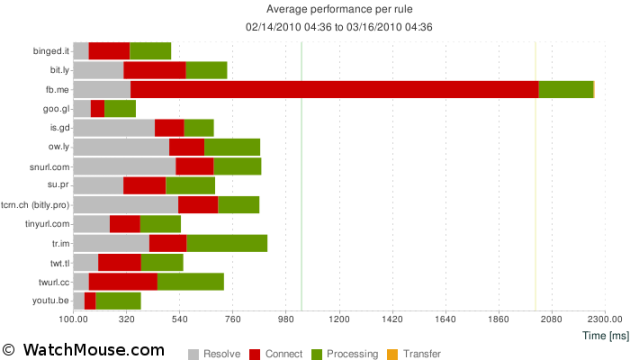
Turns out most really don’t perform all that well, and that URL shorteners actually increase the load time of pages significantly. As you can tell from the graph embedded above, a lot of URL shortening services add half to nearly a full second to page load times.
To measure this, WatchMouse checked each URL shortener every five minutes from one of its monitoring stations, which are located across the globe. For each short URL, only the redirection was measured, not the actual loading of the target page.
Pingdom did similar research on the speed and reliability of URL shortening services in August 2009, although they only looked at independent URL shorteners and not the ones from Microsoft, Facebook and Google.
Google does a pretty good job in terms of performance with Goo.gl and YouTu.be, but it still takes those about 1/3 of a second to resolve pages, which makes a world of difference if you think about how many website addresses get shortened on a daily basis.
According to WatchMouse’s findings, Facebook’s FB.me is by far the slowest of the pack, adding over two seconds on average to the page load time after the click on a link.
Another interesting thing the company noticed is that only a few of the URL shorteners optimized their name servers for international use – i.e. it takes half a second for some of the URL shorteners just to look up the IP address that is needed for a browser to retrieve a Web page.
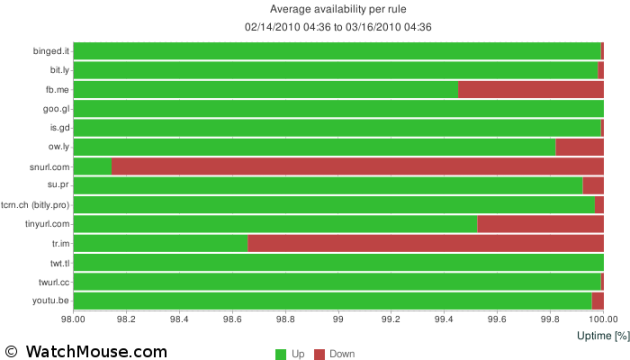
As for the availability of the URL shortening services: most do reasonably well in this regard, with snurl.com performing worst of the bunch with south of 98% uptime. Facebook’s fb.me registered the third worst uptime out of the 14 services that were tracked, although that still means about 99.5% availability – which isn’t terrible.
Now all they have to do is speed it up a little.