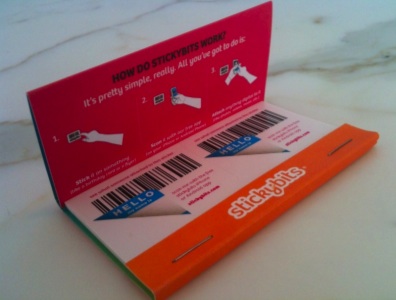
Every place and object in the world has a secret past: who lived there, who passed by, who touched it. The secret lives of objects are filled with such details. If only you could make them talk. But what if you could give any physical object a story simply by sticking a barcode on it and appending a message to that barcode? The message could be a photo, a text message, a video, or a voice note. All anyone would need to unlock the message is a phone with a special barcode scanning app.
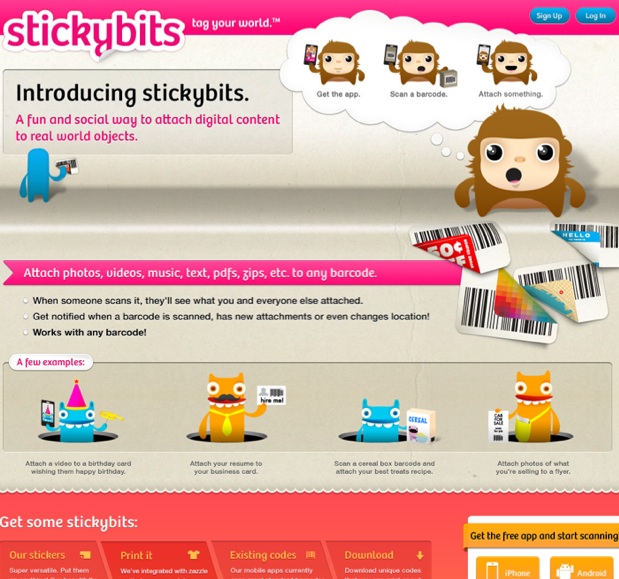
Stickybits is that app. Founded by Billy Chasen (the original programmer behind Chartbeat) and Seth Goldstein (chairman and founder of SocialMedia), the startup just closed a $300,000 seed round from Polaris Venture Partners and Mitch Kapor. Officially launching this week at Austin’s SXSW festival, stickybits is a new mobile app for both the iPhone and Android. It lets you scan any barcode and attach a message to that physical object.
The barcode in a greeting card , for instance, could trigger a video message from the sender. One on a box of medical supplies could inventory what is inside. A business card with a code on it could link to a resume or LinkedIn profile. Museums and theme parks could use them for audio tours and maps. Local merchants could use the barcodes to track deliveries or place them in their storefront windows to distribute digital coupons and offers to passersby. The possibilities are endless.
The app is free, but stickybits sells packs of 20 vinyl barcode stickers for $10. You also can download and print your own barcodes for free, or scan an existing one on a physical product like a can of Coke. (Future business model: charge brands to claim their barcodes and place their own messages first).
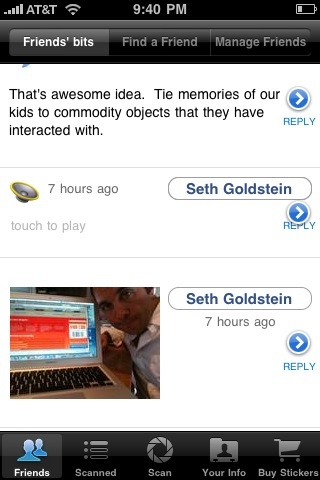
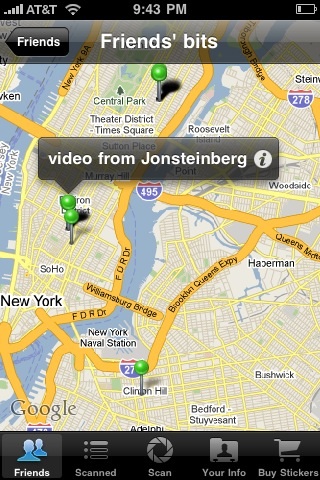
Each barcode is programmable by the first person who scans it and and leaves a photo, video, audio, or text message. The next time somebody scans that barcode, the previous message will appear on their phone. Anyone can add a new message to the same code, resulting in a stream of messages connected to whatever object or place the barcode is stuck on. Each scan, and related message, is geo-tagged so you can see as an object moves around how its story evolves.
The app lets you follow people and see their object stream, or get notified whenever one of your objects is scanned, moved, or new bits are attached to them. You can toggle between stream and map views. It supports Facebook Connect for login and any scan can be broadcast out to Facebook, Twitter, or Foursquare. With Foursquare, it actually gives you the option to check into the place where you are by scanning the barcode.
If stickybits sounds like science fiction that may be because they share some attributes with author Bruce Sterling’s concept of “Spimes” (later fleshed out in his book Shaping Things):
The most important thing to know about Spimes is that they are precisely located in space and time. They have histories. They are recorded, tracked, inventoried, and always associated with a story.
Spimes have identities, they are protagonists of a documented process.
They are searchable, like Google. You can think of Spimes as being auto-Googling objects.
Sterling predicted Spimes will eventually be designed into all objects, and contain their histories, raw materials, ingredients, ownership history and other data. Perhaps stickybits are first steps in that direction.


Powered, in part, by SimpleGeo. :)
I knew I was gonna forget something.
This is really cool… imagine the marketing possibilities… hidden tips and secrets… even like geocaching on roids!
word … going to start with my new stickybits .. http://drp.ly/z5GcU
So this is a barcode database?
not available internationally??
It should be. Did something not work?
Stickybits…
Anybody eles think “porn”.
Yeah, apple is going to love this one.
Yes, everyone, let’s scan your Toyota and add ‘Acceleration problem’ message and see how this thing could destroy a brand ~
As a retailer I wonder if you could upload a file of your inventory and list in mass your prices. It would function something like Pricegraber or Shopping.com. If this is not managed somehow I can see the results becoming cluttered with out of date retail price listings.
Great idea. Hard not to compare it to MS Tag service.
++: barcodes are already pervasive and well-understood, physical barcode tags can be generated on the fly, social layer is awesome – excited to use it.
–: the idea/service seems easy to replicate (they need a userbase/data quickly), they don’t have comparable analytics/infrastructure to MS Tag (obv.)
Clever. Nice job, Seth.
why don’t use QR codes instead of bar codes? They occupy less space (and I can print them as Moo stickers!)
It’s like IRL Twitter!
This sounds great! The ability to scan *any* barcode is what really defines it.
I love the idea of giving inanimate objects stories…
Not really, most barcodes are not unique. The standard barcode on a Coke can is the same as the barcode on most Coke cans in the country.
only special codes. so a slow start
but great for sweepstakes!!!!
as neat as this sounds i hope they have a way of managing what’s being attached to what barcodes, esp ones that are the same across an entire line of products. it’ll only be a matter of time before someone canvases your supermarket with pictures of dicks on everything from lighter fluid to baby formula.
Nice concept. The location bit will fail though for the can of coke and other products. All cans feature the same code. And how will stickybits ensure that people will use unique codes for objects?
Well this would be good if your iphone had a bar code printer attached to it to give the thing a unique bar code. Maybe I will use the bar code of the product, of wait, a hundred thousand were produced? I guess I will just have to wait for the more dynamic picture recognition referencing technology to come out to actually make this product more useful and intriguing…hats off
I’m curious on the technical side: How is it gonna play-out/integrate with pre-existing UPCs? Is stickybit barcode complimentary to items with no UPC, or actually sitting on a separate layer?
Interesting but isn’t RFID tags going to make this a lot more seamless when phones get NFC?
Especially if the iPhone gets NFC this summer, expect tons of start ups in this area
http://mobileinc.co.uk/2010/02/apple-patents-show-iphone-macbooks-to-feature-nfc-this-is-big/
Great work Billy and Seth. I can’t wait to try it out.
Isn’t the quality of scanning via mobile phone camera really poor? I’ve heard 50% failure rate. Anyone know?
Big congrats to Seth and Billy – psyched to be working with you guys.
So do these sticky bits allow me to lock a file so you can’t delete it?
Well, kind of dangerous too. If you go around the house scanning your stuff, then someone nearby who wants one knows exactly which house to break into. Need a simple way to disable the geolocation part.
There are many dangerous implications to this kind of technology but since people leave their thinking caps off when getting all goggle-eyed (or should it be google-eyed?) when new technology comes out, they wrongly associate technology with progress and progress with something positive.
This is sad.
A local store is just going to let people start sticking bar codes on their front door so they can deal with all the spam, bad reviews etc. No way. Have you drunk Seth’s cool aid?
This could bring the game of “geo-caching” to a whole new level. I’m really looking forward to this!
I can’t wait to see what super-creative use cases come out of this. Congrats, Billy + Seth!
Really interesting tech/service.
As the article notes, “You also can download and print your own barcodes for free, or scan an existing one on a physical product like a can of Coke. (Future business model: charge brands to claim their barcodes and place their own messages first).”
My question is that the brand ultimately owns this UPC code – they purchase the right to it. What right does the brand have if a Stickybits user elects to append a negative message to this UPC code as it appears possible?
I would think the brand has the right to prevent this as it is their property.
Just asking . . .
Great point. Don’t think power brands will sit by and allow people to physically tarnish their products or service. Posting comments or opinions on the web is one thing; physically labeling a product or place of service is another. I doubt anyone would get very far by placing sad face stickers all over products or establishments they don’t like. Just because you have to access a database to see the ‘sad face’ doesn’t mean a brand is going to let someone attach a tangible label to t h e i r p r o p e r t y. Control will certainly be a factor.
Cool product/service. Kind of lame name.
Bah! Only for Android 2+! :( Me and my lowly Android 1.5 phone.
It seems like an interesting idea. I’d like to see it take off.
Yep, that’s the problem I’m having too. This seems like a great app, I’d love to see it catch on… hopefully that’ll happen.
(Come on, Sprint, update our phones! So many cool new apps that we can’t have!)
Just another Biz that got funding somehow. All the negative points are going to sink this ship. With free mobile codes available for uses from geo caching to personal identity to valuable coupons. who’s going to spend money on their tags?
Then again with all the new technology out there why do we even need these abstract machine codes anymore. Thats why I like the 8-1 concept at http://www.8-1.com
The 8-1 smiley face has a patented method for making a smile into a code. Its negative points are, no funding to build it and no one on board to help promote the transition. But with anything great it is up to the people to choose. Good Luck to the Sticky Bar Code people, they’ll need it.
+1 300k, really? A developer could build this in a weekend.
I really dont get it.
QR codes do the same thing, have been around forever and work. But no one wrapped up the idea in a sugary logo and marketing plan – and added stickers. Another example of execution clobbering the idea. Adoption is everything. Ecosystem is everything else.
zigzag?