I’m here at YouTube’s office in San Bruno, where the company is holding a press conference to discuss the launch of auto-captions. YouTube Director of Product Management Hunter Walk kicked off the event by discussing some of YouTube’s goals through the years — one of which is accessibility.
Walk said that a few years ago, accessibility meant giving users more ways to access their content (for example, through their mobile phones). Now, the company is focusing more on making its content accessible to even more people. Google software engineer Ken Harrenstein then took the stage to walk through some of YouTube’s initiatives on this front.
Harrenstein walked us through YouTube’s past feature launches, including the launch of captions and subtitles. In November of last year, the company began to roll out auto-captions on a limited scale, which use speech recognition to automatically transcribe what’s said in a video. And now, it’s going to enable the feature for all videos uploaded to YouTube where English is spoken.
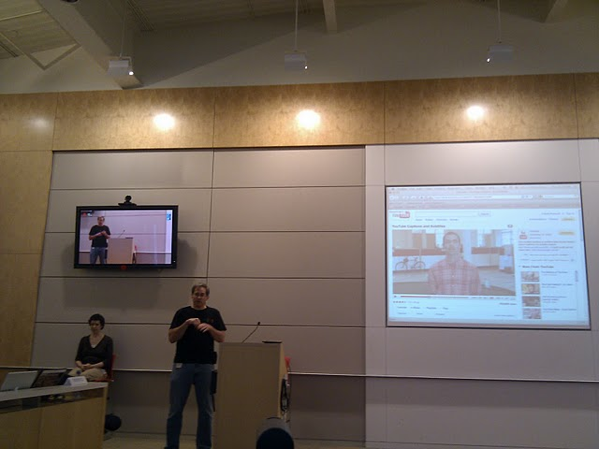
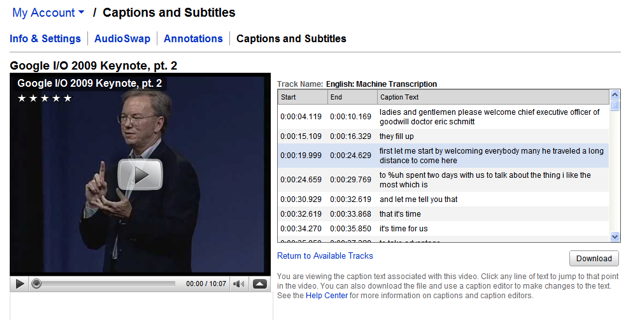
This makes the videos accessible not just to deaf people, but also to viewers around the world, who can translate any video that’s in English to another language. However, Harrenstein took time to point out that the captioning isn’t perfect, showing how the words “SIM card” got transcribed to “salmon”.
Here are some of the details for uploading videos:
- While we plan to broaden the feature to include more languages in the months to come, currently, auto-captioning is only for videos where English is spoken.
- Just like any speech recognition application, auto-captions require a clearly spoken audio track. Videos with background noise or a muffled voice can’t be auto-captioned. President Obama’s speech on the recent Chilean Earthquake is a good example of the kind of audio that works for auto-captions.
- Auto-captions aren’t perfect and just like any other transcription, the owner of the video needs to check to make sure they’re accurate. In other cases, the audio file may not be good enough to generate auto-captions. But please be patient — our speech recognition technology gets better every day.
- Auto-captions should be available to everyone who’s interested in using them. We’re also working to provide auto-captions for all past user uploads that fit the above mentioned requirements. If you’re having trouble enabling them for your video, please visit our Help Center here.
Google researcher Mike Cohen then took the stage to talk about Google’s Speech Technology. The ultimate vision, he says, is to provide accurate captions for all videos in all languages. But that comes with many problems, including a massive vocabulary, issues with poor recordings and background noise, and accents. And every language comes with its own unique challenges.
YouTube hasn’t yet run all of its videos through the new transcription service, but video owners will be able to manually request that their older videos get transcribed more quickly through each video’s options screen.
Harrenstein, who is deaf, retook the stage to tell a personal story. When he was at MIT, he didn’t go to many of his lectures because he was unable to understand the lectures (which weren’t signed). Now, he can watch MIT lectures on YouTube, with captioning enabled.
Next, some students from the California School for the Deaf in Fremont, and their instructor Joey Baer, took the stage to thank YouTube for the launch. Check out their enthusiasm in the video below. Really, this is quite amazing.


good update !
wonder if sxephil and other youtube partner will use this one? And youtube also added their own URL shortener to the mix: http://bit.ly/youtube-URL-shortener
Expect more changes to the tube on 2010…
This certainly will be a nice feature but when I tried it din’t work.
Bring on the hilarious commentary!
It didn’t work at first, kept trying with it, and finally worked. I kept clicking on the cc and repeating the video
It’s all about search…
Imagine the possibilities of full text search in youtube captions…
While it is nice that YouTube has enabled it, I see no point for it.
As well the auto-caption tool sucks…it has a hard time with a lot of words and sentences.
Perhaps you “see no point” because you’re not hearing impaired. Believe me- this is a huge feature for millions of people.
Even imperfect captions will help monetize videos.
Search caption text = More relevant ads = More money for Google.
I am surprised that this has not happened sooner, although it is a huge undertaking to say the least. I wonder if they will have a way to license out the technology to run on a private label video player?
very impressive – but caption is a side product of advertisements. Once YouTube know what the video is saying Google will find the matching ad.
Don’t forget the SEO side of this as well.
Youtube just created BAZILLION text articles ready to get indexed and position in yet another google property.
Beside that I think is AMAZING. And I can feel how cool is this for millions of people.
good point!
It’ll be seo effect of course and I think that was the part of plan
Awesome improvement. You can just sense the Google technology behind this.
It’s not a Google technology though… it is “Google processing power”.
Speech recognition is nothing new.
Their servers will work A LOT.
On the hole, it’s a friggin’ amazing news. I was waiting for this since some time.
I am Hard-of-Hearing.
This is definitely a step in the right direction, and personally, I think it’s long overdue for more companies to adopt universal access technology where available. (Netflix, I believe has been under fire for not including subtitles with ‘Instant Watch’ or whatever feature).
While there are regulations in place to ensure equal access to television and like media, regulating such a thing on the internet cannot, and indeed, should not be done. It’s encouraging to see the de-facto standard distributer of video content on the web take this issue seriously and use the advances in technology to improve everyone’s lives, even in areas of lesser importance to a larger audience.
This is one of the many reasons I am a supporter of Google as a company and a brand. There’s still further steps to take, but I am very happy today to see this announcement. Making captioning easier for publishers and accessible to those that need it is an entire ecosystem of solutions for these kinds of problems. I hope Google and other companies continue to develop technology that pushes the limits of what can be done to ensure access for everyone to online channels of communication.
This is a really awesome idea, but the technology is not quite there yet.
However, it still have immeasurable value as a source for entertainment for bored people everywhere.
i’m sure the accuracy of this is GREATLY reduced when the spoken word is over a music background – which puts lots of movie and tv clips out of the game.
I love YouTube’s captions/transcripts on videos but I think they still need human editors. The machine transcriptions are already becoming a laughing stock online. Just have a look at the screenshot above where Eric Schmidt is the “Chief Executive Officer of Goodwill” :)
Great advancement. But what I much worry about is Youtube small capacity in accepting files. I think Youtube need to enhance / multiply it’s size and length capacity.
It could have happened sooner. Anyway nice new feature.
Whoah! This is amazing!!!
They are taking it to the next level, I guess the automatic captioning didn't work very well http://youtube-global.blogspot.com/2010/06/profes...
that is amazing
really good information .