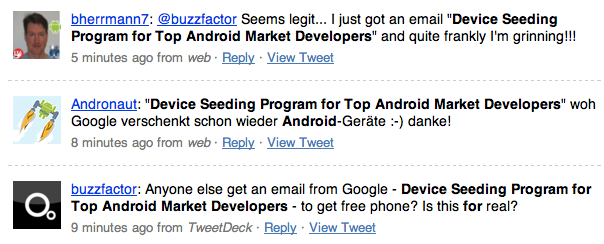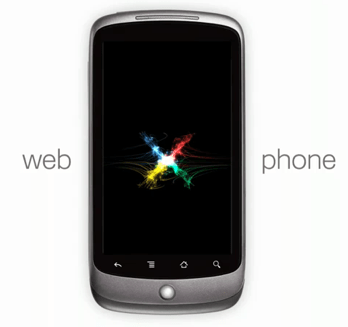
 Google has just sent out an Email to select Android developers informing them that they are eligible to receive either a Verizon Droid or a Nexus One, as part of its ‘Device Seeding Program’. The criteria for getting one of the phones is to have an application with 3.5 stars or higher and more than 5,000 downloads, which sounds like it could include quite a few developers.
In an odd move, Google isn’t actually allowing the developers to pick which device they’re receiving — if you’re in the US, you’ll get a Droid or Nexus One, at random. If you’re in Canada, the EU, Norway, Lichtenstein, Switzerland, Hong Kong, Taiwan, or Singapore, you get a Nexus One. If you’re not in any of those, you don’t get a phone at all (Google explains that the phones aren’t certified in other countries).
So why is Google doing this? Android is already having to deal with fragmentation issues, as a large number of users (and developers) have older phones that aren’t running Android 2.0. Now that the Droid, which runs 2.0, comprises a big part of Android’s market share, it’s in Google’s best interest to make sure that Android’s best developers are building software that’s compatible with the latest devices. The free phones also serve as a nice carrot to entice developers to build quality applications.
Here’s the Email Google is sending out:
Due to your contribution to the success of Android Market, we would
like to present you with a brand new Android device as part of our
developer device seeding program. You are receiving this message
because you’re one of the top developers in Android Market with one or
more of your applications having a 3.5 star or higher rating and more
than 5,000 unique downloads.In order to receive this device, you must click through to this site,
read the terms and conditions of the offer and fill out the
registration form to give us your current mailing address so that we
can ship your device.You will receive either a Verizon Droid by Motorola or a Nexus One.
Developers with mailing addresses in the US will receive either a
Droid or Nexus one, based on random distribution. Developers from
Canada, EU, and the EEA states (Norway, Lichtenstein), Switzerland,
Hong Kong, Taiwan, and Singapore will receive a Nexus One. Developers
with mailing addresses in countries not listed above will not receive
a phone since these phones are not certified to be used in other
countries.We hope that you will enjoy your new device and continue to build more
insanely popular apps for Android!
Update:: And here’s a followup statement from Google about the program (it’s real, for those of you who are worried that it’s a scam):
A thriving developer community is an important part of creating a better mobile experience for users around the world. We hope that offering devices to developers will make it easier for them to create and test great applications. This is inline with other efforts to support developers, which also includes our Android Developer Labs World Tour and our upcoming participation at the Game Developers Conference.