

Can Entrepreneurs Be Made?
Vivek Wadhwa
Feb 27, 2010

Silicon Valley investors often have a picture in their heads of the type of person who is worthy of funding: young, brash, stubborn, and arrogant. They believe that successful entrepreneurs come from entrepreneurial families and that they start their entrepreneurial journey by selling lemonade while in grade school. Angel investor and entrepreneur, Jason Calacanis said as much in his recent talk to Penn State students. And after meeting Wharton students, VC Fred Wilson expressed shock when a professor told him that you could teach people to be entrepreneurs. Wilson wrote, “I’ve been working with entrepreneurs for almost 25 years now and it is ingrained in my mind that someone is either born an entrepreneur or is not.”

Jason, Fred, and Silicon Valley VCs, I’ve got news for you: you’ve got it all wrong. Entrepreneurs aren’t born, they’re made. And they aren’t anything like you think they are. My team surveyed 549 successful entrepreneurs. We found that the majority didn’t have entrepreneurial parents. They didn’t even have entrepreneurial aspirations while going to school. They simply got tired of working for others, had a great idea they wanted to commercialize, or woke up one day with an urgent desire to build wealth before they retired. So they took the big leap.
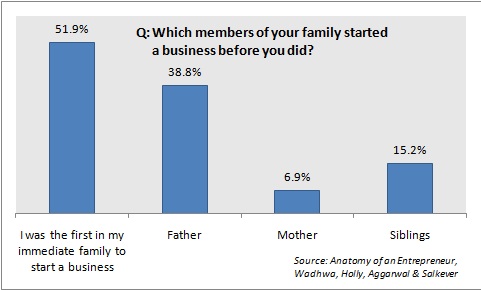
We found that 52% of the successful entrepreneurs were the first in their immediate families to start a business — just like Bill Gates, Jeff Bezos, Larry Page, Sergei Brin, and Russell Simmons (Def Jam founder). Their parents were academics, lawyers, factory workers, priests, bureaucrats, etc. About 39% had an entrepreneurial father, and 7% had an entrepreneurial mother. (Some had both.)

Only a quarter caught the entrepreneurial bug when in college. Half didn’t even think about entrepreneurship, and they had little interest in it when in school.
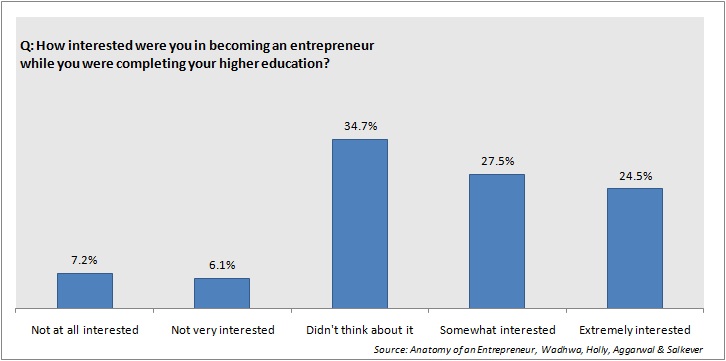
There was no significant difference between the success factors or hurdles faced by entrepreneurs who were extremely interested in entrepreneurship in school (and who likely set up the lemonade stands) and the ones who lacked interest. But entrepreneurs with extreme interest started more companies and did it sooner. Of the 24.5% who indicated that they were “extremely interested” in becoming entrepreneurs during college, 47.1% went on to start more than two companies (as compared with 32.9% of the overall sample). Sixty-nine percent started their companies within 10 years of working for someone else (as compared to 46.8% of the rest of the sample population).
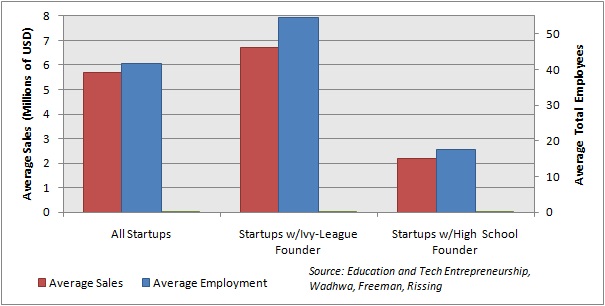
What did affect their successes?  Education — but not the college they graduate from. In a different study of the 652 CEOs and CTOs of 502 tech companies, we researched the correlation between education and the sales and headcount of companies founded. We learned that the there was a significant difference between companies started by founders with just high-school diplomas and the rest. Education provided a huge advantage. But there wasn’t a big difference between firms founded by Ivy-league graduates and the graduates of other universities.

The education and training of entrepreneurs is something that the Kauffman Foundation has been researching extensively. Over the last six years, it has invested around $50 million on academic research to understand what makes entrepreneurs tick and what policies are most conducive to entrepreneurship and to construct data bases to permit analyses of these subjects. (Kauffman has also funded some of my research at Duke, UC-Berkeley, and Harvard.) Its VP of Research, Bob Litan, says that Kauffman has learnt conclusively that entrepreneurship can be taught. The key is to provide education at “teachable moments” — when the entrepreneur is thinking about starting a venture or ready to scale it. What entrepreneurs need isn’t the type of abstract course they teach in business schools, but practical, relevant knowledge.  That’s why Kauffman created a program called Fast Trac, which has trained 300,000 entrepreneurs so far.

One of the findings of Kauffman research is that of the appx. 600,000 businesses that are started every year, less than a fraction of 1% become high-growth “scale” businesses. These new firms, especially the “scale” firms, have added all of the net incremental jobs to U.S. economy since 1980 (about 40 million), and probably account for about 1/3 of GDP growth since then. So the key to boosting economic growth is to increase the number of successful high-growth startups.  After all, the growth rate of our economy is nothing more than the aggregation of the growth of our firms.

That is why Kauffman (which has a $2 billion endowment) is investing heavily in an ambitious new program called Kauffman Labs.  This aims to dramatically increase the ability of small businesses to become big businesses. The Labs program is built around a novel idea: that highly motivated individuals with “scalable ideas” can be recruited to be entrepreneurs and to be made successful, by surrounding them with a network of other experienced entrepreneurs; sources of money; and mentors. The goal is to educate entrepreneurs and surround them with a powerful network. This is like a Y Combinator on steroids.

Anecdotal evidence also shows that there are many more factors at play than that of genes. Note this BusinessWeek article about waves of spinoffs from Google. I doubt that all of these Google employees who are starting successful businesses were born with entrepreneurial genes. VC and former entrepreneur Brad Feld also blogged about how many of his frat buddies at MIT had become successful entrepreneurs. Were all of these people born to be entrepreneurs as well? I don’t think so. It is probably education, exposure to entrepreneurship, and networks that led these people to pursue the entrepreneurial path — which means that Kauffman Foundation may have hit on the right idea with Kauffman Labs.

The reason this topic is really important is that, as Wilson writes, “Venture Capital is a lot about pattern recognition”. The reality is that VCs like him make quick judgments about people based on the stereotypes in their minds. So, like the women that I wrote about in my previous posts, we may be disadvantaging another important segment of our population – a segment that is older, more humble, more sensible, and more realistic than the population that is getting all the attention (and the money).

Editor’s note: Guest writer Vivek Wadhwa is an entrepreneur turned academic. He is a Visiting Scholar at UC-Berkeley, Senior Research Associate at Harvard Law School and Director of Research at the Center for Entrepreneurship and Research Commercialization at Duke University. Follow him on Twitter at @vwadhwa.

Advertisement
Advertisement
  • http://www.facebook.com/profile.php?id=1493487882 Thomas McKay

    Bravo!

  • http://www.techretold.com Shan

    Nice post …

  • http://avc.com fred wilson

    Vivek

    this is excellent work and thanks so much for doing it and sharing it.

    i am certain that it’s not entirely in the genes. nature and nurture combined create who we are.

    but i do believe there are unique personality traits that the best entrepreneurs exhibit.

    i suppose you could be taught them. it’s even more likely that you could learn them from a mentor in a work environment.

    but one way or another, if you want to be a great entrepreneur you have to be a certain kind of person

  • http://pinkygonzales.com/ Pinky Gonzales

    Here here! Couldn’t agree more. Just yesterday I met with an entrepreneur who was a CFO in his former life. Conservative. Stable. And one day and idea hit him that changed his life. He was 40 at the time.

    I have also found that investors are much more comfortable with a team that includes experience in addition to vision and drive. Perhaps the foolish VCs feel that they can mold young kids into whatever they want, but I’ll bank on maturity and relationships all day long.

    Great article.

  • http://JonathanNation.com Jonathan Nation

    I wish I had time to go through everything, but in skimming quickly this jumped out at me:

    “We found that the majority didn’t have entrepreneurial parents. They didn’t even have entrepreneurial aspirations while going to school. They simply got tired of working for others, had a great idea they wanted to commercialize, or woke up one day with an urgent desire to build wealth before they retired.”

    This is the case that these people were born as entrepreneurs.

    See, the difference is not that these people had a commercially viable idea and nobody else does, it’s that they were born with the desire, will, and other qualities that caused them to “simply got tired of working for others” and then take the next step.

    In addition to that, they were successful, so there is a *winners bias* in the research, unless you also surveyed a number of people who went the same pattern and smashed their face on the ground in failing.

    I plan on reading this more soon, but it seems that the author is just taking the data that the author gathers and is looking at the glass as the author wishes … might be a correlation and not causation issue.

  • http://JonathanNation.com Jonathan Nation

    the other thought is a question as to what really is an “entrepreneur” and what is not … my guess the author is using a much too broad definition.

  • Mohak

    Hi Vivek,

    Interesting ideas and point of view. I have firmly believed that there are perhaps two forms of children. Ones that want to succeed their parent’s fortunes/jobs/businesses. And the others who actually are the rebels who’s natural need is to learn from the parent’s mistakes (or perhaps in the urge to defy) and do something different. There was a study actually that clearly stated that the cycles of parent entrepreneur and the children going on to working for someone else, and vice versa are pretty high. Similarly, parent’s disillusionment in working for someone else ensures high motivation for the children to go the entrepreneurial route.

    Secondly, After being conferred honorary degrees by the very universities that a lot of the high scale company founders dropped out of, where do they figure in your stats? Do you consider them as graduates or not :)

    Mohak

  • http://www.jmdecombe.com Jean-Michel Decombe

    Data: 1 – Ignorance: 0

  • http://www.facebook.com/profile.php?id=16404762 James Gillmore

    Fred, as you’ve invested in a lot of the best startups, I’d say this highly statistical evidence doesn’t counter your original stance. The best of the best still fits the lemonade stand model.

    I also think entrepreneurship is becoming easier and easier every day in this country, and something more accepted as normal for almost anyone these days. That’s why these stats based on large pools of people aren’t biased in favor of the lemonade stand entrepreneur. But if we were to limit the pool to the best startups of the past 20 years, or even just to the startups you’ve invested in (of which some are the best startups of the past 20 years), then we’d find that these stats mean zilch.

    Starting a dog grooming shop is one thing. And starting Twitter is another.

    James from FaceySpacey.com

  • http://www.socialsmarty.com Kat Walterhouse

    Thoughtful post. I do want to emphasize when you state “Entrepreneurs aren’t born, they’re made” that you must have that entrepreneurial spirit to succeed. Is that something that can be learned? I am not certain. Your thoughts???

  • http://www.brandonpaton.com Brandon Paton

    If having entrepreneurial parents, going to an ivy-league university (vs a mediocre college), and having entrepreneurial aspirations early in life doesn’t make you an entrepreneur, what does?

    I liked the article, but it focused on proving the current misconceptions wrong rather than explaining what goes in to the making of a successful entrepreneur. The latter is what I would like to hear more of.

  • http://mo.com Brian Null

    I interview entrepreneurs for a living and I’m convinced there’s an entrepreneur hidden in all of us…
    circumstance often determines if it ever rises to the surface or not

  • http://www.bamaru.com/index.php/2010/02/geschaftssinn-nicht-genetisch/ Geschäftssinn: Nicht genetisch. « bamaru.com – Über Design, Business und die Welt 2.0

    [...] Bei Techcrunch gibt es dazu einen interessanten Artikel, in dem die landläufige Meinung beschrieben wird, dass Unternehmer als solche geboren werden. Die Eltern sind bereits Unternehmer und die Kinder fangen bereits in der Schulzeit mit einem Limonadenstand an, sich ihre ersten harten Dollars zu verdienen. Ist das empirisch nachweisbar? [...]

  • http://www.backtype.com/MichaelADeBose Michael A. De Bose

    It’s really tempting to try and develop these frameworks for what successful people and businesses look like. Wall Street and investors of all sorts have bought into the, this is what success looks like and bet powerfully wrong at one time or another. VCs and the markets at large should try to keep open minds and look for good ideas, not successful looking people.

    Good ideas aren’t about the age of the person involved. Equally past experience sometimes needs to be dead ended, especially when new paradigms are needed. I recall reading that some of the Tesla investors felt more comfortable with someone from the car industry and I was like okay until they settled on someone from gas guzzling Detroit. He may be great for Tesla who knows, but the inclination towards the familiar can ruin great ideas.

    Probably more than anything new ideas paired with the new thinking required to usher them into reality require faith.

  • http://www.patientsknowbest.com Mohammad Al-Ubaydli

    When I was young, my father came home with a book by Edward de Bono. De Bono believed that intelligence and creativity were skills, not only teachable, but also that the teaching was far more important than the talent you were “born” with.

    To this date, I think that was the most important lesson my father taught me: that everything can be learned; that if something is important, you should spend the time learning it; and that if you spend the time, you will succeed.

    Vivek, thank you and the Kauffman Foundation for this research.

  • http://www.buckingham.ac.uk/business/bbe/ Nigel Adams

    Interesting and thought provoking article.

    I think that you can encourage entrepreneurship, by providing the right type of education, along with practical advice and mentoring. You can also try to warn entrepreneurs about the pitfalls that many of their predecessors have met!

    I absolutely agree with Bob Litan of Kauffman’s statement that ‘The key is to provide education at “teachable moments” — when the entrepreneur is thinking about starting a venture or ready to scale it. What entrepreneurs need isn’t the type of abstract course they teach in business schools, but practical, relevant knowledge.’

    We at the University of Buckingham, the only independent university in UK, have developed a unique undergraduate programme during which students (18 years old and up) start and develop their businesses whilst studying for an honours degree in Business Enterprise (See http://bit.ly/6LFmpJ) and they do both in just two years.

    Our programme is a combination of academic study and practical, relevant knowledge from experienced business mentors. Interestingly, since the first cohort completed their studies in December 2007, all of our Business Enterprise graduates have either started their own business, achieved employed in interesting jobs or have gone on to post-graduate study.

    When recruiting students, amongst other traits, I look for “intelligent renegades”, as they usually have the passion and determination to work hard to achieve their objectives.

  • http://www.facebook.com/profile.php?id=16404762 James Gillmore

    There are various psychological combinations. This is a topic that people hold as mystical, and rarely do people break people down into one of many psychological profiles, where each profile consists of many ingredients, such as:
    -parents’ education
    -parent’s career
    -whether parents set impossible standards for the kid
    -whether parents pushed kids into doing things they didn’t want to do
    -whether parents loved a kid enough.

    One kid that felt truly loved by his parents who also set high goals at traditional career goals, such as college and working for corporations might get an obedient kid who grows up to follow the man and work for as an employee forever. Whereas similarly controlling and goal-oriented parents who didn’t show their kid enough attention (for whatever reasons) might produce a bum of a kid or might produce an entrepreneur of a kid.

    -community factors. some kids grow up in stronger communities that influence the kid even more then their parents.

    -personalities you’re born in the world with. Anyone that has seen a young child and observed a young child learn how to speak has wondered whether perhaps the child had a past life or whether there’s something larger at play that we dont understand that determines a kid’s personality before he’s born–called by Carl Jung as “Archetypes.” I think it’s fairly obvious that kids are not a clear slate coming into the world and do bring some qualities with them. Does it mean they can’t learn as they grow up? no of course not.

    To me, it’s fairly obvious:
    1) kid’s bring something into the world that defines their personality. I won’t attempt to define what that is, cuz that would take a lifetime of work–but it’s something.

    2) the kid’s early life with his parents defines the kid.

    3) his early life with the community around him.

    4) everything after he’s maybe 14.

    As the kid progresses through those stages, who is as a person is more and more set in stone. Generally speaking. yes, there are anomalies. And yes there are varying degrees. The best of the best entrepreneurs I’d say are constant learners, and are less likely than the average joe to be locked in stone as a certain personality type.

    But it’s pretty damn obvious to me that this is exactly how it’s going down in this world. I’m not quite sure why it’s a big mystery. Probably because too many people still believe in God and whatnot–and not any new age sense. So they can’t face all the painfully obvious indicators right in front of our eyes that govern life.

    So all that said, since we know so little about point #1 above, we could analyze the different ingredients I was originally listing that fall mainly under bucket #2 all day long, and still wouldn’t understand all the–lets call it–”chemical reactions” that can occur when the different ingredients from bucket #2 are combined with bucket #1. I guess the way to do it would be to start classifying babies into personality types. Me personally, I’m an entrepreneur (i dont think a non-entrepreneur would even be writing this sort of stuff, let alone early on a Saturday morning after being up all night on Techcrunch), and I’ve been told my whole life that I was basically this go-getter do it my way type by mom. She always recalled me straying from the other kids and climbing and stuff and just refusing to do it any other way than my way; or another story goes about me as a 2 year old trying to push a pillar over and not giving up even though it wouldn’t budge. My mother’s convinced that I came into the world that way.

    So add all these factors up into hundreds of different combinations and you’ll have some very workable profiles for people. If someone actually did all that work and tracked a large pool of people from an early age, classifying the properties of who they are as a baby and how their parents and community raised them, you’d most likely see that humanity is extremely predictable. Somebody just gotta start breaking down the behavioral symptoms as various attributes to the various properties of the psyche like Twine.com is semantically breaking down all sorts of entities in life into the properties and attributes that relate to them. Most likely, we’ll find that we’re not all as unique and in control of our destinies as we’d like to think. And Fred Wilson would be able to pick out his next winners before they reach 14 years old.

  • http://www.meetingwave.com jb

    Great post.

    Regarding VCs making “quick judgments about people based on the stereotypes in their minds”, we all make similar judgements all the time, almost always to our disadvantage.

    I understand the google founders were turned away by dozens of VCs before getting funding. At the same time, we’ve seen many copycat startups with huge funding likely based on great sales pitches and gut reactions.

    The research described in the post aligns well with an article on a related topic (good CEO traits) entitled “Level 5 Leadership” by Jim Collins in the Harvard Business Review. I was very surprised to see the traits he described as critical fo acheiving “Level 5″ status, after seeing the stereotypical CEOs on CNBC and in the press (e.g. overly confident, at least mldly arrogant, often brash, etc).

  • Jay

    What I can’t figure out is in a country that is the greatest symbol for entrepreneurship and capitalism in the world, that kids in K-12 are not taught business/entrepreneurship skills? For a healthy economy , should it not be a center pont of curriculum?
    In fact , start a business at school and you are likely to be suspended. In recent years, the feel good philosophy of ‘everyone is a winner’ has replaced competition.

  • http://www.meetingwave.com jb

    Fred – Have you changed your views or how you judge entrepreneurs compared to the years leading up to 2000?

  • http://babbl.org Dave

    Excellent article, and I agree with most of the analysis, but would like to point out one thing about the first statistic:

    “We found that 52% of the successful entrepreneurs were the first in their immediate families to start a business — just like Bill Gates…”

    Bill Gates’s dad was a co-founder and partner in his law firm, which is a highly entrepreneurial thing to do. It may not be the traditional “business” when thought of in terms of high tech businesses, but it has most of the same characteristics: risk, reward, client relationships, successes, failures, and the potential that the business can go under.

    Gates was raised with his mom and dad’s careers and lifestyle in the forefront, and I think that has a big impact.

    I still agree that not all entrepreneurs are born that way, but one thing they all must have – as my Dad says – is that “fire in the belly” – at least once they start the business.

  • http://metablogging.gr/archives/2651 Γεννιούνται οι επιχειρηματίες ή γίνονται; | Metablogging.gr

    [...] ποστάρω αυτό. Είναι από ένα ποστ του Τechcrunch με τίτλο,  Can Entrepreneurs Be Made? (σ’ ελεύθερη μετάφραση: ‘Τους επιχειρηματίες [...]

  • http://www.gizapage.com Vijay Rayapati

    Excellent piece Vivek, hope all VC’s do read this :)

  • mike

    Can great VCs and investors be made?

  • Jonathan

    I agree with Vivek’s basic conclusion, entrepreneurs come in all different shapes and sizes. However, there are characteristics amongst entrepreneurs that are common; I believe it’s far more important to focus on those, than to focus on the person’s background.

    I’m not quite 30 years old yet, I’ve started about 17 to 20 online businesses of every type, going back to 1995. I knew at 6 years old that I wanted to be an entrepreneur. How? Role model – my father was an entrepreneur, I looked up to him, and I valued the independence being an entrepreneur offered (not from time demands, but the ability to truly chart your own course).

    I don’t think being a supposed wired entrepreneur from birth has given me any particular advantages except for perhaps two things: 1) I got a sizable headstart in time; 2) I got an education in entrepreneur 101 growing up. But none of these things prevented me from making plenty of business mistakes, and having to learn for myself the path to success. I don’t think the wiring is the big determining factor in my success or failure: I think it comes down to my character – do I get back up when I get beaten; am I ambitious; does failure make me bitter; do I learn from my mistakes; do I let other people talk me out of what I want; have I gotten better at it over the years; etc etc

  • Clint

    Good article – one point of clarification @jason stated that “it’s pretty obvious that entrepreneurs are made” — he then goes onto say that seeing the entrepreneurial spirit up close and personal (i.e. parents) is certainly a catalyst, but I think he was stating it was one of many ingredients in the entrepreneurial recipe.

    BTW: The Penn State interview via TWIST was a fantastic listen – if you’ve not done so, go forth listen and evolve. ;-)

  • http://www.techretold.com Shan

    It’s the ideas that make entrepreneurs

  • http://www.brandonpaton.com Brandon Paton

    Exception response. I agree with almost all of your points.

    What I find most interesting is your notion of a predictable humanity. Identifying all the necessary variables, in my opinion, would be harder than tracking the sample group through 14 years of development and adolescence. It sounds like a huge project that would revolutionize humanity’s understanding of themselves, if the project was expanded beyond the realms of only understanding entrepreneurs.

    Understanding ourselves is one of the never ending quests of the human race.

  • Sally

    mythbusting with research, love it. Wilson first criteria for investment; do they worship me, will the do what I want.

  • Ron

    FINALLY – someone has stood up for the entrepreneurs. Most VCs are full of it. Totting MBAs with very little practical experience these guys think they know it all. Entrepreneurship is about being persistent, stubborn and not afraid of failure. I am not sure who made guys like Fred Wilson and company the know-it-all of creating a business. Too much respect is given to them and NO ONE challenges them. Why? Vivek.. congratulations! You are the man!

  • Andrew

    Yes, great piece about interesting research. Thank you for sharing it.

  • JM

    More importantly it’s execution.

  • dasein

    Excellent.

    The incestuous thinking of Silicon Valley “elites” creates its own reality that is a group pat-on-the-back. Group mental masturbation at its best.

    The bellybutton-gazing of Silicon Valley sorts, often completely out of touch with the remainder of the world, is so misplaced.

    If I were dictator, I’d disassemble Silicon Valley for a year and send everyone to somewhere else in the world, so that they could get their feet back on the ground and understand the real world.

  • http://blog.openviewpartners.com/blog/now-what Scott Maxwell

    Vivek,
    Great facts and great follow-on comments from others. It would be interesting to also see the background facts surrounding the absolute best resulting companies relative to the background facts from more average results relative to the background facts from losing companies to better understand the factors that really contribute to success.

    In my experience, a founder’s success depends on the definition of success. If it is to get to a milestone of beta stage product and a few users, the skills required are different than if it is to continue with customer development and these skills are quite different from the skills to take a company with basic product and customer development approaches and to continue with company development activities (a.k.a, expansion stage). Finally, the skills are quite different for managers that take a company through the growth stage (beyond setting up the basic product, customer, and company development methodologies).

    Also, thanks for pointing out Kaufman labs. It looks quite interesting. it would be interesting to hear your thoughts on its successes as it moves forward trying to develop people. We have a similar entity, OpenView Labs, where we incubate product, customer, and company development methodologies and people and has been quite successful helping our expansion stage portfolio companies. That said, we are not trying to build entrepreneurs in OpenView Labs, but rather we are building managers and best practice methodologies that help smaller existing companies become larger and more profitable with more enthusiastic people and customers. While I believe that this is easier than building entrepreneurs, it is still difficult to do and depends on starting with people that have an intense desire to have an impact on the world and have an extreme desire and capacity to learn, two factors that I am sure are core for successful entrepreneurs.

    Keep the research results coming!

    Scott

  • Phil

    My vote re: TC:

    More articles like this.

    Less articles comprised of stolen corporate documents.

  • amy wilsch

    “…. spent $50 million on academic research to understand what makes entrepreneurs tick and what policies are most conducive to entrepreneurship and to construct data bases to permit analyses of these subjects.”

    seriously? $50M? That could have funded a whole slew of companies…..

  • David

    lol, being an entrepreneur isn’t rocket science. Ever heard the saying “the A students work for the C and D students!” lol!!!

  • Sean

    It has nothing to do with whether your parents were entrepreneurs. What a misguided notion. It all just depends on who YOU are. You can NOT made into an entrepreneur – either you’re born with the right traits, or not. And if you’re not (95% of the population I’d wager), there’s no way in hell you’ll be a successful entrepreneur, even if you have a good idea.

  • Sean

    Exactly. You’re born with the right traits, or you’re not. There’s no “making” an entrepreneur. If you don’t got what it takes (e.g. working 80 hours a week) to run a company, you won’t succeed, no matter how good your idea is.

  • http://prachisahoo.wordpress.com prachisahoo

    Vivek, you just touched the area that’s so close to my heart. I was long thinking about blogging on “Can entrepreneurs be made” and here I see this wonderful article from you.

    I think the answer is “Yes, entrepreneurs can be made” provided the “Right kind of environment”. The biggest example is the success of the Incubator group “Techstars” at Boulder, CO. Nobody even talked about successful startups being founded in Colorado. It’s this incubator group which “energized the base” , provided the environment by creating the community there and blessed the community with “the right kind of tools and advise” that’ll make them successful.

    When I talk about “Environment”, that can also be provided by parents and yes, when parents are successful entrepreneurs this environment is right at home. But parents do not have to be entrepreneurs to provide this environment. For Ex: My mum , a normal housewife always told me “I can be what I want to be” and always encouraged me to “question before accepting traditional belief”. She also encouraged me to “Experiment a lot to prove my argument” which I think inculcated entrepreneurial traits in me from early childhood. But, I also nourished this “entrepreneurial me” by picking the right kind of books and joining the right kind of “groups”.

    So, yes, we can create this environment to build successful businesses.

  • http://www.meetingwave.com jb

    That’s an interesting question, particularly when you consider the last twenty years when so many startups (successful and failures) were founded by individuals with little or no work experience (in college or right out of college) so not much to base a judgement on.

    Investing in a biotech or pharma startup likely requires a lot of understanding about the science, market landscape, gov’t regulations, required team skills, etc., while investing in an internet-related startup likely needs to rely on different skills.

  • http://techcrunchies.com Anand Srinivasan

    One point I think is most often overlooked is that entrepreneurship is kind of contagious…Why is it that there are so many entrepreneurs in SIlicon valley, but not too many down here in my city in India? I guess in the Silicon valley, you see so many entrepreneurs around you that gives you an idea of how to go about it..

    I believe most people would love to run their own business just for the simple reason that they hate their jobs..So, if they see a neighborhood guy’s (or even relatives) business taking off, they feel compelled to take the plunge themselves..

  • http://lavraki.gr/%ce%b3%ce%b5%ce%bd%ce%bd%ce%b9%ce%bf%cf%8d%ce%bd%cf%84%ce%b1%ce%b9-%ce%bf%ce%b9-%ce%b5%cf%80%ce%b9%cf%87%ce%b5%ce%b9%cf%81%ce%b7%ce%bc%ce%b1%cf%84%ce%af%ce%b5%cf%82-%ce%ae-%ce%b3%ce% Γεννιούνται οι επιχειρηματίες ή γίνονται; | Lavraki.gr

    [...] ποστάρω αυτό. Είναι από ένα ποστ του Τechcrunch με τίτλο,  Can Entrepreneurs Be Made? (σ’ ελεύθερη μετάφραση: ‘Τους επιχειρηματίες [...]

  • http://www.facebook.com/profile.php?id=714602387 Antone Johnson

    Interesting reading. “Nature or Nurture” is one of those things that can be debated endlessly. Anecdotally, having worked on senior management teams with founders ranging from Chris DeWolfe (MySpace) to Neil Clark Warren (eHarmony) — about as broad a spectrum as you can find — generalizations are tricky, outliers are many, and the only common denominators I can identify are that these are smart guys who spot market opportunities, pursue them aggressively, and keep trying until they succeed.

  • http://www.skill-guru.com skillguru

    If it is in the traits or in genes , then why is it that students from top notch colleges become entrepreneurs ? A lot depends on the environment you work and live.
    I agree with Fred to some extent that not everyone has it to become an entrepreneur.

  • http://www.facebook.com/profile.php?id=1045210747 Christine Hueber

    Burning desire to create one’s own venture is key, I agree!

    Best,
    Christine Hueber

  • http://www.facebook.com/profile.php?id=1241181 Peter Chang

    Wrong. I know plenty of people with the ideas that are not entrepreneurs. It’s ideas that live for years and years and never get done. As JM said, it’s the execution.

  • igniman

    I can’t read it. doesn’t even have a rap song

  • http://www.facebook.com/profile.php?id=1241181 Peter Chang

    Awesome article Vivek. Thanks!

    You said near the end, “The reality is that VCs like him make quick judgments about people based on the stereotypes in their minds.”

    My guess is that when VCs look at opportunities it’s something like when companies interview candidates. They look for a certain pattern (in people) that’s worked for them and try to repeat it. They do this because they believe it will have the highest chances of success (return). After a while the belief becomes that only X types of people are really entrepreneurs and they must be born this way.

    Based on your post, it seems that while this is true, there is also a whole swath of other people who exist outside these stereotypes who also go on to be successful entrepreneurs. That’s something I can believe. It really is difficult to predict the success of ideas in new markets at very early stages by people who have never founded a company. It’s the highest kind of investment risk.. but also the highest reward.

  • http://www.inkzee.com Alex Barrera

    Excellent analysis James. I’m an entrepreneur myself plus my expertise is in AI and Neuroscience. There is a huge flaw in the experiments above.

    The stats assume that having some specific genes (which James correctly states as personalities or archetypes) equate to being an entrepreneur. This logic statement is completely false. That (most) entrepreneurs have some degree of these genes, doesn’t implies that all that have them will also be successful entrepreneurs (plus looking only at the parents and not the previous generation too is also flawed).

    As James states, your environment shapes your brain (here you can insert all the different variables James said and much more like local culture, language or languages the child learns, etc.) that means that, even with the correct personality, you can or can’t be an entrepreneur.

    What’s true (to some extent), is that it doesn’t works the other way. It’s very rare to find a successful entrepreneur that doesn’t has those traits…

    Nevertheless that would be interesting to test. Look for common personality traits, even detailed to the rough amount of predominant neurotransmitter in the brain and then check the hypothesis.

  • http://nextweeq.com pedalpete

    Does it matter? maybe entrepreneurial spirit is made, maybe it’s taught. But entrepreneurial spirit does not make a successful entrepreneur. If we all can agree that execution is the main factor in success, is execution taught or learned?

  • http://nextweeq.com pedalpete

    Ok, i’ll let you have the ‘entrepreneurs are born not made’, but if execution defines success, then where does that come from? is execution born or learned?
    You can have all the unsuccessful entrepreneurs who where born to be, I’ll still bet on those who aren’t entrepreneurs but can execute.

  • Michael Arrington

    Great article.

  • Jackson

    I’m actually more interested in a post on “How VC’s are made”. What are the characteristics they learn in their fraternity house that allow them to network so well?

  • Scott C

    Keep in mind that not everyone WANTS to be their own boss either. Think of it this way:

    If you come from a well-off family and have the ability to do whatever you like (because money isn’t an issue) you’ll be far more likely to try risky things professionally because even if you fail, you’re not going to be finished. (And if your Dad/Mom is a scientist/lawyer/doctor/etc. they aren’t gonna let you work at McDs either if you are halfway intelligent – they’d support/help you even as an adult).

    BUT, for people who invest in a college education and choose a specific career path, it makes more sense for them to focus on THAT rather than some dream of being their own boss. Why? Because they have no safety net and if all they needed was an idea (because they had money already) than college wouldn’t be worth it for them.

    So when I hear troll-ish, smarmy people like Jason Calacanis say ANYTHING (really, that dude is ultra annoying), I just say to myself, “You’re a rich little twirp who has the means to make a business but that doesn’t mean it’s a business worth doing.”

    Seriously – has anyone ever used Mahalo? It’s a pointless “startup”…like most startups. That should disqualify him from ever speaking about business endeavors since he obviously can’t tell the difference between a good idea for a service AND A STUPID WASTE OF TIME & MONEY.

  • http://tuneofthetimes.blogspot.com Saju Thomas

    When I started my career, my goals were to excel in the area I was working in, grow through the organizational ranks and be successful within the framework of a corporation. Then I got thrown into a very entrepreneurial environment, with direct contact with an entrepreneur. This changed my perspective, I started owning my ideas and started focusing on bringing it to market, making it successful etc. Although I was born (or taught early) with the drive and the ability to work hard, I did not have a single entrepreneurial bone in my body. So I would agree with Vivek that the transformation into an entrepreneur is possible if the right environment exists.

  • http://www.entrepremusings.com Aruni Gunasegaram

    I enjoyed the article! The first entrepreneur in my family was my grandfather and then it kind of skipped a generation. And he did it in Sri Lanka.

    I’m glad the link to Fred Wilson’s post was helpful.

  • mike

    Timing has a lot to do with it also.

  • http://popurls.com/pop === popurls.com === popular today

    === popurls.com === popular today…

    yeah! this story has entered the popular today section on popurls.com…

  • Angelica M.

    I agree with this in that many people might have a great, marketable, scalable idea. But it isn’t so much about who becomes an entrepreneur and who doesn’t, as much as it is how and who is deemed to be worthy of support.

    Is it the fresh faced wildly enthusiastic 25 year old with a pedigree from Stanford?

    Is it the more sober 45 year old with 20 years experience in business?

    Both may have wonderful ideas and the drive to succeed but who gets the support?

    VCs, as the article implies, are more often than not bedazzled by pedigree and alumni-itis staking their money on those who appear to have been groomed.

    “many of his frat buddies at MIT had become successful entrepreneurs. . (edit for brevity)… exposure to entrepreneurship, and networks that LED (operative word) these people to pursue the entrepreneurial path….”

    Clearly “frat buddies” have exclusive exposure to and support from a nepotism-like network whereas those outside of that circle do not.

    Ten years after the disastrous Tech Bubble, perhaps the time the VCs examine their bias.

    Furthermore, quoting: “What entrepreneurs need isn’t the type of abstract course they teach in business schools, but practical, relevant knowledge. ”

    Question then becomes why are those who currently have real-world “practical, relevant knowledge” over looked? The last sentence sums it up nicely – “a segment that is older, more humble, more sensible, and more realistic than the population that is getting all the attention (and the money).”

  • http://www.gighive.com Duane Charles

    It takes a lot of balls to simply get tired of working for others, following the idea, throw everything else to the curb to take the big leap.

    Most people stay within safe the comfort zone…
    Can you teach people to embrace the idea of danger, risk, failure, sleepless nights and madness?

  • merry

    This article is one of the things a VC should read. Although, I could use some real role models that we, newbie entrepreneur, could look up and see their mind-set so we too, could become successful.

    Also, a set of bad role-models, that we can avoid on our quest to become an entrepreneur.

  • Scott C.

    It’s not just “80 hours a week” that makes a person an entrepreneur — I’d say the biggest factor in determining whether you’re gonna be successful or not is how much money you have to spend on your plan.

    I mean, if you have $10,000 and can’t afford to quit your regular job because of bills…and can only devote 10-20 hours a week on a startup, it probably will never go anywhere.

    If you have $50,000-100,00 to spend and can easily avoid working elsewhere for 12-18 months (and have no fear of going back to 8-5 M-F jobs if you fail) then you probably have a pretty decent chance IF you work hard, know the right people and have good timing.

    At the end of the day, natural skills or not, it comes down to money you have upfront and the safety net behind you. A person with $1,000 in the bank thinks totally different than a person with $10.

  • http://www.ihsekat.com/ Takeshi

    +1.

  • Scott C.

    Wasn’t George W. Bush like a C/D student?

    …and he became the friggin’ PRESIDENT!

    So what does that tell you? If you have the means to make something happen (even if you lack the smarts), you can probably achieve whatever you’re trying for.

  • Scott C.

    That’s a rather “big ego” thing to say. So you’re saying 95% of the population ISN’T “smart” enough to manage themselves or others?

    That’s total B.S.

    Yeah – there are lots of people in the world who lack ambition of any kind and no amount of chances, perks or promises will get them to change. But to say only 5% of people WANT to be in charge of their life/fortune/destiny professionally is total crap.

    The truth is, this is a world where everyone CAN’T be a boss because then WHO’D be the workers? Since money controls the success of every business/individual (ultimately), the biggest barrier between a person being a worker vs. a person-in-charge is purely financial. If you had a poor person who knew their stuff and wanted to start a business…and you handed him $250k in funding, I bet they could make something succeed as often as Ivy League-educated, silver spoon-fed Silicon Valley snobs who think their crap always comes out pure gold.

    In short, don’t be cocky Mr. 95%.

  • COP

    Social science is not a a *real* science anyway.

  • http://blog.altosventures.com Ho Nam

    Well said Antone.

  • bluemonster

    What about All Of The Above? Entrepreneural Parents and Grandparents, aspirations since childhood, academic education obtaining multiple college degrees, first-hand experence working at Fortune Most Admired Companies, etc. Combining this criteria over decades, unbounded passion to create a GREAT company providing unmet needs and frustration from working for others who lack exciting workplace. A genealogical/geographic manifest destiny. Indeed connection, money, timing, luck and an encyclopedia of factors contribute to successful entrepreneur.

  • http://www.techretold.com Shan

    So

    Ideas+Execution+Timing =Entrepreneurship

  • Sean

    I was not implying there’s anything wrong with being in that 95% group. It’s just the simple truth – some people are born to lead, but most are born to follow.

  • tom

    @James
    True, dog grooming shop could actually make money ;)

  • David K. Park

    We have this great quote in our book Red State Blue State that was attributed to Pauline Kael in reference to Nixon winning the 1972 (landside) election: I couldn’t believe Nixon had won, since no one I knew had voted for him.

    In 1974 Tverskey & Kahneman discusses availability bias which is the pattern of making judgments based on easily recalled data rather than population data.

    It’s always interesting to see even the brightest, most analytical minds, suffering from this type of bias. That’s why behavioral economics is so interesting.

  • albsure

    For all the knowledge that people have on this forum (and in tech in general) I cannot fathom why people need to rely on this genetic determination thing. It’s destructive and evil science that when taken to it’s fullest extent can be racist, genocidal, sexist the list goes on and on…

    The reality is 99% of behaviour is learnt. Apart from the basic desire to eat, procreate, move around etc.. who you become is shaped entirely by your surroundings. To think there is a genetic trait to any behaviour is just stupid.

    Just like all theories of this type, they are designed by lazy people to exclude or include groups of people and create division. People also use this type of “science” to exalt themselves allowing them to feel superior due having the super gene that makes them better than others.

    The reason there are few “entrepreneurs” purely down to the capitalist (and communist for that matter) systems that dominate our society and make financial risks hard to perform.
    We have a capitalist system thats inflated the cost of products far beyond their true production costs (i.e. houses) and a credit system that tracks every thing you do. Making a mistake in this society can really f*ck you up. It is like this by design so that this society produces as many workers as possible. Preserving the wealth of richer people.

    The facts are, 300 yrs ago, the majority owned their own patch of land, grew their crops to eat for them and their families, built their own houses, their chairs and tables. They were in control of their destiny and provided for themselves not “THE MAN” . That was people did, ran their own private enterprises, successfully. In fact people have been doing it for thousands of years. A lot of people in developing countries still
    do this.

    Whats changed is capitalism appeared, taxation appeared, all sorts of socio-economic strangulation has occurred that makes it very unattractive (and in a lot of ways foolish) to run your own ship.

    If any of us were living 300 yrs ago there would be far more “entrepreneurs”.. it’s nothing to do with genetics, it’s 100% social and environment factors. To that extent I believe its possible to make entrepreneurs. English public schools do this all time. Telling young boys and girls that they will be leaders as part of their school indoctrination. Children who go to state schools are encouraged to learn skills so they can becoming good “workers”. It’s all a big game…

  • http://www.perceptu.com Michael Gaizutis

    Sean: To play off your point (in a different way)…

    Ultimately, it’s not about whether you’re born an “entrepreneur” or made into one. Instead, it’s really all about how you’re wired. This determines how you navigate through life, and ultimately, what you can, or will become.

    Scott: Truthfully, it’s not about your bankroll. Too many great entrepreneurs have seen countless successes from organic growth with their model, usually with next to nothing in their bank account (If examples are needed, I’d be happy to provide them :).

    All in all, again, it’s all about how you’re wired, which determines if you’ll go down the entrepreneurial path. There are likely millions of people who would never go down this path, regardless of bankroll (I know many that come to mind). And, to that point, likely millions of other people that will go down the entrepreneurial path, regardless of bankroll. You see…it’s not about how much money we make, or the money we don’t make. It’s about being the person we want to be – being true to ourselves. Real entrepreneurs are innovative, relentless, despise structure, and continue to push the envelope, time and time again.

    In the end, you can’t make an entrepreneur like you can’t make a leader. It’s inherent to who you are, or it isn’t. Food for thought…

  • http://www.yourbrandplan.com David Sandusky

    I believe everyone is born an entrepreneur and most die before they realize what is worth being entrepreneurial for.

  • http://remotelygood.com/2010/02/27/randolph-was-right/ Randolph Was Right

    [...] post by Vivek Wadhwa over at Tech Crunch. Much like the bet between Mortimer and Randolph Duke, he asks the question “Can Entrepreneurs [...]

  • http://remotelygood.com Sean

    Excellent post. Hits home for me.

  • http://www.facebook.com/profile.php?id=100000049356889 Mehdi Muhammad

    +1

  • http://www.calacanis.com Jason Calacanis

    Scott,

    When I started my first three businesses I was broke, from a family in serious debt and had no connections or advantage.

    Everything I’ve done has been through hard work, a little bit of luck and a lot of support from the teams I’ve built.

    In terms of Mahalo there a millions of folks users it monthly, and the question and answer platform is booming with activity–especially since we launched virtual currency revenue sharing.

    also, if you want my track record I think the brands stand for themselves: silicon alley reporter, engadget, techcrunch50, joystiq, autoblog, open angel forum, this week in startups and mahalo. as well as investments in a half dozen amazing startups.

    oh yeah, your mom just called and said you need to put down the xbox and come upstairs from the basement for lunch.

    best jason

  • http://www.facebook.com/profile.php?id=100000049356889 Mehdi Muhammad

    Probably you all have missed one thing here; these people(entrepreneurs) think a lot–more than normal. There is how ideas come up.

  • Howard Lerman

    Awesome article Vivek, I agree there are tons of factors at play, but I’m generally with Fred and Jason on this one.

  • http://www.facebook.com/profile.php?id=694608360 Pavel Kouznetsov

    549 entrepreneurs, ~50% got entrepreneur parents while amount of entrepreneurs in society is faaar away from 50% – more like 5% or less. Doesn’t that mean entrepreneurs being born like 10 times more often in “enterpreneural families”?

  • John S.

    f you have $50,000-100,00 to spend and can easily avoid working elsewhere for 12-18 months (and have no fear of going back to 8-5 M-F jobs if you fail) then you probably have a pretty decent chance IF you work hard, know the right people and have good timing.

    Even then, there is no guarantee of ultimate success. For every success story, you don’t hear about the 10 miserable failures that end up causing divorce, suicide, bankruptcy, etc…

  • http://www.calacanis.com Jason Calacanis

    i don’t know if entrepreneurs are primarily born or built…. i’m sure both things are possible.

    i do think that your childhood/upbringing is a key factor in life and the life of an entrepreneur.

    also, i think research on startup CEOs/entrepreneurs is different than people who are “manager CEOs.” the later tend to come from MBA programs and are taught… and they don’t need to be scrappy, they need to be managers. at the start you dont need to be a manager as much as you need to be scrappy/resilient/insane/arrogant.

    so, the definition of entrepreneur is probably the issue here.

    also, fact check: bill gates’ father was an entrepreneur.

    best j

  • http://www.facebook.com/profile.php?id=513778563 Armand Der-hacobian

    Another excellent article Vivek. Thanks.

  • truth.seeker

    Complete and utter BS. Name a truly successful and profitable web venture from the past 5 years. You can’t. That’s because VCs still haven’t figured out the internet. They’re still pouring money into stupid, dead-end ideas like Blippy simply because nobody really knows what to do with the net. Although blippy has inadvertently become entertaining by showing their deadbeat loser-users overdraft fees:

    http://f2bbs.com/bbs/show_topic/189644

  • http://www.monologueblogger.com Monologue Blogger

    The article kicks ass…good source of inspiration!

  • http://www.richlazzara.com Rich Lazzara

    Great article, thank you. It reaffirms what I continue to preach, “Everyone’s an Entrepreneur”

  • roos

    As Jason points out, sometimes difficult moments trigger your entrepreneurship spirit and you have to be the type of guy that sees opportunities, execute and fight any difficulty to succeed.

  • RE Vernanzio

    Jason, lets not forget all you’re doing is ripping off real entrepreneurs creatives with Malhollow.

    I’ll take it further than Scott. I think you’re super fucking annoying. Advice from you should be taken with a mountain of salt.

  • aj

    Vivek is my hero.

  • Prokofy Neva

    So wait, this foundation funded you, and now you are lauding their claims and making them a self-fulfilling prophecy.

    Could you please follow up on this: “That’s why Kauffman created a program called Fast Trac, which has trained 300,000 entrepreneurs so far.”

    How many of those people in that saturated environment of mentors, money, foundation dollars, etc. have opened businesses? How many of them now make a profit?

  • Chem

    I think B-School actually hinders a lot of what it takes to be a great business owner.

    First off there is that huge amount of money one owes at the end of the process. “Do I take the 200k a year with benefits and start paying down my student loan or do I take on more debt/risk and start my own company?”.

    From my perspective, starting your own company comes down to the environment. At the end of Q3 last year, I decided I hated my boss -loved my job, but my boss was/is a dick”, so I went to my wife and suggested I set up my own consultancy firm.

    Thankfully I asked a few people within my sector if they thought there was a market for someone like me advising companies in the digital entertainment space. The feedback was positive, actually three of the people I spoke to now have me on a permanent retainer, so that was great.

    I do not want VC money, I do not need VC money.

    One of the things that amuses me in the tech space is that the intellectual process of starting a business in this space follows a perverted train of thought that seems to go like:

    1. I have a great idea.
    2. I should start my own company.
    3. I should take on VC capital
    4. I should then IPO.

    How about:

    1. I have a great idea.
    2. Is there a market for this idea.
    3. How long will it be before I make money?
    4. How long with it be before I run out of my personal money?
    5. Do I want to put myself through that?
    6. Will I make more money going it alone than I would doing 9-5?
    7. Will I need financial help if I get into trouble.

    Having said that my model is based on organic growth rather than taking on an investor. I am not saying that taking on an investor is bad, but the reality is, is that it should not be the first thing that comes to ones mind when starting a firm.

    I am also working on my own product also, that is the reason why I started the consultancy practice i.e. to fund my products development.

    The numbers speak for themselves -since I am using a nickname I can open my books to ya-

    So in my last job I earned around 195k USD per year, plus perks like health gym etc.

    I currently have 9 clients -I do not want anymore for the moment- and the company takes in around 125k per month. I pay myself a low base salary of 70k per year and drive every nickel back into the company and use it for product development. So the company will not make a profit this year as I spend all profits on development.

    My overheads are low because my clients fund all travel as I am normally traveling to meetings and events on their behalf, they also pay for my overheads -which are prorated between them.

    My point being that to start a company YOU MUST BE AN EXPERT IN THAT FIELD, NOT GOOD, NOT INFORMED AN EXPERT. So if you are an expert, prove it, go out and get people to pay you for advice. This economy is the perfect time to do so as a lot of firms cannot afford senior people full-time -remember, if you are an expert you are essentially a senior guy- so they prefer to take on consultants to advise them as it costs a lot less to get me to advise your firm than it does to hire me full-time. If people are not willing to pay for your wisdom, well then you lack credibility.

    This also allows you to build a war chest which will fund your products development cycles. The thing about VC’s is that they are not dumb, the more risk you ask them to take on the more equity you give away. So if you go to them with a product that is almost complete, they have less leverage to ask you for more equity.

    I am certainly not at the point where I need to hire people as I outsource anything I cannot do.

    So granted it is not a fully mature firm at the moment, but I have enough liquidity in the company that I can survive for a long time without earning money.

    Now I acknowledge that this model does not suit everyone and it is a bit hippy dippy in the sense that I now choose when I work i.e. these days, I get up with the kids, make them breakfast and bring them to school, I stop working at around 5PM for a bit, have dinner go to the gym etc, then in the evening I do a few hours work.

    The reason I mention this is because a lot of people seem to have the impression that one must kill themselves or they are not a proper business owner.

    OK back on topic,

    So I do believe that you need two key components to be an entrepreneur:

    It has to be in your DNA to take on that risk.

    You need the proper environment to spur you on. I do not believe that it is a hereditary trait though i.e. if I am a star quarter back does that mine my offspring will be.

    My mother was a house wife and my father a laborer, they would have been over the moon if I had of become a carpenter.

    I have been extremely lucky in that my network contains some very senior people that have been kind enough to help me and offer me their advice. Advice I might add that I embraced and am always thanking them for.

    On a side note concerning VC’s I will admit that I am not big on VC’s in that I think that they enable a lot of perversion in the market i.e. bad products that don’t solve problems or create copycat solutions.

    Having said that though, I am a huge fan of Fred Wilson, I track his blog and postings over the web with considerable interest as he is very unique in the VC space as he is smarter and more candid than most.

    Does that mean Fred is Uncle Fred who will give you a pat on the back and 5 million in seed? I somehow doubt it.

    A VC is a VC, their job is to give you as little money as possible for as much equity as they can get. That is exactly the duty they have to their firms and their investors. Although Fred does come across a bit like Uncle Fred which is a good thing in my view.

  • http://riceball.com/d John

    Just a point of fact – X hundred years ago, people didn’t own their plot of land. In the US, for a time, yes, but globally, no. @albsure has it completely wrong.

    Prior to the rise of capitalism, societies were/are feudal. A “lord” controlled the land, and serfs worked upon it. These people were tied to the land, but don’t own it.

    Also, people specialized. That’s why in the English system, people have names like Cooper, Smith, Farmer, Weaver, etc. They were named by their work.

    Farmers had to give some of the crop to the Lord and King, a direct kind of tax. Tradespeople paid taxes in money or labor.

    Private enterprise developed as the skilled trades produced a surplus, and sold it in cities. The cities grew, and came into competition with the feudal lords.

    Tradespeople focused on working in the city, and formed guilds. These guilds grew in power. Merchants also grew in power. These people became the “vanguard” of capitalism.

    The ideology of the city, of capitalism, was transplanted to the US, where it influenced thinkers like Jefferson, who believed that a post-feudal agrarian society could flourish.

    The idea was that independent, yeoman farmers would be the best people for a democratic society.

    In reality, though, what happened was very different. The northern cities were heavily urban, and became more urban. The southern plantations operated like feudalism, except that the land was worked by slaves.

    Also, in the US, the family farm existed for so long in the West, primarily, because the State was taking land from indigenous nations, and giving it away or selling it at a low cost to American citizens.

    Then the State would defend the farmers against Indians. This was paid for by taxes.

    This idea of agrarian self-sufficiency is a myth. Even when the idea was hatched, it was based on ideology and fantasy.

  • http://www.coachwei.com Coach Wei

    Hi Vivek:

    Great post. Though the study is a little bit flawed. Nobody, in reality, uses “genes” or whether one’s father/mother started a business or not as a way to judge an entrepreneur. However, the are unique personality traits that good entrepreneurs exhibit.

    I also disagree with the stereotypes (“arrogant”, “stubborn”…). The attributes I see are: Strong will power, passion, resourceful and intelligent.

  • Sam

    Excellent article. The well known social entrepreneur of Singapore Mr Atul Temurnikar is a great example.

    The Global School of Silicon Valley, a new private school offering an innovative, multicultural education for K-8 students, will open its first U.S. branch in San Jose in September 2010.

    As the first U.S. campus of the Singapore-based Global Indian Foundation, the Global School of Silicon Valley is part of a vibrant award-winning network of 22 international schools in eight countries. “The mission of our schools is to nurture global citizens by imparting an international perspective that builds entrepreneurial skills from the very beginning,” said Atul Temurnikar, chairman of the Foundation. “We selected Silicon Valley as our U.S. headquarters based on its position as the world hub of innovation and entrepreneurship. The emphasis on science, technology and global understanding here matches the philosophy of our schools.”

    More at
    Permalink: http://eon.businesswire.com/news/eon/20100106006635/en

  • Chris

    I wonder how this survey of successful entrepreneurs would compare to a survey of all people seeking VC money. For example, if only 1/10 of people seeking VC money had entrepreneurial parents, but 1/2 successful entrepreneurs had them, then wouldn’t those people be 5x more likely than average to be successful? Seems like that would be very relevant to a VC. No?

  • http://blog.samidh.com/2010/02/27/the-accidental-entrepreneur/ The Accidental Entrepreneur « Admirer of Truth

    [...] Wadhwa, a very insightful scholar on entrepreneurship, wrote a post on TechCrunch presenting data that he says shows that most successful entrepreneurs were not [...]

  • http://riceball.com/d John

    Right now, I think a lot of the knowledge involved in both starting a tiny business, and growing it into a larger operation, isn’t common knowledge.

    A lot of it is tribal knowledge, transmitted through families, subcultures, ethnic groups, and other networks.

    That’s why it seems so “magical” or “inborn”. It’s knowledge that’s disseminated in traditional ways, so it doesn’t look like “school” or “education”.

    Back when the stock markets were formed, before business schools, stock trading seemed exotic. Banking seemed esoteric. The trade was taught, mostly through families and apprenticeships. (Even the story of Dow Jones has elements of apprenticeship.)

    Today, people go to school (or use books) to learn a lot of the same material.

    It’s the same with entrepreneurship. It can be (and has been) taught.

    An interesting thing to ponder is why the question is even being raised.

    In 1600, the market demand for entrepreneurs was probably close to zero. In some areas of Italy or Arabia, where they had markets, there was demand… but around the globe, knowing how to start something new was probably far less important than learning how to carry on with old agricultural traditions.

    Today, only 400 years later, the demand for technological innovation is greater. There’s a shortage of successful entrepreneurs.

    This demand is driven, in great part, by the unprecedented accumulation of wealth by the richest people in the world.

    That’s why we’re experiencing bubbles – it’s difficult to sustain growth, because a small number of investors are making bad decisions about where to invest capital. The amount of money is exceeding the amount of reliable, accessible talent.

    Probably, the best thing to do right now is to tax these wealthy people and simply redistribute the money equally. This will distribute the decision making to the masses, and, more entrepreneurs will emerge from the masses.

  • Sean

    Exactly, well said.

    I didn’t mean to sound offensive in my original post but I can see how some people would think I was. Your post puts it much more nicely :)

  • Doug

    One thing that has always struck me about entrepreneurs is that they are inherently excellent salesmen/women, who can coherently pitch an idea and bring a core group of individuals (co-founders) together who can deliver that idea. Much of an entrepreneurs success is often put down to them being able to surround themselves with the right individuals.

  • Justyn

    The problem is people looking for an academic correlation here. It’s gut, it’s instinct, it’s a certain type of wiring. Some circumstances are more likely to breed these traits, but in the end, it’s the individual. What Angels look for are signs of this wiring. To some degree, they look for similarities with themselves.

    If some schools produce more successful entrepreneurs, look further to what the road to getting to that school entailed. Or the exposure to entrepreneurial spirit in that environment.

    The secret sauce lies within the individual, any conditions, life experiences or circumstances are just indicators of the existence of that wiring. Recognizing these individuals will always be a matter of instinct.

  • jack

    It is about expected outcome. The C/D student has on an average low expected outcome so is willing to risk it all. Whatever that all is. Something like the lyrics in the song by Janis Joplin
    “Freedom is another word for nothing left to loose”

    The A student can go to medical school become a neurologist and get a guaranteed 250k. Why would he risk that?

  • jack

    or about
    foursquare
    twitter
    blippy
    etc

    Get more serious thoughtful people on the pay-roll. Your audience is smarter than MG would know what to do with…

  • vengo

    Nice article Vivek…

  • http://www.facebook.com/profile.php?id=784767541 William Grecia Blanchard

    Great work Vivek. Some of the biggest web companies were spearheaded by dropouts, so this current culture of the VC “safe bet” has not produced another big payer in the last 10 years.

    We are all still following the ghosts of 90′s past.

  • http://linkdaddy.wordpress.com/2010/02/27/entrepreneur-the-american-dream/ Entrepreneur: The American (and Global) Dream « My LinkDaddy

    [...] 27, 2010 Uncategorized Leave a Comment Entrepreneur/academic Vivek Wadhwa writes Can Entrepreneurs Be Made? Based on his research, the answer is a clear [...]

  • http://www.adrianscott.com Adrian Scott

    It’s Russell Simmons, not Russell Simons.

  • Ognjen Todic

    The discussion on this post and twitter has to some extent taken the wrong direction. Instead of arguing if lawyers are entrepreneurs, etc. let’s focus on identifying entrepreneurial traits and the best approaches to teach the ones that are teachable. The ones that are not teachable are a way of natural selection…

    Are there entrepreneurial traits that are teachable? Definitely YES. Can you consistently take a random person from the street and teach them how to be a successful entrepreneur? Definitely NOT. Who you are is comprised of your genes as well as the context in which you were brought up, educated, etc.

    Btw, Mark Suster’s list on “What Makes an Entrepreneur” is a very nice starting point (http://www.bothsidesofthetable.com/entrepreneur-dna).

  • http://www.facebook.com/profile.php?id=513778563 Armand Der-hacobian

    Another excellent post by Vivek. Thanks.

  • Saswat

    But you are missing another point . Most of the C/D students are probably jobless or would be in a mediocre job. Most of A students would have a decent job and those who took risks would have made it pretty big.

  • Saswat

    51.9+38.8+6.9+15.2 = 112.8 :-)…

  • another “academic”

    vivek- once again, massive methodology fail- congratulations.

    in order to make the claim that successful entrepreneurs are made and not born… you need to have unsuccessful entrepreneurs in your sample.

    that’s like saying that drinking coffee in the morning makes students perform better on tests- may be true, but you have to know whether non-coffee-drinking students also do well on tests.

    stop overclaiming, please. i have no problem with your argument- in fact, i agree with you, but adopt better methodology before you start trying to make big claims.

  • zetalandscape

    The same goes with leaders. For quite some time it was thought that leadership was a born trait, that it was genetic. Research has denied this to be axiomatic, replacing this with the idea of making or even minting leaders. People are developmental creature with a range of possible growth aided by the idea of neural plasticity. What is more, following with the post, neural plasticity carries on throughout life. Yes, old dogs can learn new tricks, especially when it comes to entrepreneurial endeavors.

  • http://adamfeuer.com/2010/02/28/286/ Adam Feuer » Blog Archive

    [...] TechCrunch reviews the Kauffman Foundation’s ideas about making entrepreneurs and scaling star…. Very interesting: “One of the findings of Kauffman research is that of the appx. 600,000 businesses that are started every year, less than a fraction of 1% become high-growth “scale” businesses. These new firms, especially the “scale” firms, have added all of the net incremental jobs to U.S. economy since 1980 (about 40 million), and probably account for about 1/3 of GDP growth since then. So the key to boosting economic growth is to increase the number of successful high-growth startups. After all, the growth rate of our economy is nothing more than the aggregation of the growth of our firms. [...]

  • http://techcrunchies.com Anand Srinivasan

    @guys who whine about “rich little twerps” having it easy; have you thought advices always need to be taken with perspective?

    Maybe what Jason says doesn’t seem reasonable..but that’s because he says things that has worked for him and maybe does not work for us..That’s what your sixth sense is for..Take the advices and customize it to your needs..

    As my ex-boss used to tell me, any idea..even the stupidest things in the world can make money if you invest the right effort in them…Whining is just a waste of your time and mine..

  • http://techcrunchies.com Anand Srinivasan

    Excellent piece of advice there, Chem..And it strikes a chord with me because I too think VCs are often given more air-time than they deserve when we speak of entrepreneurship..

    I see entrepreneurship as something between you (along with your partners) and the idea execution..It is sometimes annoying that people with great ideas screw it up at the first step by talking about how to get a VC funding..

    Good luck with your venture..

  • http://techcrunchies.com Anand Srinivasan

    While it is true to a certain extent, I would tend to think these are the kind of people who stand out – the kind of people who you hear talk and immediately realize they are “entrepreneur material”..

    But it’s not true always..Have you seen Mark Zuckerberg’ videos from the earliest days of Facebook? He used to kinda tremble (ok, exaggeration) while speaking out..But he’s learnt to deal with things now..

    If I am not wrong, even Bill Gates was not that extroverted salesman in his early days..

  • http://www.facebook.com/profile.php?id=638020658 Alan Carl Brown

    no, studies show dog grooming and twitter are the same thing

  • http://www.facebook.com/profile.php?id=649964030 Gaetano Marano

    .

    A: quite sure… just having enough money… :)

    e.g. … I’ve a website called NewSpaceAgency.com … well, with enough money, it could become a TRUE “new.space” company!

    .

  • http://www.facebook.com/profile.php?id=1011220460 Ed Borasky

    I don’t think you’re asking the right question. The question isn’t “Are entrepreneurs born or made?” The question is, “What differentiates a successful business from a failed one?”

    I think we know a lot of common-sense answers, skill set definitions, etc., for that question. But there’s also a pronounced element of chance – yes, the L word: *luck* – that separates successful business from failed ones.

  • http://cimota.com/blog mj

    I believe that entrepreneurs can be made, though some are born. And I believe there are some people, nomatter what you do to them, who will not be entrepreneurs.

    I believe it’s nature & nurture. Some people get the right exposure. Some people have a high quotient when born. You can make it up with nurture but not everyone has a high enough quotient to manage at all.

    Which is no bad thing. We need people at all levels – whether it’s to flip burgers or manage billion dollar businesses – being an entrepreneur is not necessarily a badge of pride to wear but in many cases a burden that must be borne.

  • Chem

    Thanks man :)

  • http://www.ArticlePlayground.com/ Article Playground

    Entrepreneurs are made everywhere!

  • http://www.squeaker.net Stefan Menden

    Vivek, while I don’t doubt many of the messages of the article, a note on your “analysis”:

    I don’t know the overall distribution of entrepreneurial families vs. non-entrepreneurial families in the US, but I assume it below 50%. If 48% of successful entrepreneurs come from entrepreneurial families, that actually proves, rather than disproves the point, that the entrepreneurial familiy environment seems to have a (very) positive effect on entrepreneurial success, as assumed by the VCs. Statistics 101.

  • David Touve

    Perhaps you should be clear that the 549 founders you surveyed come primarily from the technology sector and so-called “high-growth” industries. This sector is a special class of industries, dominated by more educated individuals.

    Regardless, it is probably rubbish that successful entrepreneurs are born.

  • http://riverdaughter.wordpress.com/2010/02/28/sunday-news-roundup-2/ Sunday News Roundup « The Confluence

    [...] speaking of jobs and how to make them, this article discusses how entrepreneurs are made not born: Silicon Valley investors often have a picture in [...]

  • http://gocarshare.com Drummond Gilbert

    Can Entrepreneurs be bred? Hopefully … I aspire to be an entrepreneur, but would definitely consider myself to be work in progress at the moment.

    If you look at different entrepreneurs, their success is down to different factors. Richard Branson, who inspired me at a young age, puts his success down to his ability to choose good leaders for his businesses rather than his ability to come up with good ideas … very few of the companies that are part of the Virgin Brand were new ideas in themselves.

    Then there is the stereotypical image portrayed in programs such as the Apprentice as a very driven individual who will do almost anything to make the key sale or close the deal.

    At face value, there may be little that unites entrepreneurs, however dig a little deeper and I think you notice that there are characteristics that they share: they will have a strong vision but be prepared to accept changes when new opportunities arise, they will be focused and good delegators and they will persevere even when times are tough.

    These are all things that I am trying to learn as I work on gocarshare.com, my first entrepreneurial endeavour. Wish me luck, it’s easier said than done!

  • http://laf.ee/wp/?p=2383 Quickthink » Blog Archive » More on Who the Entrepreneurs Are

    [...] some perspective on what types of people become entrepreneurs, and what makes them successful. Here is the link. The bottom line – entrepreneurs are not a born personality type. And education helps. But a [...]

  • anon

    An autodriver in India with a website, collecting advertising money !!

    http://www.deccanherald.com/content/55239/an-intriguing-ride.html

  • http://agencydivision.com Simon

    I don’t know, I think Vivek did a steller job on this but I think Fred still has a good point. Today it’s much easier to ‘make’ an entrepreneur than it was. There are stark differences between ‘made’ and ‘born’ entrepreneurs. As a ‘born’ entrepreneur that started a car washing business with BMX and a bucket at 11 yoa and quit high school 15 to be in business, I witnessed my own ‘born’ entrepreneurialism being viewed more as a dysfunctional behavior (which may or may not have been true). My best ideas are always the ones that rub people up the wrong way and from speaking with other company founders I’m not alone with this view.

    I would rephrase the question, can the essence of a ‘born’ entrepreneur namely ‘rebellious dysfunction’ be taught?

  • http://azeemazhar.com/?p=412 Thoughts on Mark Suster: entrepreneurs, born vs made | azeem.azhar

    [...] What I am certain is that entrepreneurship can be analysed. And data can be produced. And it can be used to drive web traffic on blogs. [...]

  • http://www.wadhwa.com Vivek Wadhwa

    Fred, thanks for being a good sport! I agree that nature and nurture combined do the magic. Yes, entrepreneurs often have some distinct traits, but these aren’t necessarily the ones that Silicon Valley judges them by.

    A lot more research is needed on this subject.

  • http://www.wadhwa.com Vivek Wadhwa

    Chem, you’re right that they don’t teach you the right skills in B-School. And your post provides some great insights…thanks

  • http://www.wadhwa.com Vivek Wadhwa

    I know many people like this…and these people have been extremely successful. Much more than some of the brash entrepreneurs we meet in the Valley.

  • http://www.wadhwa.com Vivek Wadhwa

    Good question. I am probably going to write more about this subject.

  • http://www.wadhwa.com Vivek Wadhwa

    Honorary degrees aren’t real education. They don’t count.

  • http://www.wadhwa.com Vivek Wadhwa

    Necessity sometimes drives spirit. You do reach a point in your life that you believe you have nothing to lose and want to take the big risk…

  • http://www.wadhwa.com Vivek Wadhwa

    Nigel, your program at Buckingham seems very interesting, indeed. We need more like this.

  • http://www.wadhwa.com Vivek Wadhwa

    Is a lawyer an entrepreneur? That is the same debate I’ve been having with Jason Calacanis. Going to respond in much more detail when I get time to both of you.

  • http://www.wadhwa.com Vivek Wadhwa

    In life, you grow and learn. The key is to keep learning from mistakes as you say.

  • http://www.wadhwa.com Vivek Wadhwa

    Even I felt inspired by Jason’s talk! You’re right…it was fantastic.

  • http://www.wadhwa.com Vivek Wadhwa

    Thanks. Kauffman Labs is still an experiment. Let’s hope it is a huge success…as is OpenView.

  • http://www.wadhwa.com Vivek Wadhwa

    I am going to Boulder, Colorado in a couple of weeks and plan to meet the TechStars people. I’ve heard great things about what’s happening there.

    Agree that we can create the right environment for business success.

  • http://www.wadhwa.com Vivek Wadhwa

    Anand, what you are calling “contagious” is actually a network effect. Just like what I wrote about in my last piece on A fix for discrimination — networks and mentorship.

  • Drew Lanza

    Vivek: You’ve hit the nail on the head. When I started my second company 25 years ago my mother asked me why and I told her, “Because if I’m going to work for an idiot, I might as well work for myself.” A line only a mother could love, eh? Some do it for the money, and some do it to change the world. Me? I just did it to keep my sanity. Drew

  • http://techcrunchies.com Anand Srinivasan

    No Professor..The network effect on the likes of TiE is when you have already caught the entrepreneurship bug and do not know how to go about it..

    But to make a 9-5er even start thinking about running his own business, it helps when one of their near ones plunge into it themselves..

  • Rao Dronamraju

    When I saw that the article is written by a guy named Vivek Wadhwa, I have decided it is not worth wasting my time on it anymore. I have read his previous articles and of the opinion that Vivek has no clue about anything. He has an IQ between 0 & 1

  • http://bit.ly/vipulrawal Vipul

    So true Vivek. We’re all born empty (if I may term it so). We’re taught everything from scratch by ppl around us in our lives since our birth and the situations we face; including the nature, attitude, skills, etc. So, not just an entrepreneur, but even a good manager or a technician or a musician or any professional for that matter is ‘made’.

  • http://www.facebook.com/profile.php?id=1268638038 Sekhar Ravinutala

    Every once in a while you come across a meaty, thought provoking write-up with substance. And this is one of them. Thank you Prof. Wadhwa.

  • http://www.facebook.com/profile.php?id=670058782 Richard David Jordan

    I’ve read most of your guest posts and you’re obviously a thoughtful guy, but this is just a load of nonsense. Suster does a better job than I will of countering your points on his blog post today http://www.bothsidesofthetable.com but I’d just add:

    There’s no meaning to your statement about 52% of founders didn’t have immediate families who were entrepreneurs
    - so it’s a coin flip
    - so there’s little to no correlation either way
    - and where do you draw the line arbitrarily at immediate family where circumstances will bear on things, and once you get outside of the immediate family virtually everyone has someone entrepreneurial in the mix somewhere

  • Daniel Tunkelang
  • http://www.facebook.com/profile.php?id=1288761120 Ho Nam

    Vivek, I just made this comment on Mark Suster’s blog but thought I’d post here also.

    I used to be a nature guy but have come more over the the nurture camp. I’ve seen plenty of people who are not as “talented” do very well because they applied the effort (the 10,000 hours that Mark mentions) and became really great at something – music, programming, art, entrepreneurship, etc. Over the years, I’ve seen many “plodders” (what Jim Collins refers to as Hedgehogs vs Foxes) do quite well and overtake quick starters, the “naturals.” I wrote a blog post called Foxes and Hedgehogs in Silicon Valley a few years ago which covers this topic.

    As a parents, my wife and I agreed that we would do our children a great disservice to make them believe that nature were more important than nurture. There is plenty of research to show that people who believe that they can improve by working harder tend to do better in life. People who believe that nature is more important tend to work not quite as hard and give up more easily if they don’t think that they are naturally talented at something. Even if we personally believed in nature over nurture, we decided that we should make every effort to make our children believe in their power to control their own destinies and not blame nature for their failings.

    That said, even though I personally like and believe in Vivek’s point of view, Mark made great points about the flaws in Vivek’s argument. I certainly would have hoped for more compelling “data” after $50mm in research!

    One major flaw in Vivek’s argument that I’m surprised was not pointed out is that he reaches the wrong conclusion based on his own data. To say that 52% of successful entrepreneurs did not come from an entrepreneurial family leads to the exact opposite conclusion Vivek drew. Think about it this way, what percentage of people are entrepreneurs? 10%? If a very small minority of people are entrepreneurs but almost half of successful entrepreneurs come from entrepreneurial families, doesn’t that support nature vs nurture?

    Another commenter pointing out the flaw in logic referred to Oscar winners. If 48% of all Oscar winners come from families that had Oscars, it would lead to the conclusion that coming from a Oscar winning family has a HUGE impact on the probability of winning an Oscar. You would not make the argument that 52% of Oscar winners come from families that have never won an Oscar as “evidence” and “data” to support the point that it doesn’t really matter that you were born into a family of Oscar winners! (This point is probably more clear because I assume that people know how rare it is to win an Oscar!).

  • http://technologyventures.wordpress.com/2010/02/28/can-entrepreneurship-be-taught/ Can Entrepreneurship Be Taught? «

    [...] Can Entrepreneurship Be Taught? By Andrew Nelson Vivek Wadhwa thinks so — and I strongly agree. See his report of recent research results, along with some lively commentary, on Tech Crunch: http://techcrunch.com/2010/02/27/can-entrepreneurs-be-made/ [...]

  • teebar

    Good entrepreneurs born or made?

    Thats like saying

    Good musicians born or made?

    Sure you can train good musicians… but does that mean as much as GREAT musicians? You can have a trained ensemble of musicians and they can perform a great score written by someone else… and? The part thats important is the part thats written by that someone ELSE…

    Thats the difference between a trained entrepreneur and one thats just born great.

    The training in schools just provides better tools for someone starting out. But I assure you a great entrepreneur will find his/her way out of any box you might try to place them into.

    So the argument here is moot. Train all you want… Ivy League all you want. A great mind is a combination of its environment and its response…not one OR the other.

    You can kung fu train guys all day long and give them golden degrees from golden schools… it won’t mean shit when they run into guys who are truly talented in the art.

  • http://mugathur.com/2010/03/01/nature-versus-nurture-wrong-question/ Nature Versus Nurture: Wrong Question « mugathur's Blog

    [...] Wrong Question The nature versus nurture debate has risen again [Fred Wilson, Mark Suster, Vivek Wadhwa] in regards to entrepreneurship. However, I feel like the question is fundamentally misdirected. [...]

  • http://mikeschinkel.com/blog/are-entrepreneurs-born-or-made-does-it-really-matter/ Are Entrepreneurs Born or Made: Does it really matter? | MikeSchinkel.com

    [...] authors on startup-related topics wrote a somewhat inflammatory post on TechCrunch entitled "Can Entrepreneurs Be Made?" In it he asserts that entrepeneurs are made, not born, and it’s somewhat inflammatory [...]

  • http://twitmerlin.com/dennis-whittle-entrepreneurs-are-made-not-born/ Dennis Whittle: Entrepreneurs are made, not born | Twitmerlin – News, Celebs Gossip, Social Media

    [...] is a nice piece by Vivek Wadhwa in TechCrunch.  Some excerpts: Entrepreneurs aren’t born, they’re [...]

  • http://viralstash.com/dailybuzz/6796/dennis-whittle-entrepreneurs-are-made-not-born/ Dennis Whittle: Entrepreneurs are made, not born – ViralStash.com The Daily Buzz

    [...] is a nice piece by Vivek Wadhwa in TechCrunch.  Some excerpts: Entrepreneurs aren’t born, they’re [...]

  • http://www.wadhwa.com Vivek Wadhwa

    Jason, as I wrote in this piece for BusinessWeek: http://www.businessweek.com/smallbiz/content/sep2009/sb20090915_826314.htm, lawyers and mentioned in my email, Gates Snr. is “replicative entrepreneur” because he is delivering a standardized service in a field that charges primarily by the hour for its time.

    You’ve reignited the debate about who is an entrepreneur just like you ignited this debate.

  • http://www.wadhwa.com Vivek Wadhwa

    The study isn’t flawed. You should download and read it. I was responding to views expressed by VCs that you are born an entrepreneur or that most entrepreneurs have entrepreneurial parents.

  • http://www.wadhwa.com Vivek Wadhwa

    The Singapore school is opening a San Jose campus?

  • http://www.wadhwa.com Vivek Wadhwa

    I agree. VCs are usually investing in the wrong people. They are overlooking minorities, women, and older people because they don’t fit the stereotype. They still talk about entrepreneurial DNA.

  • http://www.wadhwa.com Vivek Wadhwa

    In a previous post, I had talked about luck and faith being surprisingly strong success factors as listed by entrepreneurs.

  • http://innovatorprofiles.wordpress.com/2010/03/01/can-entrepreneurs-be-made/ Can Entrepreneurs Be Made? « Innovators Profiled

    [...] Can Entrepreneurs Be Made? By broadcastsquare Can Entrepreneurs Be Made?. [...]

  • http://www.wadhwa.com Vivek Wadhwa

    I am sure that it does. But let’s not exclude the other 52% and the women, minorities, etc.

  • http://www.wadhwa.com Vivek Wadhwa

    Yes, that is the same set of industries which you find in Silicon Valley and that readers of this blog come from.

  • http://www.wadhwa.com Vivek Wadhwa

    Good comment!

  • http://www.wadhwa.com Vivek Wadhwa

    I’ve responded to him. There are a couple of other VCs also who feel offended that I have challenged the concept of an entrepreneurial DNA. Suster acknowledges that he has no fact — just opinion. Unfortunately some people often only see what they believe they should.

  • http://www.wadhwa.com Vivek Wadhwa

    It may well be that entrepreneurs from entrepreneurial families are more likely to be entrepreneurs. The point of this article was to emphasize that that doesn’t exclude those that are not.

    My belief is that normal human beings can achieve outstanding success if they try hard enough. Yes, they may need guidance, support and encouragement, but they can do what otherwise seems impossible.

  • http://www.wadhwa.com Vivek Wadhwa

    Building a business is different. It isn’t all art, it is much more science. You can teach the basics and make people better businesspeople. As I wrote, it is about the “teachable moments”.

  • http://www.read-news.info/day-news/dennis-whittle-entrepreneurs-are-made-not-born/ Dennis Whittle: Entrepreneurs are made, not born « Read NEWS

    [...] is a nice piece by Vivek Wadhwa in TechCrunch.  Some excerpts: Entrepreneurs aren’t born, they’re [...]

  • http://mikeschinkel.wordpress.com/ mikeschinkel
  • http://andrewhy.de Andrew Hyde

    Excited to meet you.

  • teebar

    Youre telling us that art is less easy than science? or less exact?

    When is the last time you took a painting class? or learned to play a classical piece on the piano trying to replicate what Bach did years ago? Some art is so exacting or difficult that it invents new science to accomplish its goals. (ie special effects industry? movie making? )

    Teachable moments does not = great business minds. Teachable moments = people who can play a piece written by someone else – or people who can run a franchise or follow along a specified path.

    Suggesting that we can teach lots of people to be GREAT entrepreneurs is foolish. Great business requires as much ART as it does in measurement.

    ( see Steve Jobs… or the multitude of other entrepeneurs that boldly blazed a path not walked on by others. )

    Don’t believe the business plan… its a GUESS. First lesson in doing great business…

    The problem I have with articles and people saying things like this – is they are setting up quite a number of people for failure when they don’t talk about the realities and limitations of what can be taught…. I can teach everyone to play a Beatles song – but very few will WRITE a Beatles song… just like I can teach everyone to imagine they are Steve Jobs inventing stuff – but only a select few will actually reach that goal… and teaching will probably have much less effect than their own will, determination, drive, luck and creativity.

    It also keeps up the illusion that an Ivy league pass is what you need to do it… thats just a load of crap.

  • http://www.employeeevolution.com/archives/2010/02/28/are-entrepreneurs-born-or-can-they-be-made/ Are Entrepreneurs Born, Or Can They Be Made? | Employee Evolution

    [...] Vivek Wadhwa, an entrepreneur turned academic, claims that despite the common misconception that entrepreneurs are a certain “type” of person, most entrepreneurs are not simply born with the ability to start and build businesses, they learn how to do this over time. It’s the classic nature vs. nurture argument, and many well respected people including the likes of Fred Wilson of Union Square Ventures and Jason Calacanis of Mahalo, are bullish on nature. [...]

  • http://www.geowonk.com/2010/03/01/dennis-whittle-entrepreneurs-are-made-not-born/ Dennis Whittle: Entrepreneurs are made, not born | Geo Wonk

    [...] is a nice piece by Vivek Wadhwa in TechCrunch.  Some excerpts: Entrepreneurs aren’t born, they’re [...]

  • http://www.topfeedsnews.com/2010/03/01/dennis-whittle-entrepreneurs-are-made-not-born/ Dennis Whittle: Entrepreneurs are made, not born | Top Feeds News

    [...] is a nice piece by Vivek Wadhwa in TechCrunch.  Some excerpts: Entrepreneurs aren’t born, they’re [...]

  • http://jp.techcrunch.com/archives/20100227can-entrepreneurs-be-made/ 起業家を育てることはできるか?

    [...] [原文へ] [...]

  • http://astramatch.com/blog Pemo Theodore

    This is an interesting question what contributes to entrepreneur nature or nurture and I would like to refer you to a post by Steve Blank http://entrepreneur.venturebeat.com/2009/09/23/do-dysfunctional-families-breed-entrepreneurs/#comment-17282516
    In this post he suggests that possibly it is the lack of nurture that may contribute to certain entrepreneurial talent. I can relate to this not having entrepreneurial parents but being the eldest in an extremely dysfunctional family. Creativity comes from chaos and growing up in the midst of chaos can refine talents for steering any ship (business) to port and therefore success.

  • teebar

    yes I like this article better as it gives in my opinion a more realistic view point of where we get some great thinkers from…

    I’ve just met too many people who follow the notion that greatness is associated with a particular degree or education… thats just a load of crap. Education is good – it helps you learn things – but it can ALSO be detrimental to your growth when you start believing in the limitations that your teachers and books place on you.

    most of the benefits Ive seen from guys with Ivy league backgrounds is CONNECTIONS – and people with more money to toss around. Sure a great degree says you can work hard and do your homework well – it probably says a lot about your reliability and ability to make an appointment on time… but it also says you are potentially a conformist and you believe that the book is always right… that to me signals you are an idiot.

    Books are wrong.. people are wrong… the world is confusing and hard. The moment you figure that out you are worlds ahead of the suits and ties that claim to know… Don’t believe the hype – measure things yourself, do things yourself, don’t be afraid to FAIL. Failure is the best teacher of all…. no amount of good grades can prepare you for the things you cannot study for.

  • http://www.facebook.com/profile.php?id=1288761120 Ho Nam

    Vivek, I agree with your point of view. I was just disappointed with the flaws I saw in the use of data, statistics and logic.

    You cannot just concede that the data says something different than what was asserted in the article and not address the problems with the argument. It takes away from the credibility of a viewpoint that I would like to see supported with more rigor.

    That said, I will reiterate that I generally support your opinion that hard work DOES pay off and that nurture is more important than nature. It’s just basic common sense to not to worry about what type of DNA I have and focus on the things that I can control.

    Entrepreneurs that worry about factors beyond their control won’t make it far. The best entrepreneurs I’ve seen do a great job of focusing on the things that they can control and doing a fantastic job at it – through a combination of hard work, dogged determination and persistence. They believe in the saying “the harder I work, the luckier I get.”

    People really won’t get very far in life if they blame DNA or their parents for their failures or shortcomings.

  • http://davetroy.com David Troy

    This needn’t be a mystical nature vs. nurture debate. There is a lot of empirical evidence to learn from.

    I recently wrote about this issue. Dr. Saras Sarasvathy has written extensively about whether entrepreneurship can be taught, and I think it can be.

    Read more here: http://davetroy.com/?p=866

  • http://www.facebook.com/profile.php?id=1288761120 Ho Nam

    Teebar, I think even in fields such as music or sports, nature vs. nurture is not so clear cut.

    I was a musician for 20+ years (violin was my main instrument) and was the concertmaster of two orchestras over a number of years during college and after (big fish in small ponds – since I was definitely NOT world class).

    During that time, I saw how hard work turned people who were not as talented into superb musicians – sometimes became world class. People who stuck with it prevailed. People who gave up did not become great, even though they, arguably, had more talent (or at least were much better in the early years).

    There is a lot of documented evidence that the best classical musicians also happen to be the hardest working – the ones who practiced the most (put in the 10,000+ hours). I don’t think such data exists for non-classical because in pop music, talent and hard work doesn’t always win (although in the book Outliers, Malcom Gladwell makes the argument – albeit not compelling – that the Beatles’ hard work and more hours of practice contributed to their phenomenal success).

    In sports, there are lots of examples of “naturals” that were great in little leagues or college who did not keep making progress and did not make it to the big leagues.

    I had dinner with some friends the other day whose daughter is a great athlete. She was slow in the beginning to pick up sports and almost gave up her first season. Over the years, as she stuck with her sports (varsity in 2 sports) and as others gave up, she has emerged among the best in her age group in the Bay Area. It could be her ticket to a top notch college education (not that her parents cannot afford it but it differentiates her among other straight A students who do not have her extracurriculars).

    Early in life, I was more of a believer in nature vs. nurture. With experience, I’ve seen the wisdom in the nurture argument. It just makes common sense. You cannot control your DNA whereas you can control how hard you work at something.

    Passion is a huge factor also (is that attributable to DNA I wonder?). If you have a passion for something, it doesn’t seem like such hardship. All those hours of hard work and practice is actually fun!

  • teebar

    Ho Nam

    I agree its not so clear cut… however your comparison of musician vs entrepreneur needs to be refined.

    A great musician by your definition was just one who could excel at this instrument and move forward in his profession.

    I would rather compare a musician who WRITES his own music and excels at getting FANS as a better comparison to a successful entrepreneur. An entrepreneur needs fans people that buy his/her product or service – or needs to fill a need that has not been filled yet or advance an area that needs advancing. A musician who plays well is NOT necessarily a musician who composes well… thats the crux of my argument. Just because you went to school and learned your instrument well.. does NOT mean you learned how to make it big – that doesn’t come with schooling – it comes with a bit of something else.

    Many a musician who are bad technically – excelled at writing good songs. Look at the Rolling Stones… they play like they are drunk – but turned bad technique into a massively successful career run.

    You can teach TECHNIQUE… and you can teach history and patterns. You can learn certain things thru classes… but you must learn thru experience other things – and its a persons reactions to those experiential things and how they express themselves that makes a big difference.

    Im not saying people are naturals — you can LEARN to become successful – and in fact most people do… my issue is that these articles and writers speak as if you can TEACH this with some pattern and they lessen the idea that one of the things you should be teaching is that you CANNOT learn everything in a class.. and that you better get your ass out there and try… and that TRYING and failing are part of the path.

  • Norris Krueger

    (I’ll post this at Mark’s blog too)

    Let me ask an easy question: Do entrepreneurs have an above-average propensity to take risks? As it turns out… Uh, no. On average, they do not differ from the rest of us.

    That study was 30 years ago, at a time where entrepreneurship research assumed, quite naturally, that there was something called the “entrepreneurial personality.” We got over it. So should everyone. (But it is more complicated than merely “nature” vs. “nurture”. And, taking a scientific approach has already paid dividends –I suspect very few of you are current with existing science on this –and approaching the complexities will continue to bear fruit of practical value to entrepreneurs, educators, even VCs. Mark , Vivek– up for a study?)

    How about we add in some cutting edge social science? Mark Suster & Fred Wilson’s gut reaction that “nature” is critical is understandable. Entrepreneurship experts fell for that same gut reaction decades ago & it took forever to get past it. (It made us a joke in scholarly circles, a hole we’re still digging out of.) Mark – you asked for data – well, decades of work found essentially zero data that supported a distinctive “entrepreneurial personality” & what little we found offered no practical value (eg, Kelly Shaver’s great article nailed it way back in 1991). But…

    Who doesn’t want to think of Entrepreneurs as Special, even Magical People?
    They do such wondrous things that often seem far beyond what mere mortals can do. Look at Mark’s own list of 12 “traits” that he looks for in entrepreneurs. A person with those characteristics should be able to move mountains. (As an entrepreneur myself, I’d sure love to think I was one of them but… LOL)

    What are we really measuring? Of course, that’s the first fly in the ointment – we are often describing what any great performer might reflect. So are we not identifying great humans? (Not a bad basis for choosing people to help but…)

    Dynamic processes & predicting vs explaining:
    And do we care more about entrepreneurial people or about the decision to pursue an opportunity (intention) and to implement that decision (action). Thus t second ‘fly’ is that if we care about people starting businesses (effectively) we are dealing with dynamic processes where people and situations evolve, often quickly & discontinuously. That means being able to explain brilliantly need not allow us to predict anything. Right now we explain great entrepreneurs much, much better than we can predict them. (And isn’t *predicting* more valuable to VCs?)

    DNA or Human Capital?
    The third is if my parents were entrepreneurial, how do we know if my entrepreneurial mojo is from shared DNA or from a transfer of human capital?? Lots of MDs have doctor kids… and we know that it’s a matter of human capital far more than genetic capital (look up Lentz & Laband who studied doctors and… entrepreneurs.)

    Fourth, is simply parsimony –we can explain –and predict!- better with cognitive models such as simple models of entrepreneurial intentions. Human intentions are basically grounded on perceptions that the behavior is (a) desirable and is (b) feasible, all we need then is a trigger (bit.ly/a39PzE)

    My own research area focuses on how entrepreneurs think, applying cognitive & cognitive developmental psychology to how we learn to see opportunities. This has taken me into a deep dive into neuroscience, looking for biological underpinnings of entrepreneurial behavior. Are entrepreneurs wired differently? Again, that evidence is sorely lacking. Let me suggest a look at two interesting volumes published by Springer that bring together the best minds on this topic, Zoltan Acs & Dave Audretsch’s “International Handbook of Entrepreneurship Research” (bit.ly/cE2qp5 for sample chapter**) and Alan Carsrud & Malin Brannback’s new “Understanding the Entrepreneurial Mind” (bit.ly/a39PzE is from that **)

    If you buy Howard Stevenson’s great classic definition of entrepreneurship as “pursuing opportunity without regard to resources controlled”… that is saying (in Stevenson’ own words) that *heart* of entrepreneurship is seeing & acting on opportunities. We don’t find opportunities, we construct them. We can be more alert (Israel Kirzner’s clever term) to certain cues/signals but there is still a set of cognitive processes involved. And like most human phenomena, those processes vary across both persons & situations (see Rick Bagozzi’s recent work). Models that only look at person-level characteristics are worse at explaining and far worse at predicting.

    Is there evidence to support “nature”-Sure.
    I am stunned that nobody has cited the growing field of behavioral genetics. Did you know that there is a significant heritability coefficient for job satisfaction? Genetic influences are much more widespread than most realize (& it’s not terribly PC, of course) Scott Shane argues that self-employment really does have a heritability coefficient that is clearly non-zero. However, in most studies we find that even where nature is significant, nurture trumps nature (and the interaction of nature & nurture often them both).

    Neuroentrepreneurship?
    However, the deeper I look at neuroscience shows how remarkably malleable our biological systems are. Life experiences can and do mold our wiring. What we do see is that entrepreneurs engage in cognitive processes that are available to all of us, choosing mindfully or not to do so. An example: Barbara Sahakian’s lab at Cambridge found that successful (serial) entrepreneurs and a matched set of top managers were equally great at ‘cold’ cognition (emotion-independent) however, on emotion-dependent “hot” cognition, the entrepreneurs were consistently superior (bit.ly/a2fAWR). Abilities at ‘hot’ cognition are clearly learned but there’s also the choice to engage in it.

    Neuroplasticity.
    Returning to my first question about risk-taking propensity, we do know that people with more dopamine receptors in their brains tend to take more risks, prefer novelty, etc. (eg, Zald’s work at Vandy). However, we also know that people who take more risks… grow more dopamine receptors Neuroplasticity is very real. So why don’t we look at how we *grow* great entrepreneurial thinking?

    “Experience is not what happens to you, it’s what you do with what happens to you.”
    Epictetus was right. Life experiences also change how we structure knowledge. Think about how novices evolve into experts- they typically gain more knowledge content but they are even more likely to have very different knowledge structures (sometimes even simpler than novices’).

    “Growing Up Entrepreneurial”
    thus might thus be better thought of as going through critical developmental experiences that mold how we think in ways that support, reinforce & grow the entrepreneurial mindset (bit.ly/9VyUJm). Everyone of Mark’s great list of 12 key characteristics can arise from the right kinds of developmental experiences. [Mark & Vivek, if you’ve read this far- again, would you be interested in a serious research project? It’s very fundable!] In fact, the cognitive developmental model is a far simpler explanation than torturing the data to find a “nature” explanation.

    Anyway, isn’t the real question: “Do we want to explain great entrepreneurs or predict them?”
    Or put another, better way” “Don’t we want to know how we grow into great entrepreneurs?”

    Anyone interested in pursuing this, give me a holler – at worst, I can probably connect you with a great scholar in your own backyard. Thanks for indulging me here!

    Entrepreneur Up!
    Norris Krueger, Recovering Entrepreneur, PhD
    @entrep_thinking ; norris.krueger@@gmail.com

    ** Sorry to be self-referencing –the only chapters I had handy were my own, but they address issues relevant here. (But I urge anyone interested to look at both of these volumes. I have wonderful colleagues globally who could argue this better with their own great work.)

  • http://www.blognewsweb.com/2010/03/01/dennis-whittle-entrepreneurs-are-made-not-born/ Dennis Whittle: Entrepreneurs are made, not born | Blog News Web – Updated Every Minute

    [...] is a nice piece by Vivek Wadhwa in TechCrunch.  Some excerpts: Entrepreneurs aren’t born, they’re [...]

  • Tad

    Calcanis is a loud mouth who, as recent events have shown, doesn’t know what the hell he is talking about.

  • http://www.tsmgo.es/blog/emprendedor-nace-o-se-hace/ Emprendedor nace o se hace… | TSMGO: The Show Must Go On (El Show debe continuar)

    [...] ya que está deformada desde la base, eso es tanto como decir el futbolista nace o se hace, es evidente que si dispones de ciertas cualidades te será más sencillo triunfar en tu proyecto emp…, pero desde luego creo que todo es susceptible de [...]

  • http://www.rosswilliams.com Ross Williams

    Good post but the definition of an entrepreneur needs to be tighter – that term is bandied around so much now that everyone can call themselves an entrepreneur.

    What would the results look like if one applied a minimum financial value to an entrepreneur (for example, worth at least US$10million on paper)?

    Whilst I don’t believe anyone is biologically “born” an entrepreneur, I do believe that the environment around you (family, school, etc) really have the greatest impact.

    Ross

  • http://www.cloudave.com/link/entrepreneurship-nature-vs-nurture-a-religious-debate Entrepreneurship: Nature vs. Nurture? A Religious Debate | CloudAve

    [...] why am I covering the topic now?  Because Vivek Wadhwa has just written a piece on TechCrunch that “proves” the nurture argument quantitatively.  Notes Wadhwa, “Jason [Calacanis], [...]

  • http://timhoch.wordpress.com/2010/03/01/entrepreneurial-spirit/ Entrepreneurial Spirit « The Blog of Tim Hoch

    [...] 2010 March 1 by timhoch Are entrepreneurs born or made? This question is the subect of this recent blog post at Tech Crunch. The post cites a survey of entrepreneurs that shows that over half did not have entrepreneurial [...]

  • http://cooperblog.com.br/blog/materias/quebrando-tabus-sobre-o-dom-do-empreendedorismo/ Empreendedorismo: quebrando tabus | Cooperblog – eCoopertec

    [...] ler o artigo completo, em inglês, clique aqui. [...]

  • http://secondcityceo.com/2010/02/25/part-6-is-this-worth-it/ SecondCityCEO by Seth Kravitz

    Part 7: Is this Worth It? (Updated)…

    [Thank you to the hundreds of Harvard Business Review readers who have visited this post. Please feel free to leave comments and I will reply as soon as I can.] I find too many business bloggers fail to describe the real experience of starting up a com…

  • http://danielchu.wordpress.com Daniel Chu

    This post is way too general, and hence invalid to prove any conclusion at all.

    The post failed to mention the qualities of a successful entrepreneur, who can both raise money from VCs and execute precisely on the money to achieve whatever he/she sets out to achieve.

    I was born in an entrepreneurial family. What it really means is that your parents don’t get to see you very often. However, if you are persistent enough to get their attention (you know how hard it is to get attention from an entrepreneur), you will naturally find a place in their boardroom early and learn from it.

    In fact, how do you teach persistence? How do you teach ambition? Sure you can broaden their vision, but letting someone see something bigger doesn’t mean that he/she will do something about it; otherwise, every teacher can just play a clip of the universe and wait for the kids to invent some kind of crazy space ship.

    In summary, I agree that being born in an entrepreneurial family may not be the golden key, but being born with a set of entrepreneurial qualities is. Therefore, entrepreneurs are born to be and cannot be taught.

  • http://chrisarsenault.wordpress.com Chris Arsenault

    This is a great debate.

    Great summary Vivek.

    I do believe that one is an Entrepreneur at the core, for which coaching, support, mentoring helps get the best out of the person.

    Training/educating someone to “become” an entrepreneur is like saying that you can teach anyone to sign. Which is possible, yet you won’t “likely” find the best signers from the pool that don’t have the genetic “talent” at its core.

    I think that some key traits of great Entrepreneurs include: one being a leader (more than a follower), believe passionately (able to convince others to follow), think outside the box (creativity beyond the obvious) and feel comfortable with lots of pressure & stress, which is fare from given to all.

    But yes, Entrepreneurship can be nurtured.

    As a VC, I am looking for the most promising Entrepreneurs to work with out there, and working with those that instinctively entrepreneurial makes a whole lot of difference when looking at the results.

  • http://www.facebook.com/profile.php?id=400566 Albert Ko

    My opinion of entrepreneurship = Executing SMART.

    For example, say there is a “super” hot girl at the club. Every nerd from TechCrunch is staring at her. There are 100 guys in the club also, and only 5 have the balls to talk to her. Already, those 5 have a chance, and 95 fail because they execute. Say the 5 approach her at different times, and 4 of them have a horrible plan. They don’t realize what she’s wearing, lack confidence, don’t have a good team (came with 100 nerdy guys), and don’t look her in the eye when talking to her (lacking confidence and focus). Then the 1 guy approaches her, confident, with a plan to ask her what she’s drinking, whether she’s a fan of the Red Sox b/c of her shirt, etc. He scores her #. He bangs her. He succeeds. And he may be ugly, but he sure had a 10000x better chance than the 95% who didn’t bother trying.

    Thus, I think it is:
    1. Executing
    2. Having a plan
    3. Maintaining focus and finishing it

  • http://www.facebook.com/profile.php?id=400566 Albert Ko

    I will agree with him that money does make a difference in ease. “You need money to make money.” Try going to Vegas with $10 and leaving with $100,000. Try investing in GE stock with $50 and having returns of $500,000 in a few years. Try buying a house for $50,000 and hope it flips to $1,000,000.

    However, I do think it’s important that you’re WISE with your money. Playing poker with $10 can result in $15,000 in one night (my friend turned $25 into $15,000 in a night), but it takes extreme patience and skill. Thus, it’s NOT impossible to make it big if you’re broke, but it’s a HELLUVA lot easier with a ton of money.

  • http://www.facebook.com/profile.php?id=400566 Albert Ko

    I completely agree with this. Some people are born with it, and some aren’t. You can’t train someone who is the type to “give-up” to suddenly go after things with full force and commitment.

    There are those who lack commitment, and those who have the drive to never fail. People can tell, and it’s obvious with them.

  • http://www.facebook.com/profile.php?id=1288761120 Ho Nam

    Thought I’d share a great Peter Drucker quote which I’ve used in presentations to potential entrepreneurs at conferences:

    “People who seek certainty are unlikely to make a good entrepreneurs. But such people are unlikely to do well in a host of other activities as well – in politics, or in command positions in military service, or as the captain of an ocean liner. In all such pursuits, decisions have to be made, and the essence of any decision is uncertainty.

    But everyone who can face up to decision making can learn to be an entrepreneur and to behave entrepreneurially. Entrepreneurship is behavior rather than personality trait.” – Peter Drucker

    That said, I think confusion is caused by the fact that there are a small number of people in this world who are quite special – people who have touched our lives and made a difference in the world. As a VC, I look to work with such people. But such people are also our exceptional teachers, scientists, musicians, artists, and other leaders in their fields. Such people have more in common with the best entrepreneurs than the average entrepreneur. Being an entrepreneur is NOT a personality trait or some special DNA that only entrepreneurs have.

    Here is a blog post I wrote about what special qualities great teachers share with great entrepreneurs. There is more commonality there than between a great entrepreneur and the average entrepreneur:

    http://www.blog.altosventures.com/vc/2010/01/what-makes-a-great-teacher-and-entrepreneur.html

  • http://azeemazhar.com/?p=418 azeem.azhar » Blog Archive » Thoughts for Alex van Someren’s UKTI role

    [...] assets–is one of the things that keeps people poor. At the same time on the main TC site, Vivek Wadhwa has shared some data that show that in the US since 1980 startup businesses have added 40m jobs to [...]

  • http://www.joeydigital.me/2010/03/my-take-on-whether-entrepreneurship-can-be-taught/ Joey Digital » Blog Archive » My Take On Whether Entrepreneurship Can Be Taught

    [...] a pretty interesting battle going online between Vivek Wadhwa (nurture) and Mark Suster (nature) on whether entrepreneurship can be [...]

  • http://www.techslip.net Brian

    I think being raised by parents who teach their children the meaning of money and how valuable it is, also helps but then again some don’t do that.

    Entrepreneurs have that special passion for something they love, want to create a new idea in a niche market, and are always trying to come up with better solutions for old problems we all face.

    I love reading articles like this and also reading about the famous Entrepreneurs who became a huge hit. It gives inspiration to keep trying and to more importantly NEVER GIVE UP.

    Just my little ramble lol.

  • http://mikeschinkel.wordpress.com/ mikeschinkel

    “that term is bandied around so much now that everyone can call themselves an entrepreneur.”

    Wow, ain’t that the truth. I’ve been an organizer of an Atlanta web entrepreneur group for 3 years and I’ve been amazed.

    Actually most who call themselves entrepreneurs are “replicative entrepreneurs” not “replicative entrepreneurs.” Google the former and look for an ASU study to learn more.

  • http://mikeschinkel.wordpress.com/ mikeschinkel

    Oops, those were “replicative” vs. “innovative” entrepreneur.

  • http://www.craschworks.com/2010/03/01/can-entrepreneurs-be-made/ craschworks » Blog Archive » Can Entrepreneurs Be Made?

    [...] Can Entrepreneurs Be Made? Jump to Comments via techcrunch.com [...]

  • http://www.financialeyesandears.com/2010/03/01/are-entrepreneurs-born-or-made/ Are Entrepreneurs Born? Or Made?- Financial Eyes & Ears

    [...] A recent post on TechCrunch by “entrepreneur-turned-academic,” Vivek Wadhwa, addresses the controversial topic of entrepreneurial DNA. Wadhwa asks the question: are entrepreneurs born or made? [...]

  • http://www.logokiraly.hu Logó Tervezés

    If the first sentence was true, im almost a perfect subject for funding.:) Except i dont want investors to yack about how i should do my business:P

  • http://www.facebook.com/profile.php?id=534961336 Ryan Scott

    Whoever said you need to be an expert in a field in order to be an entrepreneur – nope.

    What if you are starting a new field?

    In any field you become an expert by diving in and living in the field. Create something new and you are very likely to be the only expert.

    So many people don’t start businesses because they don’t know all the answers. You will NEVER know all the answers if you doing anything worthwhile. If all the answers are known, you are retreading old territory and you can forget about being a big success in it. But you can be a nice employee.

    When your desire to make something work overcomes your fear of failure, you can be an entrepreneur. Everything else – luck, being in right place at right time, noticing opportunities, creating opportunities, overcoming the inevitable problems, and ignoring peoples negative comments all come from that.

  • http://www.facebook.com/profile.php?id=534961336 Ryan Scott

    Nature vs Nurture is a false choice.

    The question really makes no sense. They both interact with each other in an endless feedback loop. You know, like everything.

    Boiling it down to nature vs nurture is just so simple minded and wrong, its laughable.

  • http://how2startup.com/2010/03/01/why-nurture-trumps-nature/ how2startup » Blog Archive » Believe It: Why Nurture Trumps Nature in Entrepreneurship

    [...] firestorm around the question of “are entrepreneurs born or made?” with Fred Wilson, Vivek Wadhwa, Mark Suster, and Coach Wei weighing in. While I think as often happens much of the argument is [...]

  • http://campusentrepreneurship.wordpress.com/2010/03/02/can-entrepreneurs-be-made-from-vivek-wadhwa/ Can Entrepreneurs Be Made? From Vivek Wadhwa « Campus Entrepreneurship

    [...] Door pointed me to Wadhwa’s recent column in TechCrunch. There are great charts in the piece and it is well worth [...]

  • http://blog.21stcapital.com/?p=1073 Are Entrepreneurs Born? Or Made? | Extranet Factoring

    [...] A recent post on TechCrunch by “entrepreneur-turned-academic,” Vivek Wadhwa, addresses the controversial topic of entrepreneurial DNA. Wadhwa asks the question: are entrepreneurs born or made? [...]

  • http://exectweets.com/2010/03/01/9849319034/ sibob at 03/02/10 12:19:41 | Exectweets

    [...] Entrepreneurs Be Made? http://techcrunch.com/2010/02/27/can-entrepreneurs-be-made/ sibob – Tue 02 Mar 0:19 previous next billgates Melinda [...]

  • coder

    What an incredibly arrogant statement to make…

  • http://patrifriedman.com patrissimo

    Sigh. This is a lot of comments without anyone mentioning the huge statistical fallacy. The fact that 52% were the first in their family to start a business does not demonstrate that entrepreneurs are made not born. What matters is: what %age of the family of entrepreneurs starts businesses, compared to the family of non-entrepreneurs? If 20% of people related to entrepreneurs start a business, while only 2% of people not related to entrepreneurs do, then it seems like, for some reason, entrepreneurship runs strongly in families. In other words, we need to know the “base rate” in the population.

    Like, if 40% of gay people have a gay family members, that wouldn’t mean “gays aren’t born, they are made – after all, more than half of them don’t have any gay family members!” Because 40% of gay family members when less than 5% of the population is gay would actually be a strong signal that it does run in families.

  • http://jtmoon.wordpress.com/2010/03/02/nature-vs-nurture-entrepreneurship/ Nature vs Nurture: Entrepreneurship « Jongmin Timothy Moon

    [...] grow to become, are predominantly determined by nature, thus people are born to be entrepreneurs. Vivek Wadwha posted an article on TechCrunch that states otherwise: people can be taught to be entrepreneurs. [...]

  • http://www.richlazzara.com/are-entrepreneurs-made-or-born/ Are Entrepreneurs Made Or Born? | Rich Lazzara

    [...] good article appeared over the weekend that analyzed over 500 entrepreneurs and in that study a consistent [...]

  • http://www.tristart.co.uk Ken Ashley

    Great article Vivek!

    We at TriStart are of the same belief and have developed an assessment that helps entrepreneurs understand their business readiness. Our research from the Judge Business School, University of Cambridge, contained reams of data and from all types of entrepreneurs. The information garnered from this 20 minute self assessment is invaluable.

    You mentioned in the article VC’s “make snap judgements based on stereotypes in their minds” — if they could evaluate empirical data about an an individual’s business readiness instead of from a “gut feel”, more opportunities would open up to the entrepreneur. And the entrepreneur can increase his/her chance for success.

  • http://www.ezebis.com/2010/03/venture/where-do-entrepreneurial-skills-originate/ Where do Entrepreneurial Skills come from? | Ezebis

    [...] it is genetic.  I believe its a mixture of both.  Over at Techcrunch Vivek Wadhwa wrote a post Can Entrepreneurs Be Made? and asserted that the research is indicative that entrepreneurship can be learnt. The key is to [...]

  • http://www.udfi.biz/2010/03/can-entrepreneurs-be-made-sure-why-not/ Can Entrepreneurs Be Made? Sure, why not? | My so-called startup life
  • sandra wright

    It depends on how one defines “an entrepreneur” and entrepreneurship…
    With Shumpeter’s “creative destruction” for an “innovator/opportunity spotter”: exposure to lateral thinking (Eg. Edward de Bono) could enhance entrepreneurial characteristics. However, it could be argued that there is self selection, which means that, those “born” to be entrepreneurs are more likely to be drawn to these thinking styles. In contrast, there is evidence of significantly more entrepreneurial activity in certain geographical areas (eg. Florida USA, South of England); which means that, the socio-cultural environment could enhance entrepreneurial characteristics and; therefore, create entrepreneurs. Furthermore, some argue that mothers have a significant influence on the enhancement of entrepreneurial traits in their male children and that those who have/had entrepreneurial fathers and parental separation when young are more likely to be entrepreneurs themselves. As a result entrepreneurs can be made depending on their upbringing and socio-cultural environment at start-up.

  • http://braintwitch.wordpress.com/2010/03/03/entrepreneurs-born-or-made/ Entrepreneurs: Born or Made? « Braintwitch

    [...] drive and the passion growing up and that is what leads them to be successful entrepreneurs. This guest post by Vivek Wadhwa says that many or most entrepreneurs didn’t “catch the entrepreneurial [...]

  • http://beyondprofit.com/?p=1167 Entrepreneurs – Born or Made?

    [...] the talents of social entrepreneurs. Vivek Wadhwa, an entrepreneur turned academic, just wrote a thought provoking piece on TechCrunch on the subject, arguing that entrepreneurs are made, not born. Below, Beyond Profit Guest Blogger [...]

  • http://www.mikekarnj.com/blog/2010/03/04/fund-that-doesnt-invest-funds/ Fund That Doesn’t Invest Funds | Michael Karnjanaprakorn

    [...] entrepreneurs born, or are they made? A recent Tech Crunch article argues that entrepreneurs can be made based on a $50M research project conducted by the Kauffman [...]

  • http://capitalgeedesign.com Garrett Gee

    Great…especially enjoyed the study on the difference between ivy league founders and high school level founders.

  • http://www.facebook.com/profile.php?id=621599484 Paramendra Kumar Bhagat

    Born entrepreneurs can be taught. Actually they never stop learning. They learn like there is no tomorrow.

  • http://www.asqbusiness.com/?p=53 Company Profiles « ASQbusiness

    [...] My last post triggered some interesting debates in the blogosphere about whether entrepreneurs were a product of nature or could be nurtured. It’s not black or white. People are a product of their upbringing and education. Average humans can achieve extraordinary feats when they really try. I’ll concede that, like some great athletes, some great entrepreneurs may have something different about them that gives them a special advantage (this is a topic that I am presently researching). But not every entrepreneur needs to reap the same fortune as Bill Gates or Mark Zuckerberg to qualify as a success. You can build a good lifestyle business that pays the bills, or that does good for the world, and be considered a successful entrepreneur. (And you’ll probably be happier and gain more respect than most billionaires do.) Entrepreneurship isn’t all about the IPO. [...]

  • Josslossboss

    Entrepreneurialism is innate.
    As they say, “Some’s got it Some’s don’t, baby!”.
    Why is this problematic when ‘innate-ness’ applies to all fields/undertakings.
    For example: everyone can create art, but not everyone can be a (genuine) artist (Vincent van Gogh). Everyone can lead, but not everyone is an excellent leader (Nelson Mandela). They have something else: something in them that is different to others.
    You can train to be an actor (and even make it to Hollywood), but the genuinely brilliant actors have an innate skill and usually get training (and are not always found in Hollywood).

    Everyone has ideas, and some may innovate, but not everyone is an entrepreneur.
    ‘Being’ entrepreneurial has three key elements: the idea, the solution, the execution.
    ‘Idea-ing’ is identifying the problem.
    Innovation is the creative solution to the problem.
    Entrepreneurial-ism, is the execution of the solution that was identified- through guts, vision and leadership. Being entrepreneurial is about continual innovation, which is how great companies stay great (or regain greatness: ie. Apple).
    Being an entrepreneur comes from a need. Not an aspiration. A critical element driving IT/Web innovation over the past 40 years is that it has been mostly driven by people (hippies and geeks) who solved problems for things they wanted themselves. Schooling/training and experience may help in developing skills to execute (eg. Steve Jobs), and may help in identifying problems. But is the creativity that drives innovative solutions learnable? I don’t think so.
    Schooling, experience, environment help, but are not critical.

    Entrepreneurs are artists – with innate skills. Not everyone is an artist, not everyone can be entrepreneurial. You are entrepreneurial or you are not.
    What’s wrong with that?
    Go do what you are good at. Simple.

  • http://exectweets.com/2010/03/07/10109824156/ nepalsites at 03/07/10 06:43:31 | Exectweets

    [...] interesting article on entrepreneurship http://techcrunch.com/2010/02/27/can-entrepreneurs-be-made/ nepalsites – Sun 07 Mar 6:43 previous next billgates [...]

  • http://jp.techcrunch.com/archives/20100306replicators-innovators-and-bill-gates/ 複製、革新、ビル・ゲーツ

    [...] 前回の記事に対する一つの批判が元で、私は深く内省した。「問題:ビルゲーツの父親は起業家だったか」。私はゲーツを起業家的家庭の出身でない例の一つとして取り上げた。Jason Calacanisをはじめとする数多くの読者から、ゲーツの父親は法律事務所のパートナーの一人として起業家であったので、私の主張は誤っていると指摘した。 [...]

  • http://www.shaycolson.com/?p=612 Starting Up | Making Entrepreneurs | Shay 2.1

    [...] we begin this week's look at entrepreneurship, I think it would appropriate to start with a great article last week from TechCrunch by Vivek Wadwha that asks the question "Can Entrepreneurs Be [...]

  • http://capesquared.com/blog/2010/03/starting-up-making-entrepreneurs/ Starting Up | Making Entrepreneurs « Capesquared

    [...] we begin this week’s look at entrepreneurship, I think it would appropriate to start with a great article last week from TechCrunch by Vivek Wadwha that asks the question “Can Entrepreneurs Be [...]

  • http://clearfit.com Ben Baldwin – ClearFit.com

    Our research agrees with Fred Wilson’s comment on Viveks’ post, describing requisite personality traits that must be present in order for an entrepreneur to be “made.” Entrepreneurs can be taught, but only if they have the “right stuff” on which to apply the teaching, so that it sticks.

    We have processed thousands of salespeople, managers and entrepreneurs and we *always* see personality trait patterns (provided the group has been selected fairly/objectively).

    I can share some of this info with anyone who is interested.

  • http://infospace.ischool.syr.edu/2010/03/09/starting-up-making-entrepreneurs/ Information Space » Blog Archive » Starting Up | Making Entrepreneurs

    [...] think it would appropriate to start with a great article last week from TechCrunch by Vivek Wadwha that asks the question “Can Entrepreneurs Be [...]

  • http://broadminds.se/can-entrepreneurs-be-made/ Can entrepreneurs be made?

    [...] this article Vivek Wadhwa, Director of Research at the Center for Entrepreneurship and Research [...]

  • http://ydeology.com/archives/145 » Can Entrepreneurs Be Made?

    [...] Can Entrepreneurs Be Made?. [...]

  • http://www.facebook.com/profile.php?id=1119661064 Janice Riley

    As an entrepreneur who’s co-owner of one business and managing another, I recently took on a intepreneurial position at a small, emerging software development firm where I can still be the same creative free spirit.
    I believe that being an entrepreneur is a combination of nature & nurture. Some of the traits, characteristics, mentalities needed to survive the startup phase are teachable, others aren’t.
    Are individuals with those attributes more inclined to attend an Ivy league school?
    Does working for a startup also demand similar traits of its employees?

  • http://manuelgross.bligoo.com/content/view/739069/Empresarios-o-mercaderes.html#content-top Anonymous

    [...] blogger e inversor de riesgo, a un post anterior de Wadhwa en TechCrunch donde se preguntaba si un empresario puede ser creado. Wadhwa pone como ejemplo de que un empresario puede ser creado a Bill Gates III, sin embargo [...]

  • http://www.JimIsbell.com Jim Isbell

    This article is right on target. Entrepreneurs are made, not born. With the right business model, anyone can become a highly successful entrepreneur. I’m living proof of it. You just have to commit to making a change in your life for the better.

    Albert Einstein said it best. The definition of insanity is doing the same thing over and over again, yet expecting a different result. I like to put it this way. If you choose to do the same things you’ve always done, you’ll continue to get the same results you’ve always had.

    But if you want things you’ve never had before, you’ll need to do things you’ve never done before.

    Becoming an entrepreneur has given me the freedom I’ve always longed for. I’m the one that now calls the shots.

  • http://www.re-wire.net Douglas Shand

    unless we give all young people exposure to career options like becoming an entrepreneur we will still have an imbalance in opportunity. Some young people don’t have access to the skills, tools and frameworks needed to understand technology, innovation and entrepreneurship.

    I set up http://www.re-wire.net after spending over 20 years as an entrepreneur and consultant to start-ups to try and deliver a new generation and open up opportunity to all.

  • http://2above.com/personal/visionary-or-opportunist-find-out-who-i-am-and-who-you-are/ Visionary or opportunist – find out who I am (and who you are) | 2above.com

    [...] successful entrepreneurial journey, we must know who we are. Vivek Wadhwa had a popular article on techcrunch called “Can entrepreneurs be made” analyzing schools of thoughts on this [...]

  • http://timberry.bplans.com/2010/03/are-entrepreneurs-made-or-born-that-way.html Are Entrepreneurs Made or Born That Way?

    [...] Entrepreneurship There’s been a fair amount of discussion since Vivek Wadhwa posted Can Entrepreneurs Be Made?on TechCrunch late last month. He quotes Kaufmann Center research indicating, he says, that [...]

  • http://www.foundersspace.com/2010/03/24/can-entrepreneurs-be-made/ Can Entrepreneurs be Made? – Founders Space

    [...] Go see Can Entrepreneurs Be Made? [...]

  • http://www.thecreationcompany.com/blog/?p=52 Can Entrepreneurs Be Made?

    [...] just came across this article on TechCrunch – an interesting question, and one on which I have some fairy strong views. Here are some of [...]

  • http://www.nyew.org/index.php/2010/04/entrepreneurship-nature-vs-nurture/ Entrepreneurship: Nature vs. Nurture | New York Entrepreneur Week | Stand Up and Come Together

    [...] has been a flurry of debate about this topic over the past few months. Vivek Wadwha’s post on TechCrunch resurrected this age old debate last [...]

  • http://www.dontgotoworkyet.com/entrepreneur/what-is-the-entrepreneurial-dna/ What Is The Entrepreneurial DNA | Don't Go To Work Yet

    [...] entrepreneur’s born or made? Vivek Wadhwa, a former entrepreneur now in academics, tackles this issue for TechCrunch. She conducted a survey [...]

  • http://marish1.wordpress.com/2010/04/12/21/ Marish1's Blog

    [...] has been a flurry of debate about this topic over the past few months. Vivek Wadwha’s post on TechCrunch resurrected this age old debate last [...]

  • http://marish2.wordpress.com/2010/04/12/28/ Marish2's Blog

    [...] a flurry of debate about this topic over the past few months. Vivek Wadwha’s <a href=”http://techcrunch.com/2010/02/27/can-entrepreneurs-be-made/“>post on TechCrunch</a> resurrected this age old debate last [...]

  • http://ahsan341.wordpress.com/2010/04/13/3/ Ahsan's Blog

    [...] has been a flurry of debate about this topic over the past few months. Vivek Wadwha’s post on TechCrunch resurrected this age old debate last [...]

  • http://ayubahsan.wordpress.com/2010/04/13/3/ Ayub ahsan's Blog

    [...] has been a flurry of debate about this topic over the past few months. Vivek Wadwha’s post on TechCrunch resurrected this age old debate last [...]

  • http://shumylabokhari.wordpress.com/2010/04/13/3/ Shumyla Bokhari's Blog

    [...] has been a flurry of debate about this topic over the past few months. Vivek Wadwha’s post on TechCrunch resurrected this age old debate last [...]

  • http://shumyla28.wordpress.com/2010/04/13/3/ MY Blog

    [...] has been a flurry of debate about this topic over the past few months. Vivek Wadwha’s post on TechCrunch resurrected this age old debate last [...]

  • http://cynosureblogs.edublogs.org/2010/04/14/3/ | Ali

    [...] has been a flurry of debate about this topic over the past few months. Vivek Wadwha’s post on TechCrunch resurrected this age old debate last [...]

  • http://optionsblogger.edublogs.org/2010/04/14/3/ | Maria

    [...] a flurry of debate about this topic over the past few months. Vivek Wadwha’s <a href=”http://techcrunch.com/2010/02/27/can-entrepreneurs-be-made/“>post on TechCrunch</a> resurrected this age old debate last [...]

  • http://blackblogger.edublogs.org/2010/04/14/3/ | Ali

    [...] a flurry of debate about this topic over the past few months. Vivek Wadwha’s <a href=”http://techcrunch.com/2010/02/27/can-entrepreneurs-be-made/“>post on TechCrunch</a> resurrected this age old debate last [...]

  • http://bases.stanford.edu/2010/04/14/nature-vs-nurture-in-entrepreneurship-a-discussion-panel/ Nature vs. Nurture in Entrepreneurship: A Discussion Panel : Business Association of Stanford Entrepreneurial Students (BASES)

    [...] entrepreneurs be made? This question was recently discussed on some of the foremost blogs on entrepreneurship on the web.  The answer to the question is incredibly [...]

  • http://exclusiveblog.edublogs.org/2010/04/14/3/ | Mohsin

    [...] has been a flurry of debate about this topic over the past few months. Vivek Wadwha’s post on TechCrunch resurrected this age old debate last [...]

  • http://premiumblog.edublogs.org/2010/04/14/3/ | Ahsan

    [...] a flurry of debate about this topic over the past few months. Vivek Wadwha’s <a href=”http://techcrunch.com/2010/02/27/can-entrepreneurs-be-made/“>post on TechCrunch</a> resurrected this age old debate last [...]

  • http://optionsblogger.edublogs.org/2010/04/16/4/ | Maria

    [...] has been a flurry of debate about this topic over the past few months. Vivek Wadwha’s post on TechCrunch resurrected this age old debate last [...]

  • http://steveblank.com/2010/04/19/blind-men-and-an-elephant-nature-versus-nurture-and-entrepreneurship/ Blind Men and an Elephant- Nature Versus Nurture and Entrepreneurship « Steve Blank

    [...] Vivek Wadhwa, Director of Research, Center for Entrepreneurship at Duke, the Kauffmann Foundation for Entreprenuership and others have the opposing view – you can teach people to be entrepreneurial. [...]

  • http://intensedebate.com/profiles/nusret1 yuregininsesi

    Interesting reading. "Nature or Nurture" is one of those things that can be debated endlessly. Anecdotally, having worked on senior management teams with founders ranging from Chris DeWolfe (MySpace) to Neil Clark Warren (eHarmony) — about as broad a spectrum as you can find — generalizations are tricky, outliers are many, and the only common denominators I can identify are that these are smart guys who spot market opportunities, pursue them aggressively, and keep trying until they succeed.

  • Dino

    Depends on what you mean by BORN and MADE. I think people who are born in entrepreneurial families have a chance to be MADE, and they are MADE. People who are NOT born in entrepreneurial families and have become entrepreneurs are what I could potentially call BORN (if they have not had any coaching in it).

  • http://entreper.com Jason Webb

    Pretty nice post. I just stumbled upon your blog and wanted to say that I have really enjoyed browsing your blog posts. In any case I’ll be subscribing to your feed and I hope you write again soon!

  • http://laptop-komputer.com luis fabiano

    awesome that was great article,thanks for share with us.

  • http://mortgagecalculatorlender.com vicente basquitos

    yes indeed I agree on that, quite favorable, after reading the news,thanks

blog comments powered by Disqus
Advertisement
Got a tip? Building a startup? Tell us