Editor’s note: This is the fourth in a series of posts by guest writer Ashkan Karbasfrooshan
.Previously, he wrote about the State of Online Video, 12 Surprising Things Holding Back Online Video Advertising, and Context is King: How Videos Are Found And Consumed Online. In part 4 today, he examines where he thinks the sweet spot is for making money in onljne video. Karbasfrooshan is the founder and CEO of WatchMojo.
In Search of Profits
Ten years ago, web companies didn’t generate much revenue. These days, web companies are some of the most profitable around. Online video is where the Web was ten years ago: in investment mode as video companies that are generating high revenue are not necessarily the most profitable.
Are those companies suffering low margins because they’re investing in the future or are they fundamentally lower-margin businesses?
Ad Networks Are Low Margin Businesses
This week, video ad network Brightroll raised $10 million from Scale Venture Partners. Ad networks aggregate audiences and sell ads to marketers, sharing the proceeds with publishers/producers. Scale’s Rob Theis’ argues: “the most strategic Internet investments are those that compete not with other Internet businesses, but with the much larger amount of money still being spent offline.”
Brightroll’s CEO Tod Sacerdoti added: “I think by this time next year the majority of the top five to ten video properties by any measure will be aggregator networks. The best example for this is display advertising.” Indeed, networks have an unmatched ability to scale but can also crash to the ground awfully fast.
The low margin is the least of their problems; differentiation and defensibility are. Blue Lithium and Right Media hit jackpots by selling to Yahoo! But those who didn’t sell (Tribal Fusion, Valueclick) suddenly found themselves under pressure from search advertising on performance and video on branding.
Content Networks Have Little Differentiation
Similarly, aggregators gather videos from content providers, sharing ad revenues. iFilm (sold to Viacom, renamed Spike), Guba, Grouper (sold to SONY, renamed Crackle), Revver, YouTube (sold to Google), Veoh, DailyMotion, Metacafe, Viddler, blip.tv, are all vying for content, audiences and dollars.
YouTube is master of this domain. Hulu is giving YouTube a run for its money, but the business model is anything but certain and its long term exit strategy is murky (Disney, News Corp. and NBC Universal/Comcast are shareholders but also competitors).
Ultimately, ad and content networks operate in a high-risk, winner-take-all game. For publishers, it’s a lower risk world. Consider the two acquisitions News Corp. made in 2005: Rupert Murdoch paid more for IGN ($650M) than for MySpace ($580 million), but MySpace’s subsequent growth made him look like a genius (for a while). Today, MySpace is searching for its raison d’etre while IGN treks along as an unstoppable force in its sphere.
The Myth of Hyper Distribution?
In online video, producers are agnostic to distribution channel or platform. To reduce risk, they diversify distribution, but the jury’s out on whether hyper distribution bears fruit. Hyper distribution refers to syndicating one’s content as broadly as possible with little or no restrictions.
When it comes to generating revenues, is hyper-distribution wise? Not according to Chris Pirillo, a prosumer video producer who leverages video to promote his empire but only counts YouTube as a commercial platform: “YouTube offers the largest audiences and generates most the revenue. If you’re not YouTube, you have challenges in creating value for content producers”. If that changes, look out for Freewheel, which according to CEO Doug Knopper allows “media companies and content owners to be able to monetize their video libraries across multiple channels and devices”.
Advertisers Follow Audiences…
Ex-Disney CEO Michael Eisner doesn’t pretend to know how the industry is going to play out, but he’s got no doubts what the end result will be: “I don’t know if the growth in content made for the Internet will be evolutionary or revolutionary, but it can’t not happen: a death march has been going on for other media who are in trouble because there is a more efficient way to share content around the world with the Internet.”
Business Models Take Time to Develop
Eisner made his fortune in television. One VC who’s made his online has another opinion. In Fred Wilson’s influential 2005 post “The Future of Media (aka Please Take My RSS Feed)”, he suggests to:
1 – Microchunk it – Reduce the content to its simplest form.
2 – Free it – Put it out there without walls around it or strings on it.
3 – Syndicate it – Let anyone take it and run with it.
4 – Monetize it – Put the monetization and tracking systems into the microchunk.
In theory, in the future when video streams monetize the way search queries have (whereby a search query is always associated with some kind of paid listing) then perhaps Wilson’s thesis will prove right. But in practice, at least in the five years that have passed since the post, it’s been a recipe for financial disaster.
Hyper distribution is great for promotional purposes but not necessarily for commercial purposes. Marketers do pay more attention as an audience grows, but they also pay a premium for scarcity and exclusivity.
This is the fundamental conundrum facing new media producers who rely on hyper-distribution to build brands and audiences but who weaken their pricing power and ability to secure guaranteed dollars by giving away their videos. This can work if you can build ad-supported businesses, but that takes time and money.
Today, a few new media producers have managed to build ad-supported businesses, namely Revision3 and Next New Networks. But between the two, they have raised over $30 million in venture capital. Most producers don’t have that luxury. For those others, I recommend creating content that other media companies will pay for, to buy them enough time to build a syndication business and eventually, a fully ad-supported business which commands the large ad dollars.
An imperfect but useful analogy I use is the banking model, where retail, corporate and investment banking fees can create a large business.
This diversified strategy provides:
- a safe income stream: licensing, like retail banking, provides a recurring and non-volatile revenue base.
- a growth business: syndication, like corporate banking, requires other companies in the ecosystem to do well. This can provide higher CPM rates by placing content in the right context.
- a wildly lucrative stream: advertising, like investment banking, takes time to develop, is speculative and seasonal, and risks drying up abruptly. Notice how advertising revenue spikes each fourth quarter, for example.
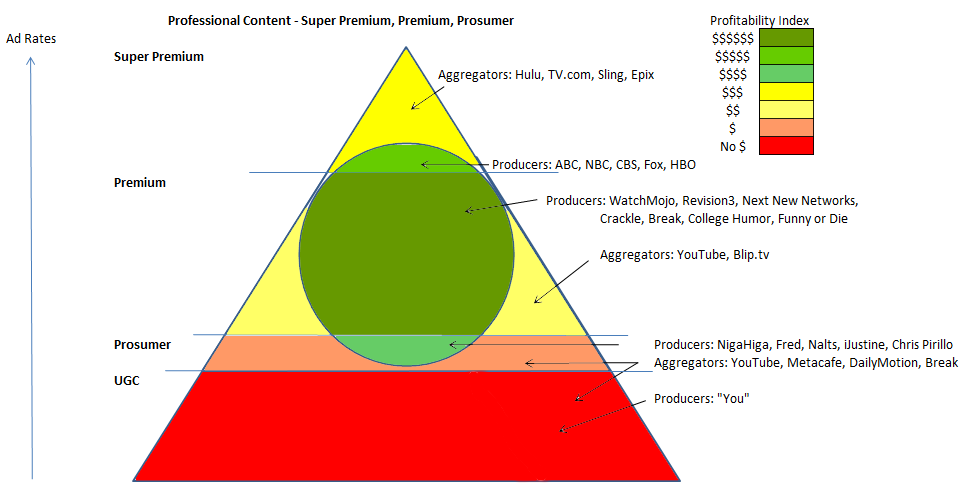
The reason why I place content producers in the highest Profitability circle over time in the first chart above is because only they can build such a business. (The Profitability Index represented in the chart takes into account operating margins and total return on investment, including likelihood of a liquidity event). And, yes, I am completely biased, since this is the kind of business I am trying to build with WatchMojo. Aggregators and networks are solely advertising based businesses; just ask YouTube who generated $10,000 in a paid model test, even though it can generate billions in simpler ways. Video advertising will be a bigger business, but not necessarily a higher-margin business.
Video will be Everywhere: on all Websites
Video on the Web is no longer just about entertainment. It is also about marketing, instruction, and conveying information of all kinds.
- Content bellwether Wikipedia announced it will be rolling out videos soon enough.
- e-Commerce leader Zappos encourages users to submit their video experiences which increase sales 6% to 30%. In 2010, it will create 50,000 videos.
- It won’t be long before organizations feature their accountants, lawyers, management, VCs in videos too.
Video will be Everywhere: in Ads
Videos won’t simply be on all websites; video ads will converge with rich media and display banners. Publishers and ad networks will swap out low yield ad placements for videos that sell at a premium. Rupert Murdoch is right to say that there isn’t enough advertising to make all publishing online profitable, but if you insert a video-enabled ad where a display banner exists today, maybe it will become more profitable, as video rates tend to generate a tenfold premium over display banners. Of course, the flip side of that argument is that if video ad inventory lost all scarcity as display banners have, then it rates would also see a steep drop.
Video is the Anti-Search
Google’s dominance of the Web today stems from a perfect storm. Search benefitted from low expectations. Whereas Google’s competitors threw in the towel to focus on portaldom (or outright handed them the business), online video companies’ war chests seemingly have no bottom as they wage the war for the online audience.
With YouTube being a unit of Google, it’s hard to compete being a pure video aggregator. Those who have tried are flailing badly. Yet video’s expectations have always been high and will only get higher.
History Repeats Itself
Video will follow search in two ways though.
Search is software and Google is the only successful ad-supported technology company. Video is media, which has a natural disposition to embrace ad-supported models. As such, advertising will monetize video streams. In fact, as large ad agencies and marketers shift online, they’ll embrace branding campaigns and push video advertising could eventually top search advertising. Once that starts, online advertising will surpass television, it’s already happened in the UK.
Search for The Leading Ad Format
Everyone agrees that video advertising will be huge but what will the prevailing ad format be?
Stakeholders are obsessed with finding the ad format likely to follow television’s 30-second ad spot and search’s paid listings.
What might lead the way?
Pre-rolls are the equivalent of pop-ups (and mid/post rolls the equivalent of pop-unders) in that users hate them, but unlike pop-ups, I actually think pre-rolls won’t disappear, mainly because
- They’re the most in-demand ad format (according to Brightroll CEO Tod Sacerdoti)
- It is easier to include a pre-roll when you’re syndicating to other websites and platforms (says blip.tv co-founder Dina Kaplan)
- But largely because they’ll get more user-friendly: the 30-second ad will make way for 5-10 second interactive pre-rolls (SpotXchange CEO Michael Shehan).
However, there will always be properties which will forego pre-roll revenue to improve the user experience in order to build audiences, and all else being equal users will migrate to those sites. So I’m not sure the pre-roll will remain all that ubiquitous. The other problem with pre-rolls is lack of attention. When a pre-roll starts, I tune out and look for my headphones or go grab a coffee.
That’s why I like the contextual display banner (and not necessarily the companion banner). A companion banner comes bundled with the video pre-roll, but sits alongside the video A contextual banner comes without the pre-roll. Whereas most banners disappear quickly next to text with one downward scroll of the mouse, alongside a video player, that banner becomes quite valuable and top-of-mind since people are just staring at the video.
We’ve also seen the rise (and fall) of overlays, which is basically an expanded Picture-in-Picture (PIP) format; we know how that fared.
Of course, content producers are also salivating over branded content (more than product integration and product placement, the brand becomes central to the story) or outright sponsorships.
Finally, there’s the Web’s favorite offspring: the viral video. Viral video is not an ad format, of course, but it is not quite branded content nor is it supported by ads. As these become more common, achieving success with content alone becomes a sure-fire recipe for failure. All content will need to be supported by a media buy or some kind of promotional push. After all, on TV you spend millions creating an ad but you need to buy media spots to promote it. It’s not going to be that different online. Yes, it’s a meritocracy, but it’s a loud, cluttered one.
KISS: Keep It Simple Stupid
There won’t be a single dominant ad format but the holy grail will prove simpler than expected. It always does.
Remember Don Lapre’s infomercials? He would go on and on about placing “Tiny Classified Ads” in newspapers. I never thought much of those ads until Google’s adoption of (essentially) little text ads next to search results led to their explosive growth.
Sometimes in business, the solution is simpler than you can imagine.


“Ten years ago, web companies didn’t generate much revenue. ”
You could have fooled me. The NASDAQ in 2000 looked a whole lot healthier than it does today.
10 years ago e-commerce ruled where people actually started companies that sold things for money on the internet.
Today VCs throw anything out there and try to make it profitable by manipulating the data collected.
2000 = a hamburger
2010 = putting the crumbs of a hamburger together hoping to reconstitute something that will keep you from dying of hunger.
To make money you need big clients and a solid pipeline. Britecove is a good example of how to make money in the video CDN world
Plus son of Quebecor, Tyler Cavell, already tried this.
http://www.crunchbase.com/company/mediascrape
He’s in the deadpool now. You can’t keep a company afloat without massive contracts. That’s actually how Britecove does it. The NFL, Regis and Kelly ect… Whether the services are worth it or not, you have to bring in the profit which is overhead.
To have a good idea, or a good model is meaningless to executives who strike deals. They don’t give a flying crap. I hate to break it to most people but that’s how the hamburger crumbles.
“The NASDAQ in 2000 looked a whole lot healthier than it does today.”
THAT is your counter to “they didn’t generate much revenue”? Hello, Big Bursting Dot-Com Bubble.
Actually even on youtube you could create money online, although with a caveat that you also need to obey their unusual-ever changing rules/policies else your channel will be banned. The latest on youtube is here: http://bit.ly/youtube-URL-shortener
Good post. I posted my take over here:
http://blog.brightcove.com/en/2010/02/topic-how-make-money-online-video
Jeff Whatcott
Brightcove
Sorry Jeff, but this post did little more than state the obvious. The reason why he, and brightcove for that matter, will not be the next “google” is lack of innovation. You guys are just hammering out the same tired ass bullshit, and nobody is buying. Try to use your mind to go beyond established convention. Thank God you weren’t there working with the Wright brothers, or we would still all be riding bicycles.
Very interesting article! Thanks for the insight!
Nice take on this whole video thing. Great article
Nice article. Thanks.
The Hulu is “any but certain” links are to 2007 and 2008 articles so a little dated, but not sure if much changed. There was a businessweek article a few months ago that provided some insight into their plans including a subscription model without ads for paying users and use of targeted ads for free use.
Seems like there’s a trend making content king again with some paywalls going up, some of the acquisitions (Comcast NBC), Hulu considering subscription, EPIXHD being launched by content owners, etc.
Regarding the subscription models, there will likley be a lot of push back from those used to getting everything for free on the internet. But if the subscription monetization allows for better content generation, might work.
I recall seeing an interview with John Malone about the doubts raised when they started pay cable (“You expect people to PAY for tv?”). I also remember a friend once telling me with 100% conviction that his subscription to HBO was the best value for the money in his opinion. Content is still important and if good enough people will pay, even if on the Internet.
Isn’t it ironic that an Iranian is teaching people how to make money from online video?
Youtube, Hulu, MySpace, Facebook all haven’t make a dime from online video yet, even given their volume economics. Youtube is close, given another year, they will break even.
The only people making money from video today are porn aggregators who embed malware, or premium video aggregators who charge a monthly premium: Netflix.
Nice to see an article, that is thoughtful, and covering the space. I cannot speak officially for BrightRoll here. I just wanted to give a quick kudos and then wait to join any discussion that ensues here in the comments.
cheers, dru
This is why I rarely produce stuff on Youtube anymore. Even though my videos had a good amount of views (30,000+) and good ratings (4+ stars each), they translated to almost no website traffic off Hulu (this was back before Annotations…each video had my web address either before/after or as an overlay). Also, Youtube is a total **** when it comes to letting non-premium accounts customize their channel or pages, so even if I wanted to put custom ads/artwork/etc. on my stuff, I couldn’t (unless I had a large amount of regular traffic first).
Also, I considered myself a pretty creative guy and did a lot of game review/discussion videos back in 2006-2007. I used After Effects, Premiere and other professional tools for my videos and for the time, they were leagues better than the typical “point webcam at self and record” junk.
In short, the amount of time and energy it takes to do ANYTHING video related just isn’t worth it whether you’re speaking in actual ROI with money or even just regular web readers.
I also tried using “paying” video sites like Revver…but after having a few videos on Revver for almost a year and getting a couple thousands views I only earned like 3 cents. Meanwhile, people who were posting copyright-infringing movie/videogame trailers or anime were raking in hundreds of dollars in video revenue. Again, not worth the effort/hassle.
Pretty nice article Ash
Totally agree , thanks for this article :)
maybe youtube should let audio feeds as well because video just eat too much bandwith..
but hey,maybe p2p technlogy solves that
You can post audio to YouTube. You make a video file, using a black slate for video but using your audio.
Hi Ashkan,
I’ve really enjoyed your series of posts and thank you for providing your insight into online video.
Mainstream online marketers are always a few years behind their counterpart in online porn industry. Who knows how many marketers are visitng YouPorn to learn how to monetize video.
Remember back when Yahoo paid over $5 billion for broadcast.com? Now the domain just redirects to yahoo’s homepage.
I disagree with the assessment of where the profitability band exists. The companies in the dark green band are trapped BETWEEN a “volume” and “quality” quality model: between LOST and Demand Media – it’s a slow death in the online video market of today because you can’t find sufficient repeatability in a core business.
Thanks for the feedback and fair observation, however, one remedy or counter to that is producing evergreen / timeless content, which over time remains relevant and gains value. This was covered in Part 1.
I’ve really enjoyed this whole series from Ash. Great insights.
I wanted to add one thought to his recommendation to independent producers who, as he pointed out, might not have the resources of Next New Networks. We’ve recently opened up our platform to independent producers with creator-owned content who want to tie into our systems for distribution, promotion, and advertising, a program we call Next New Creators. Big success stories so far — people who are making money and getting millions of monthly views for their content working with us — include The Gregory Bros (“Auto-Tune the News”) and Grace Randolph’s show “Beyond the Trailer.” We help independent producers get a quicker path to revenue in a few ways:
1) Building their viewership and audience. This leads directly to increased revenue through our direct ad sales, and AdSense and YouTube direct sales revenue through the YouTube Partner Program, which we work closely with for all of our series.
2) Connecting them with branded entertainment opportunities. Our nBot Studios division has produced branded series with companies like American Express, Intel and ASUS, Samsung, and Dice.com, with a lot more on the way in 2010, and we go to our network of Next New Creators first for producing and creative talent.
3) Optimizing their creative. We help creators get ready to make more money by building sponsorship opportunities into their series, creating marketing materials for them, getting them resources to streamline their production costs, and putting them in front of top sponsors at events like Digitas’ NewFront.
There’s a big opportunity for everyone — advertisers, distributors, and creators — to build a sustainable revenue model for all of the amazing new shows emerging on the web. We’re working hard with partners like YouTube, Freewheel, and agencies like Digitas to help make it happen.
you can get the best chance make money from online here
issty.blogspot.com
You can also read about how to make money in online videos here: http://www.thehdstandard.com/general-discussion/how-to-make-money-with-online-videos/
Catalin
Professional Streaming Consultant
Great article and recap of video for the online marketer.
Thank you.
Jesse Guthrie
Glad to see the startup we just launched is in the green circle.
We believe there is an opportunity to selectively aggregate premium content — and especially so in selective interest areas. We’ve chosen automotive. Our model reimburses premium content producers and distribution channels (rather than charging them); relying entirely on ad revenue. Reception has been excellent, as we’re already feeling pressure on inventory.
Ash, thanks for these articles. To clarify one point, if you’re syndicating content to a variety of destinations (as blip.tv does), you need to focus on in-stream advertising, whether that’s pre-rolls, overlays, post-rolls or interactive bugs.
In terms of monetization, it’s all about your margins. I wouldn’t necessarily place producers (although you did admit your bias) over aggregators, because it depends on whether you’re able to command premium CPMs, whether advertisers trust your content is safe (and that you have the reach to make a buy worthwhile), and what your COGS are and how much control you have over managing them.
If you can manage your costs (and bandwidth prices are continually going down), command premium CPMs and continually increase your reach and percentage of monetizable views, there is a good business to be made in online video.
And, it’s worth noting that online buys can be much more efficient, targeted and measurable than TV buys. That’s why we’re seeing some movement of TV dollars over to Web video – and even a tiny percentage of those dollars shifting will make a big difference to the networks, and to online publishers.
Great comments, Dina…
All great points. To clarify:
- The Profitability Index captures
a) Profit margin on operations,
b) Total Return on Investment as measured by income and capital gain,
c) Likelihood of positive Liquidity Event.
Only the #1 aggregator/network has real value, though the #2, 3, etc., content producer can still have a lot of value to a would-be buyer.
I think the bigger threat for networks is that you are always at the mercy of a publisher pulling inventory away and giving it to someone else, and over time, this reduces margin. Also, don’t get me wrong, the #1 network (be it content or advertising) is an absolutely kick ass business, but it the odds of being #1 in those spaces is risky.
Ash
The web has become a market for everything. Just the other day I came across this website http://www.HowtoseduceAmarriedwoman.com and realized that there is nothing that people will not try to sell.
This is just a replacement of traditional media. So revenue will most likely come from advertising.
Wow, that is probably one of the best articles I read about making money online with video. Thanks for the great info.
Mkay I was already quoting Ashkan Karbasfrooshan in my talks and in my book. But now that I’ve made his pyramid chart, I’ve now got a Karbasfrooshan doll hanging over my bedside.
BTW- a better format than preroll… a midroll. GIve the show/creator about 10-20 seconds to lure the viewer in before shoving a forced ad in their face. My prediction would be that more people would adopt that, and the dropoff would be lower.
We’ve done midroll campaigns with lots of major advertisers including Warner Bros, Starburst, and Microsoft. It’s incredibly effective, for just the reasons nalts says — one of the great things about online video is we can track playthrough and show that the midrolls were viewed — and while we don’t have enough data yet of dropoff from pre-rolls vs. midrolls, we can say that videos with midroll advertising do not seem to have significantly more dropoff than videos without, which is great. Many of them actually have higher engagement and completion rates.
YouTube doesn’t support dynamic midroll insertion yet (we place dynamic pre-rolls and post-rolls on our YouTube videos through our integration with Freewheel), but we currently have it as standard video unit available on all Next New Networks sites.
good post,
show this article
Apple ipad -complete report and review
http://www.xomba.com/apple_ipadcomplete_report_review
Loved your post, Very interesting, just tweeted.
Why is it that consumers wont pay for valuable content online?
People make content that people want to watch. If the content is valuable then audiences are built. If audiences are present then valuable content can be monetized.
Here are a few reasons why online is certainly the way to go today.
http://blog.youcastr.com/7-reasons-you-should-be-selling-video-online
There is a very good way to make money online in a 100% legal way. I will not explain everything here, but I can tell you that I did it myself and are currently making a descent amount of money. I a m not a millionaire, but if you have a lot of contacts, you might make even more money than I do.
Oh, and if you do not even want to make money, it is a good service. Too mysterious my post, well, that is the intention. For more information watch this video, they explain it better than me david-rivera.ws
thanks a lot . very nice post