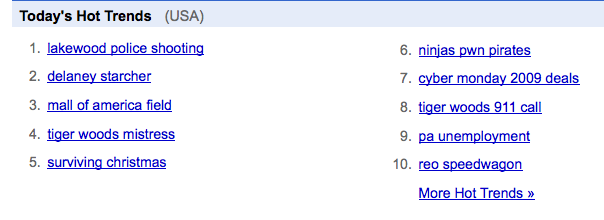
Whenever you want to take a reading of the current zeitgeist, popular search terms can tell you a lot about what’s on people’s minds. Right now, for instance, the hottest search terms on Google Trends include “lakewood police shooting,” “tiger woods mistress,” “surviving Christmas,” and “cyber monday 2009 deals.” If you look at Trending Topics on Twitter, however, you’ll see “#isitme,” “Google Wave,” and “Soul Train Awards.” I suspect only the last one might make it as a trending search term.

The overlap between trending search terms and Tweets is remarkably low (even if Twitter itself is a popular search term). A couple weeks ago I was moderating a realtime search panel when Vik Singh (the engineer behind Yahoo Boss, soon to be an EIR at Sutter Hill Ventures) declared that only 2 percent of all Tweets match trending search terms.
His stats came from an analysis of 10 million Tweets he crawled last summer. He looked at all Tweets, not just trending topics. When he stripped out the non-essential words, he found that the average Tweet consists of 6.28 terms, or the equivalent of a really good search query. But there is not much overlap between what people are Tweeting about and what the general population is searching for. Maybe that is because people tend to search for what they don’t know, whereas they Tweet about what they do know or think they know. Or maybe it’s just because people on Twitter are not normal.
Some other data Singh found:
- Percentage of Tweets with URLS: ~18%
- (Percentage of those which were unique URLs: ~65%)
- Percentage of messages @replies or other @x terms: ~37%
- Percentage of messages with #hashtags: ~7%
- Percentage of messages with retweets: ~1%
Again, this data is based on a crawl of 10 million Tweets, but those Tweets were from the end of July, which was way before Twitter made retweets an official feature of the service. So I’d be surprised if the retweet rate is still so low. There are also a lot more people on Twitter now, so maybe the subject of people’s Tweets now overlaps with search trends more than the 2 percent Singh found. It would be illuminating if someone ran the same analysis today. Until Twitter becomes a daily habit for everyone on the Web (not just tech-heads and other early adopters), Tweets will not reflect the general zeitgeist.
But it does already reflect the zeitgeist of the people you care about and follow. And maybe in the end that is all that matters.


Wouldn’t that be a good thing, since if they don’t overlap, then Twitter has a unique trending ability–the trends of what people are talking about, not what people are searching for (similar to what is stated in the article). That can be give a fuller picture to the rest of us who want to be up to date in our hottest topics! Plus the google search trends are more news media driven, such as seeing the news on Yahoo and searching for it, rather than what people want to talk about on their own volition.
Yes, it’s a good thing. I have compared twitter trending topics, google trends and yahoo buzz for months using my web2express real time analysis system. It’s clear that the trends from the three main sources are so different that they are not comparable. This is not a surprise at all since their data sources vastly differs. Their methods for determining trending topics are presumably not comparable either. Twitter has grown into a strange animal with authentic conversations, commercial messages, spam, and poisonous hashtags. Because of the high noise auto-discovering trending topics from tweets is a challenge.
This is exactly the kind of thing Twitter should be blogging about on a weekly basis, and how they’ll improve it, plans for the future, etc. It boggles my mind that Twitter’s front page doesn’t have a link to their blog (or anything else that’s theirs) for that matter.
Google Wave has been on Twitter Trend for non-stoping 1 month!
Twitter ranks what people talk about.
Google rakns what people want to find out.
Is it really so hard to understand people don’t talk about most of what they want to find out?
But if I need to bet, I would bet Google is more restricted and the list is not very precise.
well said.
i would also like to mention that twitter top trend is mostly spam.
This is exactly why the argument that twitter is a news source is flawed.
It’s like relying on pundits or columnists for real news.
Twitter is commentary that has the occasional newsworthy fact slipped in.
Excellent point. Watching the Social Media sect go on and on about Twitter is watching plumbers go on about a wrench. Its highly likely that the only time Twitter, the phone lines and the news channels are in sync is when something large enough happens to hijack the average person’s attention and matters to most. Being in tech, I’ve had people ask me what was Twitter and even who on earth is Perez Hilton. Every time I get these questions, its not because they were just on Twitter. Actual news cycles can preempt any channel and will make their way to Twitter. The reverse is not true, exponentially.
check out yourself: http://bit.ly/19cv4p Google vs. Twitter search
Twitter’s trending topic are pretty inaccurate in terms of what’s popular on twitter.
Either they’re pure spam (the guy supposed to moderate them is at lunch / sleeping / it’s the week-end), or out of sync with what’s actually happening on twitter.
Tiger Wood’s crash became a trending topic like 45 minutes after it should have. This is the average time for the intern moderating trending topics other there to react.
gotta say, just based off personal experience i disagree with this. out of those 10 google hot trends i’ve seen TONS of conversation around #1 (I am from seattle) and #4/8 from people i follow.
i agree that lots of twitter trending topics are just spam, and wonder if part of this discrepancy is the difficulty of capturing a conversation that doesn’t use specific keywords like “lakewood cop shooting”
What’s so surprising about this? Google and Twitter are two different “channels”, used for different reasons, by different people.
It is quite reasonable that what people search for on Google and Twitter trending topics are vastly different. Right now, there are a sea of students preparing to put the finishing touches on term papers and the like as semesters end. Are they more likely to use Google/Bing or are they actually going to use Twitter as a source?
No surprise. I do think they should rename “Trending Topics” to something more honest though.
“New CD Release Sponsored by Said CD’s Label”
“The Latest Reality-Show Hype-Producing BS Sponsored by Said Reality Show’s Network”
“Pointless Memes the former Myspace Kids are Tweeting About”
Did I miss any?
The Twitter data was all collected LAST summer? With the enormous growth Twitter has experienced since then it’s hard to put much stock in these numbers, especially those stats about retweets and links… elements that have become easier to do in the last year and have surely risen in use.
It’s for summer 2009 not 2008
Offcourse i believe the usage of twitter is far different the usage of google. So there seems to be no surprise in varying trends on twitter and google
Not sure I get the whole point about the study:
How does the author expand the length of the queries? It looks like he combined the trendy keywords from google trends. Which means he searched twitts containing at least any combination of two trendy keywords? It would be like searching for twitts related to “chelsea clinton” and at the same time to “tiger woods”.
Not surpising that “only 2 percent of all Tweets match [multiple] trending search terms [at the same time]“.
Promster
No that’s not what the blog post says, he did “query expansion” a search trick to expand the context around an individual query so that the length is as long as the size of a tweet so the lengths are more even. Then compared each tweet to each query separately, counting the query matches. Also, it says matching “tokens” or individual words, not combinations of 2 words.