I have to hand it to Ning – it took them well over a year after their initial beta launch to fulfill their promise of allowing “anyone” to create social applications, but they’ve done it. Ning relaunches tonight with new functionality and an interface that allows even the most novice of web users to create their own highly customized social network in moments. The site has been down most of the day – the new stuff should be online around 10 pm PST.
Until today, creating new applications in Ning required at least some programming knowledge, unless you simply cloned an existing application. For the first few months after it initially launched it was so hard to use that basically no one was – I called it a dead application. I’ve softened on the company since then, giving them their requested time to fully bake the service. After seeing a demo earlier this afternoon, I’m now willing to offer a full mea culpa. The new Ning is an impressive and useful service.
The New Ning
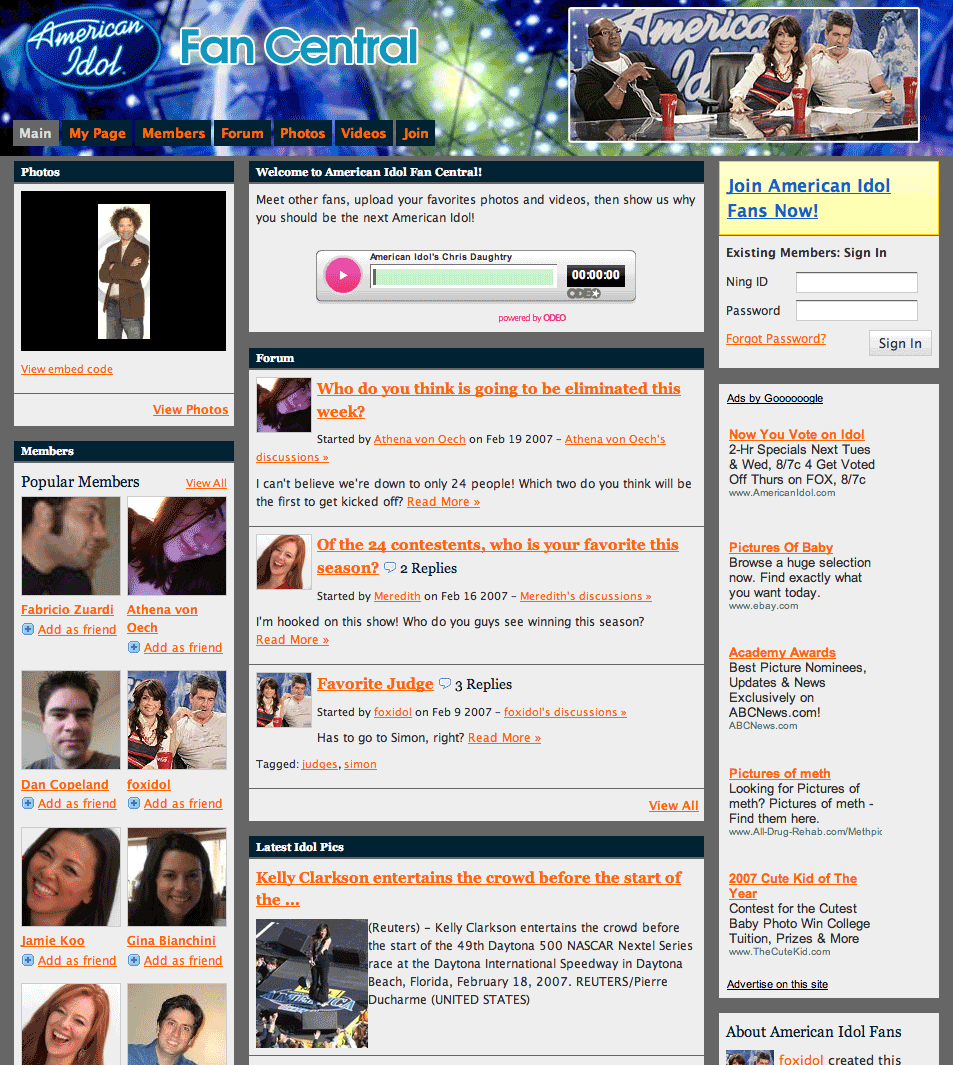
Ning can be used to create a fully functional and customized social network in minutes (click on image to right for larger view).
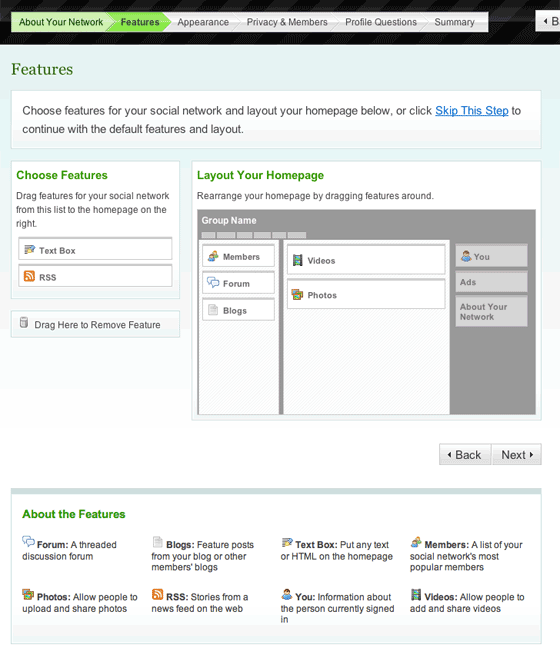
There are some screen shots included at the end of the post showing the app creation interface. The first step after naming and describing the new application is drag and drop desired modules- such as text boxes, RSS feeds photos, forums, blogs and videos – into the application in the area you want them. Adding the “members” module, for example, shows a list of the networks most popular members within that module.
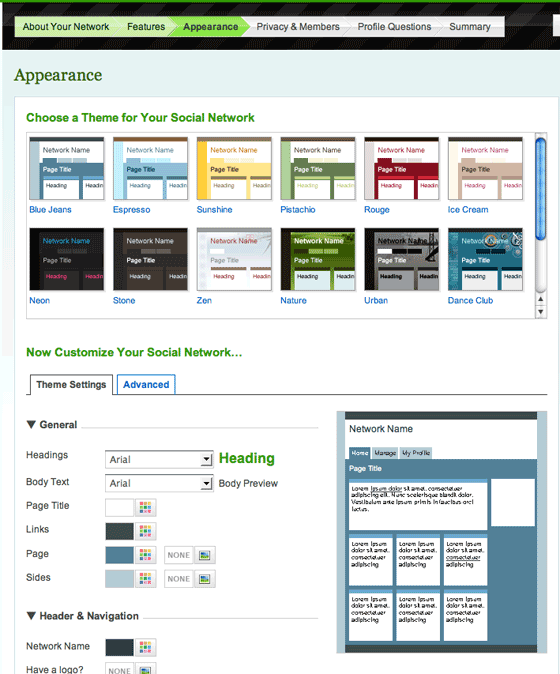
Customizable themes and templates can then be applied (again, by clicking and dragging, no coding), a logo uploaded, etc. The creator decides if it is a public or private network, and member profile questions can then be added.
For users who want to do more customizing, CSS and HTML files can be uploaded. Very few aspects of the application are not customizable.
The application is then ready to launch. It’s completely free, and Ning offers a la carte upgrades like the ability to add your own Google Adsense code for $20/month, and domain name aliasing for $5/month.
Even before today’s launch, Ning CEO Gina Bianchini says growth has been strong and steady. Nearly 30,000 applications have been created to date, up from less than 5,000 a year ago. Page views have been spiking, reaching 20 million per month, 20x traffic a year ago. Unique visitors have reached nearly 5 million per month as well, 10x a year ago.
The company remains privately financed, mostly from Marc Andreessen, who’s put $9 million or so into Ning to date. The company has 27 employees and is headquartered in Palo Alto.
Screen Shots of the creation interface:


When I first looked at Ning several months back every tool I created would have the name Ning on it somewhere. Maybe they will allow for better branding this time.
The Ning logo can now be removed from the top bar as well. Totally optional.
I am really excited to try this out. Looks very promising!
Boy, thats some serious power for novice web entrepreneurs. My web agency has already been receiving dozens of requests to “build a myspace”, I guess now I can just pass them off to Ning
The problem I see with Ning is that for anybody serious about building a social networking venture, the lack of control and ownership is a big problem. The value in any social network is access to and ownership of the userbase and data and this just doesn’t give you that.
This is great for local organizations, a church, your average enthusiast, etc. but I don’t see many entities with the resources (or desire) to build a large social networking relying on this. I consider Ning to be the Ezboard of social networks. For those who are unfamiliar with Ezboard, it’s a service which enables anybody to set up a free message board. I have seen some of Ezboard’s most popular communities migrate away to their own platform because the ownership, full control and flexibility needed is just not available in a solution like this and once you get big enough, it doesn’t make any sense to outsource your fate.
Another question about Ning is just how scalable it is. That is, if I am able to build up a huge social network on their service, what can I expect in terms of reliability? What’s the biggest social network created on their service?
Hey Drama,
Thanks for your comments! We’re seeing individuals, start-ups, and large media companies using Ning today. For a few examples of large media companies using Ning today, check out http://keppler.cbs.com and http://theclass.cbs.com. The Keppler video site for the show CSI is actually the first site created by CBS that enable fans to post their own videos.
As for scability, one of the reasons that we’ve taken the time to quietly build out Ning is so that our platform and infrastructure scales. At this point, we’re horizontally scalable to support a social network that takes off and becomes huge as well as many social networks taking off at the same time. At this point, it’s a matter of quickly adding more servers. While, like any service, we’ll run into hiccups along the way, we’re confident that we can meet demand.
Again, thanks for the comments!
#5 says “I consider Ning to be the Ezboard of social networks”
Well, I was going to say it could be like the YahooGroups of social networks
But then, so what? Have you looked at the numbers from ezBoard or YahooGroups? I know ezboard handles millions of users. About YahooGroups, do we need to get into that? If it doesn’t handle over 100 million subscriptions it doesn’t handle any.
I don’t use Ning but it’s one of the few projects that when I saw it I was like “ok, if they execute and deliver, this can be big”. It has everything I love about a service: it’s simple, yet complex inside, and above all, it’s a very useful community building tool. It makes Vox look like.. whatever.
There…
This is pretty cool. I know a few people running phpfox and Ill have to point them to this. Pretty soon social networks may be a ‘feature’ of sites as they become more popular and grow into more verticals, it would be nice to tie all these in with OpenID somehow to leverage all your networks.
The service looks quite promising can’t wait to try it !
Drama,
Marc understand ops management and scalability better than most people out there. You can’t build Loudcloud/Opsware from the ground up and not be a wizard at that.
I found what they are doing with movies/shows/events particularly clever approach to adoption.
To me, the ability to create your own “social network” seems like forum 2.0 or boards 2.0.
It’s not a bad idea, wikipedia claims “ProBoards forums receive a total of over 500 million pageviews per month, making ProBoards one of the largest (websites) on the Internet.”
So, I expect this is what they’re after, a distributed set of social networks with advertising laced throughout. However, I think new webapps need something beyond the social network to be the next “killer app.”
I agree with RBA, for developers this is something we should watch
I agree with the comments above by Drama 2.0. Control, scalability, added functionality and control of your social network is fairly important. I’m looking forward to this product in great antisipation.
Especially as a Corporate Social Network Software provider in the UK !
Idea is really cool but I agree with the other fellow reader that you don’t have full control. For example, if your application requires you to run a background process or you want to keep user data private without exposing it to any 3rd party.
Let’s see, how many serious application will be built on Ning.
Hey there Saket!
Depending on how you define “full control” it might be that the only way that you can get the level of control you are suggesting is to develop your own application, on your own servers, with your own code. For the folks who want to do that, we completely understand.
That being said, we’re pretty darn good for people who might not be developers – or even more casual developers – who still want to create social network for their community or as business. You can be up in minutes and then customize and control pretty much every aspect of your new social network.
Again, not the exact same level of control as if you built it on your own servers yourself, but for a free or low cost service (if you want to take advantage of our premium services) I hope you’ll be pleasantly surprised.
We should be up and running with the new version in the next bit. We’ve decided to add a few more features to it tonight
Thanks!
silk icon set ftw
RBA: Don’t get me wrong, I think Ning itself could become a good business, however you’re not going to see the next MySpace or Facebook being built on it. Ezboard, to my knowledge, makes the most significant portion of is revenue charging for its premium message board services, but if you go down the list of message boards they host, you’re not going to find the crème de la crème of the message board world. They have impressive numbers but it’s distributed across thousands upon thousands of message boards, many of which have few users and are entirely inactive. As I noted, I know of a number of popular message boards that were started on Ezboard and once the creators saw that they had a valuable community, they switched over to a platform they had full control of.
I expect the same thing to happen with Ning. Ning might one day have 50 million members across all of its social networks but you’re probably not going to see a single social network on there with hundreds of thousands or millions of users. If you have the ability to build up a social network of that size, you have a real business opportunity and having to rely on something like Ning, which doesn’t give you unfettered ownership, access, control and flexibility, will destroy that opportunity.
I’m sure some of the people here are familiar with cheap social networking scripts like phpFox. In essence, Ning is a hosted platform like phpFox (probably much better). But the question is: have News Corp., Viacom, Google, et. al. ever expressed any interest in buying a social network built upon some licensed technology. If you intend to attempt to build a valuable business around social networking, owning the technology platform it’s built on is crucial in my opinion, even if the technology platforms have become commoditized. Also note that it was reported that NBC passed on an acquisition in the space because they weren’t convinced that the acquisition target’s platform was scalable, and it’s difficult to impossible to control scalability when you’re reliant on something you didn’t build or don’t own (unless it’s a licensed solution from a solid company and has been widely proven).
Conclusion: Ning will appeal only to small users (local organizations, hobbyists, etc.). It looks like they could do very well with this market and I wouldn’t be surprised to see this evolve into a business like Ezboard’s. Solid business, not incredibly sexy.
People Aggregator is still better IMO
Nice to know other companies take a full year to get to the next version
haha, they have a pic of the ITV-digital monkey on their holding page!
Ning is great stuff, these guys are rockin’
Saket — thanks for the comments — actually on Ning you can both run background processes (bots) and you can keep data private. In addition, *all* of the functionality is exposed through web services API’s plus an integrated PHP runtime so you can script any functionality you want that we don’t support either on Ning or on any other server (via web services).
Is it wrong to openly wonder about the stats of 20 million page views and 5 million uniques a month? Hey, anything’s possible I guess, but for a company that’s mentioned pretty much nowhere anymore (and really never was), that seems awfully high.
Drama — thanks for your comments — actually we are shooting for something very different than EZBoard. We’re building a full platform — completely programmable in every respect. More like an online operating system than anything else, actually — just focused on powering social networks.
When you look at it like we do, the “build your own social network for anything” version we’re releasing tonight — while killer for ordinary people, we hope! — is just one program (written in PHP and Javascript, calling the Ning web services API’s) that can run on the platform.
The platform is providing, via those web services API’s, all of the key functionality — friends, messaging, user authentication, content management, search, tagging, video, photos, mobile uploading, etc.
The point being:
* We can build on that platform — and we can add features on it very rapidly from here on out.
* Anyone can customize any aspect of what we have built, by diving into the PHP and Javascript — although we also provide many ways for ordinary people to do customization via point and click, and also provide easy access into the HTML and CSS for people who prefer that.
* Anyone can build any new application using our core services — that application can either run in the Ning environment (our embedded PHP runtime) or outside and just use our web services API’s.
The result, we hope, is that if you are an ordinary user, Ning looks like “build your own social network for anything” with point and click, easy as can be. If you also want to customize it with HTML and CSS, you can do that. And then if you’re comfortable with code, you can go wild and do anything you want in the PHP and Javascript or via web services.
Mike: I’ll have two videos of Ning (Gina and Mike) up on ScobleShow.com in a few minutes. At 5 a.m. we’ll have something fun from ClipMarks too.
Edwin — thanks for the kind comment! — on that topic, we also have a killer team of ops talent, including several Loudcloud/Opsware alumni.
Re “serious applications” — we certainly hope to be able to support serious applications well (including at scale), but a big part of the point of what we are trying to do is that there are many, many, many applications/social networks that are *not* serious — those created for fun, for love, for enthusiasm, or just for the hell of it — that should be super-easy to tilt up and run in a couple minutes with no coding (or lots of coding, if you want!).
I’ve always loved that the web evolved into millions of web sites — many deeply unserious
— and with Ning we’re trying to do the same thing for social networks of all shapes, sizes, and descriptions.
Actually, the video is up. Demo video coming shortly. http://www.podtech.net/scobleshow/technology/1372/social-networking-with-ning-version-20
Hi Mike D!
Another other way to look at the statictics and their context is this: we have grown organically even when we’re not “mentioned pretty much nowhere anymore (and really never was)”. That was by design (which does not imply stealth madness; we’ve been live and open to the public for well over a year). We wanted to have the time for the platform to mature. We needed to worry about the right things at the right time: features rather than growth. The features are there now (and will continue to be added in the near future at a rapid clip). Now that we have a base feature set that we believe is solid and that we (and the community) can build upon, we’re ready to grow.
-Gerir
Here’s the video demo (Gina rocks!!!) of Ning 2.0: http://www.podtech.net/scobleshow/technology/1373/build-your-own-social-space-with-ning-version-2