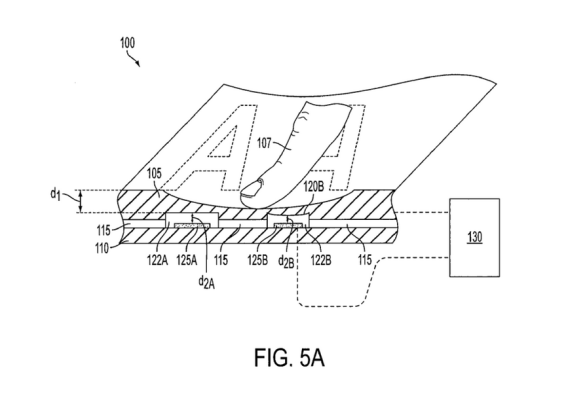
Apple received a patent from the USPTO today (via AppleInsider) that describes a technology that would allow device casings to employ a combination of pressure and capacitive sensitivity to detect input. At the very least, the tech could be used to map functions like those Apple currently assigns to the home, power and volume buttons to areas of an iPhone or iPad’s bezel.
Other uses for the patent, which was originally filed in 2009, are described by Apple as a backup or alternate input method for when standard capacitive-based touch interaction either won’t work or is impractical. Capacitive input, the kind used in the iPhone’s touchscreen currently, is much more accurate and responsive than resistive input, but it doesn’t work when wearing gloves, or when there’s sufficient grime on a screen, or when unwanted input signals are coming from a wrist resting on the display and confusing the sensors.
Apple’s system is proposed as an alternative input mechanism for those kinds of situations. And since it’s not exactly a traditional resistive (pressure-only) resistive input method, it could also use capacitive clues to make it more refined as well as being much more sensitive to changes in pressure than capacitive systems. The combination of both types could guard against accidental input when a device is in a pocket, for example.
As the system could live right in the housing of a device (the iPhone 5’s metal casing would be pretty perfect for it, in fact), it could greatly alter the way people interact with Apple devices. You could put scroll bars on either side of a smartphone, for instance, so that moving a finger or thumb up or down with differing pressure pages through content faster or slower.
The company could build context-dependent controls into the back or side housing of all-metal devices with this tech, or even use it to add input to an iWatch housing. The benefits are mainly that it could provide a way to keep the screen clear, which becomes more important as we move to devices with smaller bezels, or smaller displays in the case of an iWatch.
As with any Apple patent, however, this isn’t a roadmap. But it could be a neat way of adding another dimension of interaction to compete with recent changes from other OEMs, including touch input through gloves and eye movement tracking.