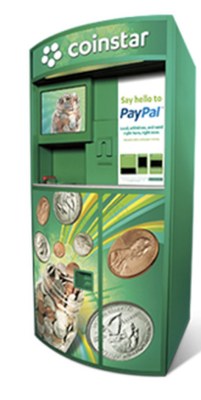
PayPal is today announcing an expanded relationship with Coinstar, the maker of those coin-counting machines that you dump your collected pocket change into, in return for actual dollar bills. Starting with a limited rollout in Texas, Northern California, and Ohio, customers will now be able to use these kiosks to add coins or dollars into or withdraw money from their PayPal accounts. They’ll also be able to use the machines to send money to other PayPal accounts, the company says.
The partnership with Coinstar was first announced last spring, as one of PayPal’s earlier forays into establishing a presence for itself outside our mobile phones and PCs, by integrating with technology found out in the real world.
PayPal originally trialed the machines in the Dallas metro area, installing them primarily in grocery stores. The company reports that consumer adoption grew quickly. According to its early test results, 40 percent of those who used the newly added PayPal feature on the machine returned to use it again, averaging two visits per month.
This is one of many recent moves for the payments company, which has been, over the past year or so, heavily focused on establishing partnerships in order to introduce its service to the offline world. The company has been working with nearly two-dozen nationwide retail chains, including Home Depot, Jamba Juice and more, to be integrated into their point-of-sale systems. It has separately announced integrations with point-of-sale and hardware makers like NCR and, earlier this month, gas station and convenience store-focused Gilbarco Veeder-Root’s point-of-sale system. It’s also running tests with McDonald’s in France.
In all cases, the moves are about making PayPal so ubiquitous that it comes across as just another payment option at the places where people shop daily and weekly. It wants customers to see their options as not just cash, check, credit, debit, but also PayPal, when they go to check out. That’s why the focus has been on integrations with point-of-sale makers and other everyday locales like retailers, gas stations and grocery stores. The company also began selling plastic cards just before the holidays, which allow customers to load up their virtual accounts by paying in cash at a store.
The push to rapidly roll out real-world partnerships on a large scale represents a challenge that other would-be mobile payments or wallet makers will have to combat, most notably those like Google (Google Wallet), Starbucks pal Square, and the recently upgraded mobile payments options from the credit card makers themselves. Mobile wallets have yet to become the norm in the U.S., largely because there are a multitude of options today, not enough support at checkout, and no single player has established itself in the lead. Though Square is seeing decent growth, and Google is expected to have some interesting announcements about Google Wallet this spring at Google I/O, PayPal is clearly ready to compete.