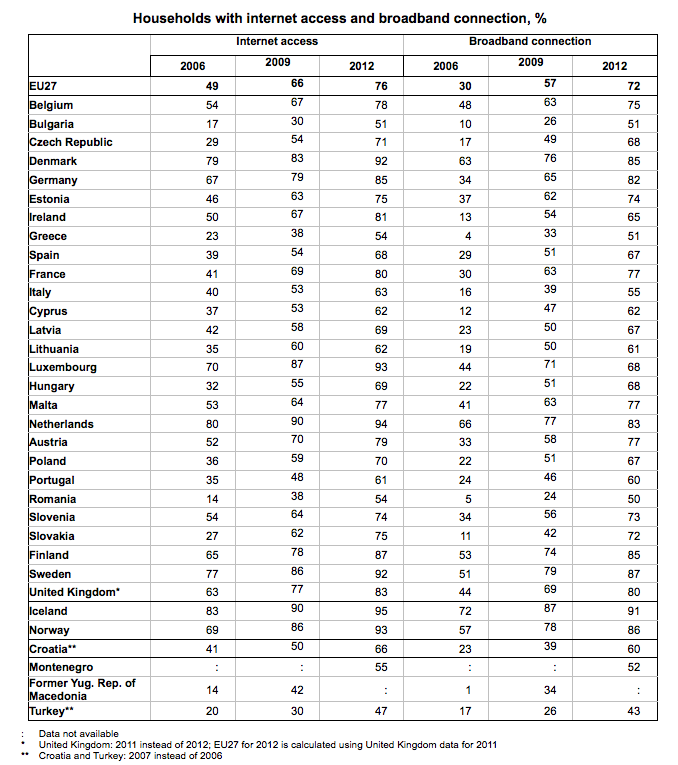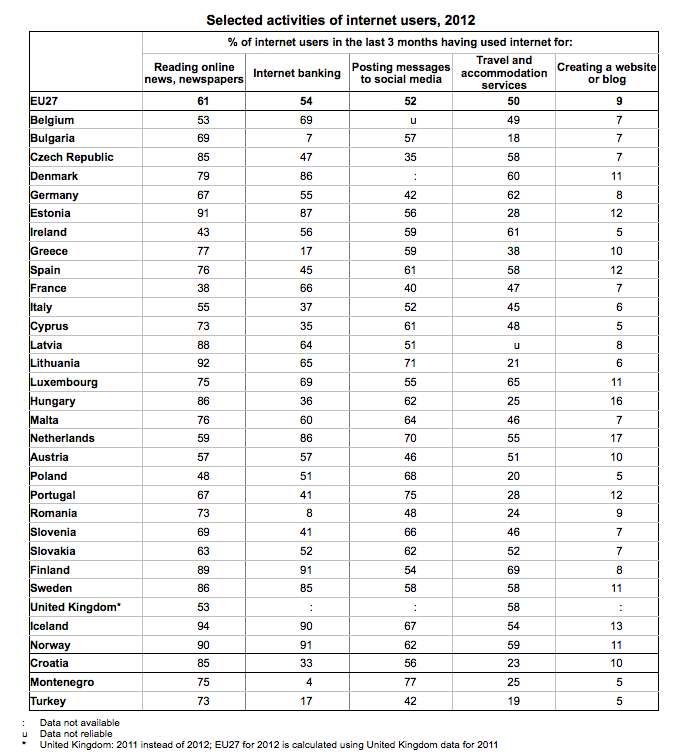
It’s official: Europe is fast approaching a point at which broadband is becoming ubiquitous among consumers, and with it is coming a surge of popularity for online news, social media, and e-commerce. Today the European Commission released details for how European countries have been adopting broadband, and what they are using it for. The top-line figures: in 2012 72% of households now have a broadband connection. And in a survey of what it is that people do online, the most popular activity is newsreading, at 60%.
The stats were released just as Neelie Kroes, the VP of the European Commission, prepares to give a speech in which she lays out priorities for the next year in European digital policy. Topics she’s expected to cover include a 10-point plan for broadband growth; plans for copyright actions; and a new initiative for designing and manufacturing hardware — described informally as an “Airbus for chips” — to rival countries in Asia and North America. (You can watch that speech yourself here.)
The stats were compiled by Eurostat, the Luxembourg-based directorate of the European Commission that provides statistics to EU institutions and also a unified measurement framework across the different member states.
Europe on average has come a very long way in broadband penetration. Whereas in 2006 only 30% of the population had broadband access, now that figure is at 72%. Some countries like Denmark and Finland are now at 85% and significantly no country is at less than 50% penetration.
Social media is one of the most popular categories for online activity. Some 52% of European residents with broadband connections use them to post messages to social media sites. Even more popular is reading: more than 60% of consumers use their broadband to read online news. But, in a sign of how “lean-back” is the order of the day, only 9% of them are creating their own blog or other website content. The figures also speak to platform consolidation online — people are increasingly going to sites like Facebook and Twitter to express themselves, and less so trying to create their own spaces online for the same purpose.
Kroes today is laying out a seven-point plan for Europe’s digital agenda in the next year, which we’ll detail below. But one striking takeaway from Eurostat’s figures is that although we are laying the groundwork for basic broadband connectivity, when it comes to services over those networks, there is still a lot of work to be done. The digital divide is actually alive and well.
For example, take Internet banking. The EU average for 2012, it says, is that 52% of users are now using some form of Internet banking services. But the disparity between individual countries is massive. In Bulgaria, for example, only 7% of consumers use Internet banking. In Iceland, the figure is 90%.
Kroes’ speech, meanwhile, is a culmination of many of the different strands of activity that the EC has been pursuing already this year and plans to make more formal focus points in the year ahead. They range from the generic to new frontiers:
- A stable regulatory environment for broadband. Kroes notes that more private investment is needed to improve broadband connectivity, and take those places where it already exists to the next level of speed. To get that investment, a better regulatory framework is needed, she says.
- Public works. The EC is “eating the dogfood” so to speak, and plans to fast-track requirements for eSignatures, eIDs and, electronic health records in its own services. That investment, it believes, is a mark of how it too is getting behind the changes and investments it expects the private sector to make as well.
- Training and startups. She notes that there is a shortage of qualified people for IT jobs in Europe — some 1 million jobs will be vacant in 2015, it is estimated — so here the aim will be to improve education and vocational training. This is also where Europe is getting behind startups, and will offer some kind of plan to “support” founders. Whether that will come in the form of grants, seed funds, tax relief or something else remains to be seen.
- Cyber-security. Like public works, another example of two-level help. First, this is about the EC creating a framework for how to implement cyber security across the region. Second, the thinking is that this could stimulate more product creation and investment in the area, perhaps from the EC itself as well.
- Copyright. This is a long-term goal, in that reforms of Europe’s antiquated copyright legislation are not actually expected to even be discussed until 2014. For now, it’s about laying the groundwork for what a new copyright system should look like in the digital age. This is of course a huge topic: not only in terms of patents and trademarks but also to help stimulate the content industry, which, thanks to the web, has faced a lot of loopholes and violations of intellectual property rights to date.
- Cloud computing. More dogfood. Europe’s planning a cloud partnership to “harness public buying power” for cloud services.
- Hardware. The “Airbus of chips” is the goal here, dedicating public money to the development of a stronger hardware design and manufacturing operation. Given that it’s taken countries like the U.S. and China decades to develop their own ecosystems in this department, I can’t see this as anything more than either just a nice idea, or a very, very long-term goal.