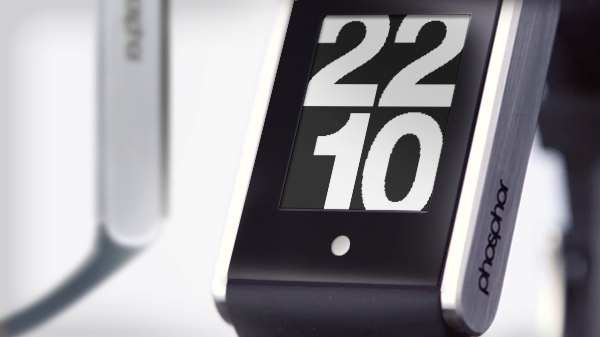
To paraphrase Cracker, what the world needs now is another e-ink smart watch like I need a hole in the head. However, Phosphor has been in this game for years and I’m willing to give them at least the benefit of the doubt. Like the Pebble and the Strata, Phosphor has created a unique, feature-rich watch that adds some very interesting features to their well-known e-ink watch line and ups the ante with long battery life and lots of class.
The watch has multiple “faces” and you can swap them by sliding a finger across the crystal. It runs for a year on a regular button-type battery, so there is no need to charge it.
The watch isn’t “smart” per se but instead is a digital watch with a large e-ink face. It has a world-time function, six alarms, reminders, and a bright built-in LED backlight. It also includes a calculator and lunar information including days to full moon and a horoscope. The watch costs $99 (the $89 early bird discount is sold out). Considering the retail price will be $159 for the higher-end model, it’s a pretty good deal.
Arguably this isn’t as smart as the other smart watches that made ripples on Kickstarter, but I think it’s fascinating that Phosphor is practicing market analysis via crowdfunding. The watch is obviously difficult to build but with Phosphor’s expertise they could have manufactured and sold it just like they sold their other models over the years. By creating this Kickstarter, they’re essentially testing the waters for their Touch Time without having to invest in tooling, production, and distribution ahead of time. They can make just as many as there is demand, which is a real sea change in consumer electronics.