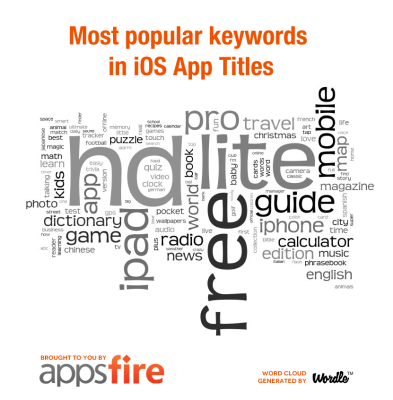
Wondering about which words are the most commonly used in mobile app titles? So was Appsfire, apparently. The company just shot us over the results of a study it ran to determine the top words developers are using in app titles today. While some of the results are obvious (“app” clocks in at number 8 – kind of redundant, don’t you think?), there are still some interesting trends to be discovered in list.
To be clear, we’re talking about titles here, not metadata, and not descriptions. What goes in the title is an important marketing tool, because not only does it help users find the app in the App Store itself, it also helps them find the app later, after it’s installed on their phone. Based on this analysis (a sampling, obviously – not a holistic look at the now some 650,000 applications available on iOS today), you can get an idea about which app store categories are popular, as well as what sort of other descriptive keywords are helping users surface these apps.
One notable thing the company found was that developers are continuing to use the word “free” in their app store titles, even though that’s pretty obvious just by looking at the price. This indicates that spelling it out – it’s “free” – actually helps shoppers convert. Developers also continue to use “Lite” and “Pro” to differentiate between the paid and free versions of their apps.
“iPad” (#4), “iPhone” (#9), and “HD” (#1) are really common, too, as they help app store buyers figure out whether or not the app is going to work on their device. But Appsfire also notes that it may also indicate that developers are leaning towards building specific apps for each platform, instead of “universal” experiences. Only 23% of the total live apps are universal, the company notes, meaning around 152,000.
And now, the complete list:
- HD – 27,777
- Lite – 21,690
- Free – 18,511
- iPad – 11,313
- Pro – 9024
- Guide – 8361
- Mobile – 7695
- App – 6142
- iPhone – 5441
- Game – 5377
- Travel – 4851
- Radio – 4633
- World – 4504
- Map – 4351
- Dictionary – 4220
- Edition – 4198
- Calculator – 4164
- Kids – 3852
- English – 3680
- News – 3611
- Book – 3254
- Magazine – 3009
- Photo – 2957
- Puzzle – 2835
- Music – 2764
Note: the source of the data is Appsfire’s app metadata engine, AppGenome, more on that here.
UPDATE: If you’re interested in these sorts of things, reader Adrien Friggeri shared with us a study he did on the colors of the top 300 icons in the app store.