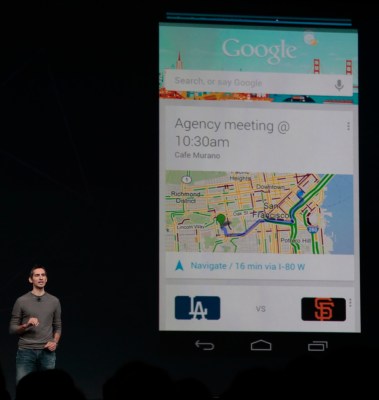
Android users are about to get access to more relevant results and real-time updates, thanks to a cool-looking new feature called Google Now. It’s one of the new features in Android 4.1 Jelly Bean unveiled this morning at Google I/O. Demonstrators described it as a feature that “gets to the right information at the right time… automatically.”
Through Google Now, users should be able to bring up “cards” with relevant real-time data and reminders. Over time, Google plans to add more cards to expand the feature’s functionality.
To explain how it works, Googlers demonstrated how Google Now might assist them in the course of a regular day. First of all, Google Now will remind you about appointments, and then it can use your travel preferences (like the fact that you prefer to take mass transit rather than drive) and real-time data to tell you exactly when you need to leave so that you arrive on time.
Second, Google Now knows that the demonstrator is a Giants fan, so it brings up a card reminding him about an upcoming game.
Third, when it’s lunchtime, Google Now can suggest some nearby restaurants and allows the user to make reservations.
Fourth, Google Now knows about your travel plans, so it can notify you about upcoming flights, as well as delays to those flights. In the on-stage demo, Google Now saw that a flight had been delayed, so it told the demonstrator that he would have time for his normal lunchtime workout.