Editor’s note: Scott Weiss is a general partner at Andreessen Horowitz and the former co-founder and CEO of IronPort Systems, which was acquired by Cisco in 2007.
When I was a kid, I read tons of superhero comic books. I fantasized about superpowers, but the storylines about heroes with massive Achilles’ heels really held my attention the most. They saved the world but had screwed up personal lives, made lots of mistakes, and often acted like complete assholes. In retrospect, I related to their flaws. And, probably not coincidentally, my favorite characters exhibited core weaknesses I had experienced: Spider-Man (immaturity), Iron Man (overconfidence/hubris), and Wolverine (rage). Ironically, when the character’s weakness comingled with the superpower, it would often spur them to succeed against impossible odds.
It was in this context that I was riveted reading Steve Jobs’ biography by Walter Isaacson. Given the number of different interviews and unfettered access granted to Isaacson, it felt like an incredibly authentic account of Jobs’ life. His greatest accomplishments, mistakes, superpowers, and flaws were laid out about as raw as I’ve ever read. Steve’s superpowers were many: He was wickedly brilliant, could see around corners, and had unparalleled understanding of how people interact with technology, to name just a few.
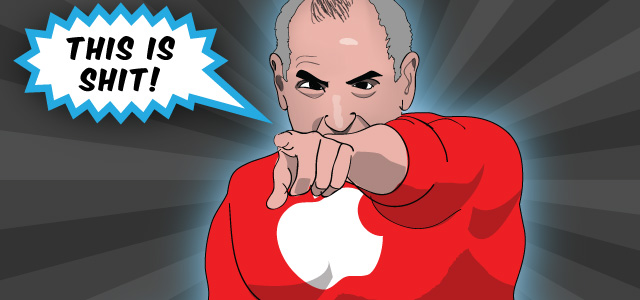
Did Steve have an Achilles’ heel? From the book, one could conclude that he was an extremely demanding boss. Like a beacon, superstars from every function (e.g. engineering, design, marketing, etc.) were drawn to work for Steve. They described his aura as absolutely overwhelming. And Steve pushed these A+ players to extraordinary, impossible achievements. Steve’s drive for speed and perfection often resulted in harsh, public criticism — usually directed at his very best people. Steve would constantly look over their work and declare, “This is shit!” or “This really sucks!” On my Kindle, I searched the words “shit” and “sucks” and counted 24 instances where he used one of those phrases referring to someone’s work/product.
I’ve had a number of entrepreneurs suggest that this persona isn’t unique to Steve Jobs but a common trait among some of the most successful founder/CEOs in the world. Larry Ellison, Bill Gates, Larry Page, and Jeff Bezos have all been reported as similarly caustic at times. Is this something to be emulated?
As I was reading the book, something struck me like a hammer: Despite Steve Jobs’ choice of words, lack of empathy, and sometimes prickly demeanor, he spent a huge amount of time giving his most talented employees constant, hard, critical feedback.
Thinking about how most companies dole out feedback — if they do at all — it’s usually directed at the bottom quartile of performers versus the top. A typical manager at review time spends 80% of their time preparing detailed reviews on the bottom 25%. The top quartile gets lame, short reviews — the equivalent of “You’re doing great, keep up the good work!” So, a manager takes all that time and effort to get someone doing the work of half of a full-time employee (FTE) to do the work of .75 or 1 FTE. In contrast, Steve Jobs — with his feedback energy directed at the top — manages to motivate people already doing the work of 2 or 3 FTEs to do the work of 10, maybe 20 FTEs. Now that’s serious leverage! Could this be a superpower comingling with a weakness?
I’ve found that the A players are comparably lazy with regards to their potential. Without serious motivation, they will never reach it—or even try. Despite his delivery, I believe Steve’s critical energy was directionally correct.
Here are a few other suggestions for motivating top talent:
- Flip the feedback equation to 80% of your energy spent on the top quartile. This is really hard in practice as the feedback is usually more nuanced. And the top performers are usually defensive. ;-)
- Infuse some damn passion. The best people don’t just want money, they want to go on a crusade and make a difference. An entrepreneur needs to constantly re-enroll the troops with a compelling, authentic story of how and why we will do the impossible.
- Set stretch goals and push like hell to meet them. It’s great if these goals have meaning as well — e.g. we need the software release out before a
major industry conference. - Find a bogeyman competitor to hate. (Preferably a company bigger than yours — Microsoft!) At IronPort, we called out our competitors to the entire company and rallied the team to play catch-up. We also gave bonuses to the sales teams for rip-outs of a competitor’s appliance and then mounted them like trophies on the wall.
- Work your ass off by example. A leader who is always present, ridiculously responsive and contributes real, hard work sets the right pace and tone.
A constant challenge for leaders is to find effective AND positive ways to motivate. The very best companies have inspirational founders who have found a way to coax the superpowers out of their top employees. When the top quartile contributes at 5x to 10x, it makes a serious difference.