
Tonight, President Obama will give his 2012 State of the Union address before a joint session of Congress. The annual address, which will take place Tuesday night at 9pm EST/6pm PST (watch it online at Whitehouse.gov here), is expected to include Obama’s mission going forward and his central focus as president, which he’s said is “rebuilding an economy where hard work pays off and responsibility is rewarded.” Coming off the start of the Republican primaries, the heated battle over SOPA/PIPA, and a rough 2011, many will no doubt be tuning in to get a taste of what the President’s future plans are to ensure a “sound economic recovery.”
As this is the final State of the Union of Obama’s first term (and perhaps his presidency), there’s no doubt that many around the world will be paying attention to what the president says tonight. According to ABC, an estimated 43 million viewers watched Obama’s State of the Union last year. Thus, the team behind Babelverse, a European startup that grabbed third place in this year’s Le Web startup competition, announced today that they will translate the State of the Union address into as many as 6,796 languages.
Founded by Mayel de Borniol and Josef Dunne, Babelverse is a realtime on-demand interpretation service, which was born at the Greek tech event Startergy and developed at Startup Chile, a government-backed, Chilean accelerator program, conceived in part by Vivek Wadhwa. (You can read more about what Wadhwa called “Chile’s grand innovation experiment” here.)
The concept behind the application was originally designed as a way to improve communication during international rescue operations in the aftermath of the 2011 Japanese tsunami. Co-founder Josef Dunne said of tonight’s address in a statement, “The outcome of the address has a direct bearing on the lives of individuals across the globe … and we would like it to be accessible to the 7 billion citizens of the world, no matter what their native tongue is.”
Babelverse’s goal is to create a realtime, universal translator, in which people from all over the world can converse in realtime, in their own languages. It’s an exciting idea, and is obviously meant to draw on the story of the Tower of Babel — and Star Trek.
To monetize this service, Babelverse plans to sell realtime interpretation and credit packages to end users and businesses, with the majority of proceeds going to interpreters in order to create an income for those linguists out there, while keeping the service available to all. In December, Dunne explained, “We will not end up like elance.com type websites, where users set their own rates, which leads to a reverse auction, and the tendency is that the cheapest and lowest quality often win. Quality is integral for our business.”
Babelverse plans to incorporate a user-generated ranking system to improve quality of translations, making it clear whether translators are professionals or amateurs. They have a long road ahead, but making realtime translations of the world’s many languages available to everyone, anytime, everywhere, and on any device is an ideal worth pursuing.
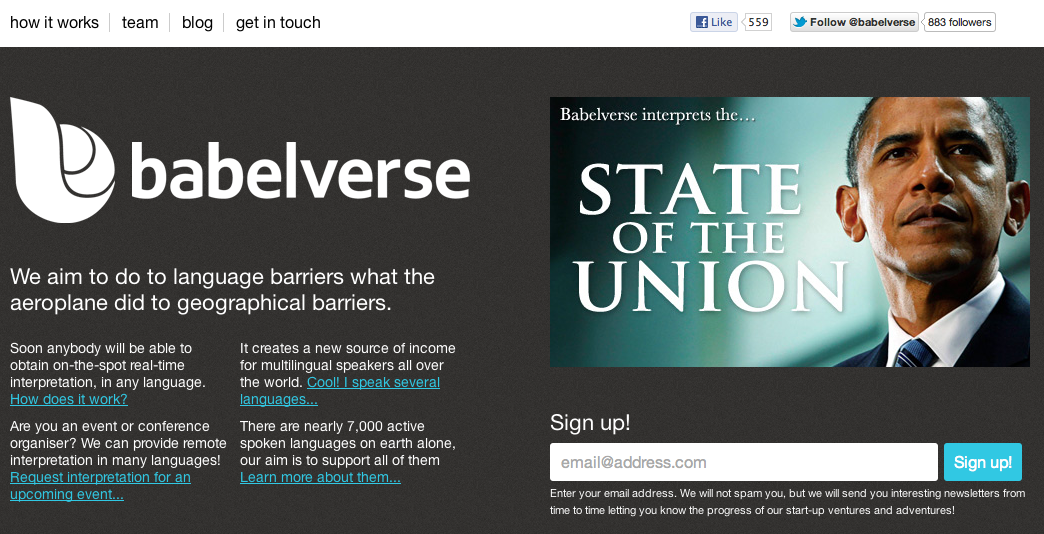
As to the State of the Union, Babelverse is hoping to translate the President’s words into what they hope to be as many as 7,000 languages and will be streamed here. (And English speakers with translation experience can volunteer their time during the address here.)
Excerpt image credit White House (Pete Souza)