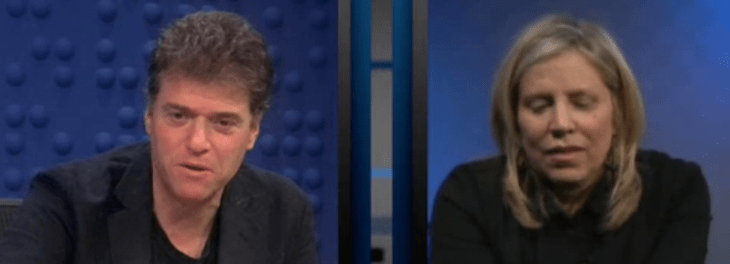
Well, believe it or not, 2012 is just around the corner, and the big question, of course, on most of our minds is, What's going to happen in 2012? To find out, to look into the future, I called up my friend Marian Salzman, the mistress of trends in the future, the woman who every year comes out with her list of trends for the forthcoming year.
Marian, welcome back to Tech Crunch TV.
Thanks for having me.
Well, Marian, can you believe that 2012 is just around the corner?
Yeah, and that means a presidential election, the Olympics, and who knows what else.
Well, who knows? If you don't know, then nobody knows. You... earlier this month, you released your...The Big Little Book of Nexts, in which you predict what's gonna happen in 2012. So, let the Tech Crunch TV audience into the secrets of next year's high and low points. And of course, the major trends that are going to define the year.
You know, one of the things I think is going to happen is because it's going to be a very polarizing year. You're going to have people moving towards an American election, you're going to have people wanting to embrace change. You're going to have people sort of pushing back, saying the Tea Party is one side, occupied wall street's another side, You're going to have candidates emerging, you're going to have people in the community working very, very hard to keep everything very local, because in this country politics is a very local sport.
And you're going to have a national media going at it, but ultimately, the everyday person is going to working their Facebook friends, their twitter followers, Their YouTube followers. And I think that we are in for a very, very rocky day and night 24/7 365 year of mini-crises.
How much more polarizing can 2012 be compared to 2011? It, 2012 could be enormously polarizing, depending on who the candidates become, how dirty it gets, how egregious we allow the privacy debate to become, how little privacy we allow our candidates. If we don't learn to be more coalition like, it could be very, very disagreeable.
But, why more than 2011, in which the political parties seemed to share absolutely nothing in common, and the political landscape was defined by its polarizing quality?
But 2011 has just been background noise, it's just been emotional overload. 2012 is actually a defining moment in history. There will either be the reelection of Barack Obama, which means an affirmation that we are going to embrace the rest of the world, or it's going to be the choice of a Republican candidate, who is going to then drive us to look inwards again.
So, we've already been through the first Red Scare for example, which was the Soviet Union. The second Red Scare, which is the vast investment on the part of China in the US.
And the next scare would probably be to then look very, very inwards, so I think that we're at a real crossroads. So the question is going to be, which side do people vote for?
Isn 't it possible though in 2012, that Obama will be reelected by an electorate that's not massively.
impressed with him, but would prefer him to the Republican candidate, and things would remain pretty much as normal.I think there's a very good chance the will be reelected. I think it's going to come down to how extreme the Republican party goes in terms of what kind of candidate they put forward.
I think that looking at it in December.
2011, in early January 2012, the kinds of candidates they are putting forward at the top of their ticket right now, are probably, have been too extreme, but I think nothing could be better for the white house than a Michele Bachmann or Newt Gingrich. I think as you move towards a John Huntsman, people that are more are centrist.
I'm not sure, i'm not sure, i mean America is exhausted. I mean, Americans have had all their buttons pushed, they're looking for hope in a land of hopelessness.
Well, that's' not very cheerful, Marian.
This is not really the happy season, i can't remember a time when people where this, at the edge.
Could a major political trend in 2012 be a third party?
I think it is going to be a major [xx] I think, one of the big learning may be that we're going to move towards a coalition style government, more like European countries have. I think a new party an independent party could very much be plausible. The problem is, our system right now doesn't really allow for it.
It's not easy for somebody to engineer. I mean, we've had Ralph Nadirs in history history, we've had John Anderson's in history, but we don't really have a system to accommodate it.
Marian, your day job is, you're president of Euro RSC worldwide, you're a big time advertising and marketing executive. How important is politics on the marketing and advertising ties in industry. How much does it impact, and is the relationship causal, or does it go the other way? I think optimism is at the very, very hard of what a marketer does.
We're in the business of inventing desire, we're in the business of providing messaging into the community that we then hope people pass along one to another, because that kind of influence is actually the best way to sell a product or a service. As a consequence, I think the political environment is of absolute importance.
Way more important than you realize looking from the outside in. I think that the climate right now has not been great for marketeers, but what's on the other side could be much, much worse. By that I mean the negativity is and great for us, but I think any more up heaval would just be really diabolical.
Marian, Steve Jobs famously offered the did Obama help, in terms of his advertising in 2008. He offered it again in 2012. unfortunately he isn't around now to give it, how do you see political advertising developing in 2012? What would be the major trends in it?
So, I believe it's going to be real time, it's going to be real men, it's going to be reality in every way. Not Kim Kardashian reality, that's gonna be real people with real stories, with real testimonials, with real transparency. I think those themes are the themes right right now that we're seeing in all marketing, that there needs to be story lines, there needs to be total transparency, and you've gotta move people with true desire to actually get up and do you've gotta give people an activation step.
How will that play out, though in terms of anger? The dominant theme in 2011, which presumably will continue in 2012.
Yeah, it's gonna be a real problem, because I think that some of the advertising is gonna actually stir up more anger. It's gonna play at all those things that got you upset to begin with, which is gonna reinforce all the negatives. It's gonna be, are you angry about this? Now here's 5 reasons to be more angry, and here's a real person that's really been suffering.
Are you really angry about that? Well here is, you know, here is how it plays out for everyday people, just like you. I think there is gonna be real stories, that are real testimonials, at the same time, trumpeting the things that the good guys are doing through that lens and filter.
Given that so much of our anger is directed at traditional media, the newspapers, and of course the traditional advertising and marketing agencies. Will advertising increasingly look as if it's traditional content, particularly online?
So, you know, it's interesting that you say that, so much the anger is directed, I think that we are really sick in tired of being marketed that. I don't know that we're that angry at advertising. It's I think that now and we judge good advertising like we judged good TV programming. I mean, a great ad, we'll watch it and we'll enjoy it, a great TV program, we'll watch it and enjoy it.
A crappy TV program, where it's disdained as we are of a crappy ad. I think that we're gonna judge everything on would you pass it along to a friend? Would you share it? And I think we're gonna put metrics to every everything we do.
What are gonna be the top trends, Marian, in terms of generations, and the generation divide? Will young people go back to living with their parents in this economic crisis?
They are gonna go back. The family home is gonna become the another piece, I think of American life for the next several years, but you're gonna see kids moving back with their parents and the grandparents and even the great-grandparents moving back in. So you're gonna see very small bedrooms, bedchambers, if you would, and you see very large kitchens that are gonna be really the command central rooms, which the whole family's gonna utilize as a meal room, as a class room, as a meeting room, 'cause people can't afford to go anywhere else.
The student loan prices is so vast in this country, that you're gonna see people who are just gonna say, I've got to move back home, until I could figure out how to get myself out of this mess.
So, be living in what, Victorian-style homes?
I don't know what style they're gonna be, I know that they're going to be how to be as stretched as they possibly can, with as little private space as they can get away with.
That's fascinating, and will people enjoy that? Will they embrace it, or will they you be increasingly angry be rather like Italy or Russia right?
I think there is going to be a lot of analogies to Italy for cause there is no reason for Americans to leave their parents' home. They're allowed to have sex, and now the only reason Americans ever left their parents' home was there was a great sexual divide. I think one other question you asked me about was what What are these young people gonna do?
They're gonna change the work day, the Millennial do not believe in the agrarian clock, and they don't understand understand why our offices are open 9 to 5, or 9 to 6, or 9 to 7. They wanna figure out what 8 to 10 hours they are amount of work in a 24 hour day. And they're gonna really push us to be open 24 hours, and let them choose when their biological clock wants to be at work.
How salient in 2012 do you think people's critique of the educational system particularly the pricing of colleges and more and more people are talking about what a scam it is that you have to pay several hundred thousand dollars to to spend four years in a college and not get a job afterwards and not be very well educated, is this going to be an issue that is going to come to the cultural form.
i actually believe in 2012 is going to be the year that the two big american dreams drop dead. We were raised as american's to believe you ought to own a home, and that you needed to go to four year college and that was great american dream, and i think they both have turned out to be totally fraudulent.
There's no reason to own a home right now, will have renter's envy, people who rent can get new jobs, they can move, they have freedom, they have flexibility. And college, unless you go to a very, very elite cluster of colleges, and get a very very unique degree. College, at least in the near term, may or may not actually pay off for you.
And the cost of paying all that student debt, leaves you almost unemployable, because how in the world are you gonna pay for that education in the near term it's going to be really looked at as a luxury item, really, for that 1 or 2 percent that can afford it.
So 2012 is gonna be a pretty big year the year that the two great american dreams died.
Right, and i don't think it's gonna be a pretty funeral. I think it's gonna be a very, very angry group of people that bury these dreams. The question is gonna be what we replace them with. I mean, if we replace them with dreams of innovation, dreams of [xx], dreams of social business, dreams of people, making changes for the community, great.
And if we don't, one can only imagine what it could be like.
So 2012 is gonna be a funeral and in that funeral, i think you predict something called double debt frugality, which sounds particularly depressing. What is double debt frugality, and how is that gonna play out in 2012?
Okay, so double debt frugality is, we've already been through this once in 2009, after the 2008 collapse. We sort of went out and shopped a little bit because things were so cheap. But now, we're saying it's gonna be the year of the essentials only. If I don't need it, I'm not gonna buy it. Stuff is necessary.
I mean, we all have too much stuff, in less, whatever we're buying is what giving back to the community, or it's about making some kind of difference, or really needed to preserve my health and wellness, i am not going to spend money on it. Personal electronics were the only exception.
Ironic why ?
Because personal electronics are about security, they are about safety and they are about brain food and i think those are the things we really care about, we care about being healthy and well, we care about being smart. This smart is really what allows us to be competitive.
So, 2012 is not gonna be the year that we react against our gadgets, that we throw away our iPhones, and our iPads? Now, the only thing we might potentially do is, figure out how to carve out every week a 24 hour period, where we basically go silent and go dark. In order to to find this rest of the time to meditate and to commune with oneself, with one's family, we might find a turn-off zone, but we are certainly not going to throw them away.
We're going to absolutely keep them powered up at all times. They're our lifelines.
Well I think a lot of entrepreneurs, who have been watching this, have probably already committed suicide. So, for those who are still watching, cheer them up a little bit Marianne. In 2012, what are going to be the opportunities for entrepreneurs, particularly in the tech sector? I know that you think that privacy is gonna be the big growth area, which may not be so great for social entrepreneurs, but is certainly good for companies like reputation dot com which are making money out of privacy.
I think people, who are in the business are providing privacy as an option, are gonna find themselves beneficiaries. I do think social shopping is gonna be a huge growth area, and you have a social shopping alternative that people can flick on, private or not. A very, very big opportunity.I think all social consumerism is gonna do very well.
What you are gonna buy, you're gonna buy online. Why in the world would you spear into any other way. We're going to enter the age of the screen and the screen is going to feel more whole than doing something face to face. Face to face is going to feel much less indulgent. And what will happen to Facebook?
Facebook expects to go, to do its IPO in 2012. Is there gonna be a reaction against that, against Mark Zuckerberg's idea of everyone living in a vast dorm room, given your predictions about the push back on public.
No, I think that people are gonna be, the deep dirty secret is we all have Mark Zuckerberg envy. Everybody wishes they had not only been Mark Zuckerberg, that they had been his sister, they had been his mother, they had been his brother, they had been his girlfriend, they had been his. No, I think that people, Facebook is their way that they're linking up to their old friends.
They're linking up to their community. I do think Facebook suicides are on the rise I think that people that are going to take themselves off and then go back on, I think we're going to hold Facebook accountable for more community management, but no I think people are going to be very happy that it's creating this wealth occurrence that's going to just make charities better off.
Well finally, Marian, since I've got you here and 2012 hasn't happened and yet, and you'll certainly be back on this time next year. Two predictions, one on somebody in 2012 who's gonna make it big, that we don't think currently well. And, secondly, a company, a product, a trend, that nobody expects that will be everyone's this time next year.
OK, my prediction is that the Republican candidate is going to be John Huntsman and he is really going to give Obama a run for the money.
I think gray area?
Absolutely serious. Absolutely serious. I think the others are sort of in the realm of quackery, and while I would never support them, I think there's actually viable candidate on the other side, and I think that he's so viable, that actually the other side has ignored him, so I think that he's gonna be very, very famous, and along with that, his daughters are gonna become new It girls, so I think we can look forward to seeing them on everything from the cover of Vogue to inserts in People Magazine, as the new It girls.
There's several of them. They're very, very attractive, and I think we're all be talking about them, this time next year. I mean they'll be our version of Pippa Middleton. Companies that were not currently talking about that, we need to. That's a really interesting one, because I think that it's all going to be about local, so I think that the real thing is probably Patch.
I think that we've all underestimated the importance of Patch, and I know, for me, I would give up the newspaper before I would give up Patch. The newspaper makes no difference to me in my work anymore at all. I can pull everything I need but Patch for its local stories and local community. I think everything is going so totally hyper-local, down to the postal code, so, I'll go with Patch.
I think most people right now don't know what I'm talking about, when I say Patch, and this time next year, I think they'll be referencing Patch for their news source.
Well, I hope Tim Armstrong and [xx] are watching this because I know that bet big on patch. You've been very brave, Marian, I thank you so much for coming on our show and [xx] such bold predictions. Will you promise to come back this time next year?
Yes, thank you.
And at the time perhaps we will have a president huntsman. and where this will not be called TechCrunch TV it will called Patch TV. Marian Salzman, thank you so much for appearing on TechCrunch TV.
Happy New Year everyone! And to celebrate the beginning of 2012, I invited the noted trendologist, Marian Salzman, the author of the excellent Little Book of Nexts, into our New York City studio to preview the year and tell us what will be the top trends of 2012.
Whatever else one thinks of Marian’s trends, they certainly are never boring. From predicting the death of the two big American dreams (owning a home and going to college) to looking for hope in a land of hopelessness to “double dip frugality” to a dramatically more polarized America, Marian’s predictions are pretty bracing. But 2012 won’t be entirely gloom and doom, she promises. Our appetite for personal electronics will remain undiminished, Marian told me, and social consumerism will be a huge growth area, with local networks, such as AOL’s very own Patch, being particularly hot. And this time next year, she suggests, we have might even have a President Huntsman – the only Republican candidate, she says, who can give Obama a run for his money.