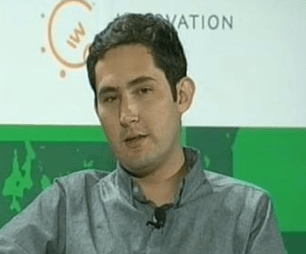
During the talk Systrom revealed that the startup has now hit the 12 million user milestone, with 100K weekly downloads coming just from China, impressively. The app sees around one download per second worldwide, with that rate increasing on the weekends. “The amount of interest people have [in Asia] is huge,” Systrom said, “Japan is our second largest market.”
It seems like the international appeal of Instagram wasn’t that unexpected; The app was translated into 10 different languages four weeks after its launch, with two of those languages being simplified versions of Chinese.
Systrom also confirmed that the company was in contact with Chinese companies like Weibo, in order to better tailor the social app to the uniqueness of a market that has little access to Twitter and Facebook.
Back to US innovation for a little bit. We are going to have Kevin Systrom from Instagram. Instagram has just been a phenomenon in Silicon Valley. I mean who would have thought making photos look a little older and share-able will translate to one of the fastest growing mobile apps that we've seen so far and the guy who's been in charge of this. His name is Kevin Systrom. He's sort of fell into this as an application starting his business to do something else and it's been, you know, trying to keep up with the growth and innovate in real time. We thought it would be interesting to have have someone from the local market interview Kevin, so we asked our good friend Gang Lu, who is the editor of TechNode, who's been an amazing on the ground editorial partnered us with the entire conference to do the Fireside chat so please welcome to the stage Gang Lu and Kevin Systrom. Thank you so much.Thanks. Kevin, please be seated because if you are standing I will be very embarrassed because you are too tall. Before we start, I think, for me, it is really my honor to be here. Just from my opinion because I actually was educated by TechCrunch back in 2006, where I started my internet dream. Also, I think I am one of the few Chinese who already know how hard you guys are working to make this happen, so I really want to say thank you, TechCrunch, for getting everyone together and for bringing so many great speakers here. Thank you very much. Also I think maybe I'm the only Chinese MC on stage yesterday or even for today. So I think, probably it sounds weird on behalf of Chinese, but I think I can say on behalf of the Chinese start ups or Chinese young entrepreneurs. I think...I just really want to say, TechCrunch, you are really here. And I think it's our...I don't know. I'm so exciting you are here and big thanks to you because you are being...doing such a great job and to tell everyone here what's really happening in Silicon Valley. So thank you again. Okay, Kevin. Right. Do you know how popular you are in China? We have a good idea.Yeah, let's do a test. How many of you ever heard Instagram or use Instagram? Raise your hand please.That's a lot of hands. Good. So I need to ask the next question. How many of you if you think, you know, there are more than over ten copycats of Instagram in China? Raise your hand. Not many? I am surprised. You would think you would be more. Okay. But you are popular. Because this panel is all about like founder story, so because you've got so many followers and also so many fans and also the many young entrepreneurs that follow you while doing with Instagram. So tell us more about what inspires you, you know, to do the Instagram?Sure. Instagram to us was always an exploration of what we could do with the mobile phone. The iPhone 4 came out just about when we launched Instagram and what we did was we sat down and we said to ourselves, "What's the most exciting thing about the iPhone 4?" And two of the things that really popped out were the new display that was super-high resolution and also a camera that, you know, was unparalleled in the mobile world. So taking those two, we combined them and said, "What can we build with this?" And after, you know, many months of iteration, we looked at the different opportunities and we said, "You know, let's make a social network that is centered around sharing photos. And it was something we hadn't really seen before. We had seen Flickr. We had seen Photobucket. We had seen lots of the online communities where you can share photos, but we never saw a mobile photo-sharing start-up that really worked. So what we did was, we sat back and we said, what can we do to make it work? So, we focused on a bunch of key problems and over the course of about eight weeks, we produced Instagram. And on our first day, we launched and had twenty-five thousand users sign up. And, that was a really big moment for us because we realized we were onto something new and big. But did you expect the huge amount?Every entrepreneur wants to expect that they're going to have a really big first day. You know, I had, my co-founder Mike and I were taking bets on how many installs we would get the first day, or sign-ups rather. And I bet twenty-five hundred and he bet twenty-five thousand. And,it was like you are crazy, there's no way we are going to make twenty-five thousand, and of course he won the bet, so. No, there's never a way that you are going to when you get when something really takes off. And all you can really hope for as an entrepreneur is that you will see that. But, you have to design for it as well. the things that we did, you know, we contacted early influencers to promote the product very early on, we had a great group of advisers created really hard on how people were going to discover the app and through things like Twitter, Facebook, you know, and other social networks like Tumblr. We focused on distribute that first day but no, we never really expected it to be as big as it was. How many users you have right now? We have twelve million registered users. With how many people? How many staff on your team?So, we have six people right now. And two of them are full time engineers and I count myself as half an engineer. How can you manage to with just six peoples? You know, it's an exercise in scaling and an exercise in being nimble, but at the end of the day, you actually don't need that many people to keep a service up for that many users, obviously. But it's about design and keeping things simple and being agile. And I think specifically for us, Amazon web services is something we can leverage in the States that works really well for us. We have an entire system of over 100 instances, you know, 100 computers running the the service. But it's tough because, you know, the three of us on the engineering side often wake up very early in the morning to server alerts and a lot of times, you know, traffic surges overseas and that's not exactly during the day so you're not awake. And it means you have very irregular sleep schedule.Yeah, I'm just curious. How as you know I come from China. Yeah, so I don't have exact numbers from China I know, but, I was looking for this talk and we get over a hundred thousand downloads in China alone, every single week. One hundred thousand?And that is really big for us. As to how many of those continue to use the product, I don't know, we can probably look into that, but what I'm excited about is the potential of an Instragram overseas. Japan is our second-largest market behind the U.S., and it's very clear to us that having an international presence is key to us growing very quickly in the future. And, in fact, our fourth week out of launching, we decided to translate the interface into To those are simplified Chinese and traditional Chinese question. I think here. If I may on behalf of all the Instagram copy cats. I'm already. like what is the business model behind this? How are you going to make money off this? Well, so I think the reason you see copycats is because people are really excited about how quickly the platform is growing. But, to be very clear, there are just as many copycats in the United States or in Europe, right? So, day after day we are fending off people trying to eat the way out of the network. Instead of saying, how are we are going to make money from this day one, what we've done is said to ourselves, if we believe we can get to a certain scale, can we create a new entertainment platform? A new entertainment network, right? A place where people will buy ads because they're engaged every single day. You talk about copycats. I think one of the problems with copycats and one of the problems with these competitors is that unless you build to scale, you're just costs. So you're just hemorrhaging money, serving images and serving bandwidth. Hopefully by us concentrating on growth right now, we'll get to a scale where the business model starts to make a lot more sense with an advertising network. How long you think you are going to take? That's a great question. It depends how quickly we scale. What's awesome is we're accelerating in terms of how quickly we're growing. And honestly over the past couple of months, we've seen numbers close to one user signing up per second, and often on the weekends much higher than that. We're excited about the potential going forward. While you are here and you have got so many "likers" here, are you going to bring Instagram to China? One of the great things about being digital is that you can be anywhere in the world, right? We're not going to be opening an office overseas anytime soon. With that being said, we're working very closely with folks in Japan and hopefully in China in the future to see how we can build a solution that makes sense for alot people in these countries, because for instance if you go on you share a photo on Instagram today, the top option is Facebook, right? Not a lot of people shared a Facebook here, though there are a lot of services that make a lot more of sense to share to. So what we needed to do was customize the interface, customize the product to work more seamlessly with locales that aren't the United States because it is very important to us. I heard, I heard that you are talking with Wave-o, to integrate Wave-o servers into Instragram, is that right?
So we talked to a lot of people and one of the most interesting ones is Wave-o and I think we've been interested in exploring how to get instagram content out and how to create more sharing networks overseas and I think that would be a great option.Right. So, what is next for Instagram, apart from the modernization issue?Right, you know the thing we're hard working now is growing the team, since we are only six people. We interview a lot of people every week, and every morning our team meets and we talk about what we are doing for recruiting. We've kept our bar very, very high and in some ways it's a good thing, in others it's a challenge, but it means that we're going to grow our team correctly and hopefully bring in the right people that will help us face challenges, such as overseas competitors or overseas scale, and build the products that people love. Right. Let's finish up on Instagram. Maybe you can focus more about being entrepenuers, because you know in China, competition here is so tough. And also that so many companies or entrepreneurs are doing similar stuff, like working on photo sharing sites. But the situation here compares to Silicon Valley because there is no way you will get acquired by big companies. but I think that warrior, those young entrepreneurs are here. So what's your take? What's the exit for you? You are going to be IPO one day or be acquired? You know, if you're building a...if you're trying to build a 100 year company and we've only been around one year...You know, the idea of thinking about an end is just not something that we focused on. Right now the future looks very bright. We're growing very quickly. People are very excited about it. We're creating a whole new category in mobile and, you know, it doesn't make sense for us to push the exit button any time soon I don't think. We're much more excited about growing up into a long term, sustainable business. And part of that is simply, you know, chugging along through these first few years searching for our place in the world of social media and searching for how we fit, you know, among all the giants out there. And so far I think we've carved out a really nice niche for ourselves, and it's going to be really interesting to see over the next few years how We grow that into something very large.Right. Okay, I don't know how much you know about China. Is it your first time here? Yeah.What's your impression here?It's really exciting. I mean when I was standing outside yesterday and talking with entrepreneurs and really exciting to see how passionate people are here. Do you feel any difference? You know there are minor differences but when it comes down to it people We're paassionate about technology, doesn't matter what language you speak, right? And the awesome thing about Mobile here I think in many ways the United States lags behind much of Asia, we're only catching up now with the iPhone but to see people with these devices out, and using them consistently is really exciting because, the opportunity with this many people is unparallel. running Instagram. How long have you been running Instagram? So we launched about a year ago. What's the hardest time you think? The hardest time was the first day.
The first day? Yeah, the first day was the hardest. We had a single computer you know, and the site went down multiple times and I remember waking up and saying to myself "Man, we're ruining our chance." because we were down half of the day, but it turns people are very forgiving for something that they love a lot, and that's been really hard. Another hard part is simply, you know, deciding what to do next. I think the product can go in so many different directions and it's up to us to be the editors, it's up to us to focus and keep feature creep from coming in. Making sure that we stayed focus on providing the best experience for, you know, people to share their lives on the go and you know, whatever direction that takes going forward will be really interesting to see develop, but every step along the way we need to make sure that we are doing the right thing and instead of doing too many things all at once. Yeah, you have raised a bunch of money, but not you only have six people. So, what's back because I could have been talking to those of no co-setups. Once they have money, the first thing I think of is expanding as soon as you can. So, what's your opinion on that? I think a lot of start-ups can get stuck in the hiring for hiring sake cycle and it's not clear to me that it's necessarily the best. Obviously the Instagram model is to stay much leaner and grow when you need to grow. Capital is a tool at your disposal. It's not necessarily a responsibility to spend it, right? It's not a responsibility to use it in fact, I think, our investors are very excited by how leveraged we are, and how low our burden rate is. And, you know, without a business model that is bringing in cash week over week. I think it's really prudent to keep your staff pretty lean and make sure that you're focusing on growing the network so that when you do find the opportunity and when you do discover exactly how it's going to become a very big business you can use that capitol and apply it for more growth. Before is this your first startup? So i worked at another startup before doing instagram. Instagram actually came out of. startup that was working on before called Burban and that was a check-in app and we decided that was a bargain. So, i have, you know, been part of a few start up's along the way including in Odio [sp?] which was the pre-Twitter. I was a summer intern there in college. So, i've had exposure to both small [xx] larger companies, i worked at Google for three years, so...
So what was your job in Google?I was working half of the time on their product called Gmail and then half of the time on corporate development, helping with mergers and acquisitions. Right, ok, so what's or how to think of a traitor about it at the start up's. So, if you know, because here is the people afraid of traitors people think they are young, but they are afraid of failures. But in Silicon Valley, cause the last time I was in Silicon Valley, what I feel the difference like in Silicon Valley like every start up just smile to each other, well, as they all seem very happy, but here if you come China, like, everyone looks so serious. It is like if one day they cannot go IPO, or if they cannot know if they are going to make money after six months or one year, then they are going to die. So, I don't know, how's the thinking in Silicon Valley? Everybody seems so passionate about the start up and without any fear.
So I think one of the things that really contributes to people being able to take more risks is. Listen, like every single entrepreneur that does something like Y Combinator, if it doesn't work out, easily can get a job somewhere else in technology, and it is very, very easy to go up and down, you know, Sandhill Row asking people "Where can I work?" and they will point out thirty places that are hiring smart engineers. I think that's why when i left to go do a startup. My thinking was like, i'm going to take a chance on this thing and see how far we can go. looking back frankly, we could have probably raised a lot less money. We spent very, you know, we spent a fraction of what we raised initially to get a protopotype out the door but as an entrepreneur you always have this cushion to simply say, you know, "If this doesn't work out, i am going to go and work at a " You know, a Google or a Facebook or you know, a larger company or one of the other, you know, 1900, you know, start up's out there that does hiring right, and also my last question is, I think people here always, it also [xx] worried about, like with big companies. So, for your employee, if you do feed them with a cake, here there are plenty of copy-cat with cake here. But, one day [xx] or, some other big company that launches a similiar service, then all of startup just basically gets killed. Then you go to a "clould storage" service and you have Apple here. I think one day because picture, the photos and some saying, you know, very fundamental thing for the mobile, you know, industry do you feel like big company going to kill you? Or going to change your new feature?You know, in Silicon Valley, everyone wonders about this, right. Every single start up has the question, what if, you know, x, y, or z just does this where x, y, or z is one of the big three, the Googles, Apples, Facebooks, whatever.Yeah.It just really hasn't been the case that big companies have gone out and squashed people in the way that people expect. I think FourSquare is a great example of a company that is still doing very well. And, honestly, the goals of large companies are often very different. Now, you know, I wouldn't start say, a search company right now. I wouldn't start something directly in the path of a very large company, but I think when you're doing say social, you're always going to overlap with one of the larger social companies in some way. But, your job as an entrepreneur is to make sure you have a unique value proposition Such that even if someone does add filters to the product it's not necessarily an end game for you. So you say that you are not going to do the search, or you will?No, searches, I mean we'll have search baked into Instagram, but you know what I mean, like I think that the idea of creating a search engine nowadays is I don't know, it's a tough sell and I think that Google has that figured out and many billions of dollars to back them up. So, I guess what I am saying is, if you are going to do a start-up, if you are going to start a company, you have to ask yourself how you are unique, and how you are positioned, even if someone bigger did decide to take a stab at what you are doing. The question probably would be more general. So, how do you see the mobile industry in general? So, I think we see people playing with photos, playing with "check-in" so, what, how do you think of all of this? What's exciting to be about mobile is how incredibly vibrant development is right now. All of my friends back in San Francisco that are doing start ups. Nearly all of them are doing a mobile start up and now it just wasn't the case five years ago. I think the iPhone has ushered in a whole new era of start ups. They are focused on very mobile-centric experiences. It is very much the next device that's going to usher in, you know, a whole bunch of innovation, right? That you know, a lot of people for a very long time have been asking themselves, "Why has mobile been, why hasn't it taken off?" Right and finally, I think you're seeing people on mobile in the way that they focus on the web, say ten years ago. And when I look at it, what I get excited about, you know mobile, is that it is so open, right? There are so many opportunities that aren't being attacked. There are a lot of folks that have built for the web in the past, taking their solutions and putting them in mobile. But all of the start-ups that I get really excited about these days are "mobile first" companies and it's really exciting to see that emerge. Right, so besides photo. If we say ok, one day if you stop Instagram, what else are you going to do with mobile? try not to think. I think videos are really interesting, you know, when I go out, the reason why I don't share more videos is simply a bandwidth issue. It's really hard to upload. It's kind of clunky. When you're out and about the last thing you want to download is a giant video right, and I think it's one of the untapped kind of opportunities going forward, and we're going to see some really interesting innovation in mobile video as well. But, really, video and pictures I think both fall under the umbrella of visual media that's going to be shared on the mobile phone going forward. That's really the area that I see a lot of opportunity for, and personally, I'm most passionate about. And that's why we're building solutions for that umbrella.
Right. So, do you think one day you could launch like a video version like this for sharing photos and sharing videos.That's a great question. We've toyed with it. I wouldn't say that it's on the near term road map, but I wouldn't count it out in the future. Video is definitely something I'm very passionate about. But, again and I've said this multiple times on different stages. I think it is one of the most interesting opportunities, but it's interesting because it's a really tough challenge, especially with bandwidth that we have today and it's just the concrete experience in mobile. I think our goal is entrepreneurs are to figure the solution ...around those challenges. You figure out how to make it an awesome experience because there's something about video that's so compelling and so enthralling... Man 1: and we really want to make sure we do it correctly. Man 2: OK. Because we just have a few seconds left I'll take my very last questions. entrepreneurs or what's the spirit do you think that's really behind the entrepreneurs.So, for me You know, being a entrepreneur is all about saying, looking at situations and realizing that there are ways to make things happen. To do, to make things happen at any cost, and to make things happen very quickly. A lot of people see a challenge, or a lot of people see an impossibility, and I think as an entrepreneur you need to see a challenge, right? You need to see an opportunity where others see an impossibility. And some of the most exciting, you know, start-ups of the last two years are exactly that. When people say oh, there's no way you could ever launch another photo-sharing start-up and be relevant in the world, right? That's impossible. And we saw it as a challenge. Like, how could we do that? And that's really what entrepreneurship is to me. Okay . I think I'll have to wrap up here. Thank you so much, Kevin.Thanks very much.Thank you. Yeah. So, hopefully, I'll see you soon.