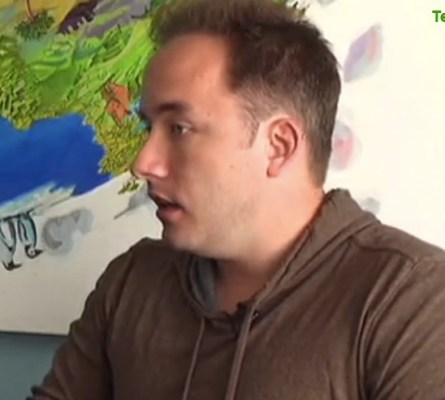
(TCTV Exclusive) DropBox CEO Drew Houston Says The $250 Million “Is All Going Into The Company”

Tuesday, October 18th, 2011

Erick Schonfeld is the Editor in Chief of TechCrunch. He oversees the editorial content of the site, helps to program the Disrupt conferences and CrunchUps, produces TCTV shows, and writes daily for the blog. He is also the father of three adorable children. He joined TechCrunch as Co-Editor in 2007, and helped take it from a popular... → Learn More

drew hoston
Erick Schonfeld here with TechCrunch and with Drew Houston, CEO founder of DropBox. Today is you finally, officially announce that you closed your big $250 million round. Is this is the series B?

Yeah.

Is that the largest series B ever in the history?

Yeah, it might be. I mean our, Our lawyers are cracking up over that we haven't, you know, wrote 2 more letters.

Right.

To share.

But you actually closed it in September, would it?

You're announcing it today?

Yup.

End of September.

Right . So, tell me a little bit about why did it take you so long to do a series B? series A, when was that. This is an unusual fund-raising process.

Sure.

Just take me a little bit through that.

Yes, so We last raised money in October 2008, so that was our Series A with Sequoisa Accel. and, you know, actually for this it turned out that, you know, the company was profitable. You know, we weren't even really on the lookout. There was no sort of driving event that, you know, made us think carefully, you know, think heavily about funding.

It was really totally opportunistic. But one other option I thought about is, last year we had millions of users, this year we have tens of millions of users and we have a pretty clear path towards hundreds of millions of users. You know, we are operating at just a completely different scale now. So there's a lot to be said for being aggressive, or having the flexibility to make more aggressive bets and, you know, whether it's things like the partnership we announced with HTC in the article, or acquisitions and just generally growing the team.

We're just, there's a lot more balls in the air.

Right, so all throughout this period, and the A was what, seven?

Six six million and then we did seed in 2007.

Okay.

One point two, basically.

So, seven million is total technically before.

Yeah.

And basically since that time you've had plenty of opportunities to raise more money and you chose not to because you were really running lean and you didn't have to.

Right.

So what was is about? Was is just about the quality of investors who kept coming to you? Was is about finally figuring out what you could do with that money to really.

Yeah.

Take the company to the next level. Why now?

Actually, we are just getting started. Both a product standpoint and from our audience standpoint. So, when you look at a number like forty or forty-five odd million users, the way we think about it is that's actually a pretty small number in comparison to how many people out there who have a computer or phone Right.

Or an internet connection. And so we are only a couple of percent to the way there.

Sure And so, of the two hundred and fifty million how much of that is going back into the company? How much of that is being taken off the table by shareholders, insiders?

It's all gone into the company.

All of it. Really?

Yeah, so You didn't take any of it off the table?

nobody sold any of the stock. I mean we just don't comment on that kind of thing especially in light of all the What? I think that's great.

Yeah.

I mean that's sort of refreshing, right?

Yeah, because you've seen. I mean certainly, you know, companies. I mean I was just saying. I was talking to Bill Gross and saying that this is like bigger than an IPO in term of the actual money that was raised, Yeah.

compared to like even a decade ago.

Sure.

Right?

So, it is a liquidity event and it certainly makes sense for founders to take money off the table. But you're seeing different ways that the founders are taking money off the table, Yeah.

especially when sometimes the companies need the cash, or sometimes they don't, so I'm interested to hear, like, your thoughts on that.

Yes, I mean, you know, it's something that we've talked about to our investors. I mean it's flexibility, right? And you know, but as far as specifics we, you know, we just don't comment on that.

But so, the $250 million I could see you spending on a lot of things. You could spend on marketing Yeah.

To increase awareness. You could spend that on building out an infrastructure beyond what you're doing. hiring engineers, hiring salespeople. I mean, all of the above. Are there particular areas that now you'll be able to do that you weren't able to do before, or could do it faster? Well, I think it's the kind of thing where, you know, opportunities surface, and, you know, and it's like a week in which you can make a decision.

and we just thought it made, as we looked at our and different things, we just thought it made a lot of sense. that, you know, if an acquisition comes up or rather, your partnership opportunity is coming up or, you know, creative things we can do on the business model side coming up or, you know, there's the flexibility of the experiment with advertising.

Our growth has been zero advertising to date, but you know maybe that's something that can change in the future.

Let me ask a little about sort of evaluation and how that stop changing Yeah.

Right? So, and we reported this. I mean, initially, we sort of I think. Million dollar range and then $2 billion Yeah.

And then we heard things as high as 10 billion, and sort of settled at four, and I think that's a function of which investors you finally ended up going with.

Yeah.

But you know, and this was just in a matter of months, really, how the valuation changed. Was there actually You know, that much change in your underlying business that warrants that change evaluation. Was it more for the market was just really hungry we're, you know, getting in a piece of Dropbox.

Here, I think it's all the above. I mean, you know, one of the things we mentioned today is that we're on paste as our triple our users basis here and so We're not disclosing exact figures. We're saying we have more than 45 million users right now. But You look at 150?

If you. We're saying within the year of 2011.

We'll get there. We'll get there. But if you look at like last year, beginning of last year, January, 2010, we had 4 million users. Now, we have more than 10 times that.

Wow.

And so I think that's how and, you know, the business, I won't How many of those are specific?

Sorry, I can't get into specifics on that, but that has certainly grown alongside the rest of the user growth for sure.

Today DropBox decided to officially announce its $250 million series B round (which actually closed in Sepetember and we called last summer, and filled in with follow up reports). I took a break from the Web 2.0 Summit to drop by the DropBox offices down the street in San Francisco to talk to CEO and founder Drew Houston about what may be the largest series B funding round ever. (Actually, Better Place topped it with a $350 million series B in 2010).

In the exclusive TCTV video interview above, I ask Houston about the round and what he plans to do with all that money. After all, he just raised more money than many companies do when they go public. How much did the founders and existing shareholders take off the table? “It’s all going into the company,” he tells me. “Nobody sold any stock.”

Houston believes he is on pace to triple the number of DropBox’s users this year from 45 million. DropBox is in a very good spot. But now it faces competition from Apple, which just launched iCloud, Google, and others. In the clip below I ask Houston about the threat from Apple and whether he really turned down a $1 billion offer from Steve Jobs. Watch below to hear him describe that meeting.

How big a threat is Apple to you? Cause if, and I'm very, you know, I'm not very satisfied with iCloud. today, but and, you know, it's not their necessarily their core competence.

Yeah.

It has been in the past, but I have to believe that, you know, they're taking it seriously and they're gonna make it better over time?

Yeah, and they have the advantage of, they've got the operating system advantage, right? So they can build it right into the operating system.

Sure.

At least for Apple consumers, like, you know, if I can, it's already built in, why would I use something else?

Yeah.

Just in general, and it's not just Apple, it's Google, etcetera, right?

Sure.

So well, how did the 250 million help you battle the big guys?

So, what our users love is that they're free to choose any device or service and you know, of the companies that might come to mind, and us, we're the only one that's gonna make a great iPad experience, as well as a Blackberry experience, as well as a Windows experience, as well as Linux experience.

And so as things become more and more complicated and you have all these different things in your life a lot of them will be made by different companies and I think one of the limitations people are struggling with, from an Apple standpoint, is iCloud is a pretty much Apple only story. And any other platforms are either non-existent or an afterthought.

But, it was a wide world out there beyond just the Apple ecosystem and I think, you know, each company is different but I think that's going to be something that, where our focus on delivering a great experience everywhere is something that's a big strength. and you turned down a billion dollar acquisition offer from Apple?

Steve Jobs?

There's been a lot speculation on that. We actually never talked numbers. And if anything is really just kind of the conversation we outlined in the Forbes piece, which was, hey, you know, you guys might want consider joining forces with us. We said we wanted to build an independent company, and kind of that was that.

Can you describe that meeting with Stever Jobs?

Yeah, it was wild. You know, you get the email saying you're all set for your meeting at one infinite loop and you walk in the entryway and you talk to the receptionist, and you're like, We're here to see Steve. You can just imagine, yeah, sure you are. And, but no she's like, okay, great. Have a seat and Hrosh and I are fiddling with our laptops, we're like oh god, I don't know if he's seen it, don't know if he's seen the demo, if we need to set up a demo, so we're furiously getting everything together.

And then we go upstairs into his kind of area, into his conference room, and it's just like this shrine to all things Apple over 25 years, right? From Macs, to the early Macs all the way to iPods and Mac cares and everything else, and iPhones, And you know, sure enough, we sit down and he comes into that room and his assistant hands him a cup of tea and you know, he sits down and there's this kind of long pause and he's like, "Where do we begin?" And you know, it's surreal because he's like, "You guys have a great products." And sort of long story short, he's like, "You guys should consider throwing in with us because you'll reach a large number of people, you will be able to build this really great and integrated experience.

Right. When was that meeting?

This was in late 2009.

2009.

Yeah.

And you must have considered it. I mean that's--

Well, we actually, no.
I mean we set pretty clear expectations and cause we had talked to some other folks in Apple and said, "Look, you know we're totally fans of everything that Apple does and we have a ton of respect for the company." And actually, you know, the benefits that he described make a ton of sense. But we've always thought that if we were sort of limited, or if we affiliate ourselves too closely with one company, then it'd necessarily make, either-- we'd have too much incentive to make the, say, Apple ecosystem, a lot better than everything else.

Mm-hm, right.

Or it would sort of get us kicked out of all these other ecosystems.

Company: Dropbox
Website: dropbox.com
Launch Date: June 1, 2007
Funding: $257M

Dropbox was founded in 2007 by Drew Houston and Arash Ferdowsi. Frustrated by working from multiple computers, Drew was inspired to create a service that would let people bring all their files anywhere, with no need to email around attachments. Drew created a demo of Dropbox and showed it to fellow MIT student Arash Ferdowsi, who dropped out with only one semester left to help make Dropbox a reality. Guiding their decisions was a relentless focus on crafting a...

Learn more
Person: Drew Houston
Companies: Dropbox, HubSpot, Accolade, Bit9

Drew Houston is CEO and Co-Founder of Dropbox, and has led Dropbox’s growth from a simple idea to a service relied upon by millions around the world. Drew leads Dropbox’s activities, and is actively involved in its business and product decisions. Before founding Dropbox, Drew attended MIT where he studied computer science. He took a quick leave from school to form Accolade, an online SAT prep startup, and also worked as a software engineer for Bit9. After graduating from...

Learn more

Sponsored Ads

Sponsored Ads

Sponsored Ads

Upcoming Events

SXSW 2012

Austin, Texas

Disrupt NY 2012

New York City

Disrupt SF 2012

San Francisco, CA