
Tonara’s iPad App Looks To Reinvent Sheet Music For The Digital Age

Monday, September 12th, 2011

Jason Kincaid currently works as a writer at TechCrunch. He grew up in Danville, California and later relocated to UCLA in Los Angeles, California, where he studied biology with a minor in ‘Society and Genetics’. You can reach him at jkincaidtc@gmail.com (he has other addresses too, so don’t worry if you have a different one). → Learn More

Screen Shot 2011-09-12 at 11.14.33 AM

Please welcome to the stage, from Tonara: Yair Lavi and Ron Regev.

Hello everyone, We would like to introduce Tonara and welcome you to the future of music plane, a world where the music listens to you. Music has been around since the days of King David and Orpheus. It took some twenty-five hundred years for the first business of music to emerge. And that was the business of sheet music.

The past century has seen tremendous developments in both the technology and the business of music. Vinyl records, LPs, CDs MP3s, iPods, iTunes, Spotify. The one area of music which is currently a two billion dollar a year market, world wide, that has not been touched by technology for the last few centuries, is the way performers use sheet music.

Right now, there are hundreds of millions of music players all over the world using obsolete technology. It's time to move on. This, is what we're working with right now. And this is the future of sheet music. I would like to introduce Yair Lavi, the co-founder of Tonara. My name is Ron Reagan.

I'm a concert pianist. I'm also Tonara's Chief Music Officer, but I'm not as the chief of anything. I'm here because when I was growing up, I was the target audience of Tonara's technology. And I have been waiting for it for the past twenty years. Ever since I saw my first Kindle, I knew what millions of musicians knew, that something like this must happen to us as well.

Then I discovered Tonara, and I was hooked. You see, a Kindle for sheet music needs three things. It needs best in class music scores. I choose Style Sheet Music Store. And technology that can listen to the performer. Such technology would be able to follow the playing of anyone who reads music and provide solutions to problems that millions of musicians are struggling with daily.

For instance, while you are playing an instrument, you don't really have three hands. Sometimes you don't' even have three feet. Technology that can turn the pages for you automatically at the proper place, would be really cool. That's what Tonara does. For the first time, we have music that listens to you.

For decades, people have been trying to get computers to follow computers with complex harmonies. Tonara's technology is the first to ever succeed. That is why we can bring the Kindle revolution to the world of music. Let's see how this works.

Doesn 't' matter how also how slow you play, play slower even slower now play faster, Tonara's technology is resilient to noise. Keep watching the marker on the screen. Help us make some noise.

Thank you. Sorry. Thank you.

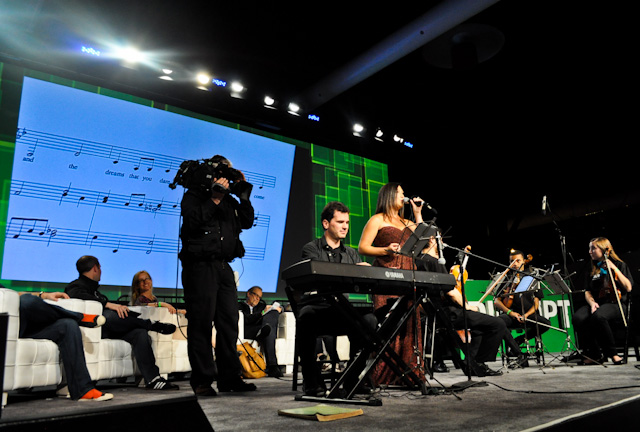
Now let's see how this works when you have several people playing at the same time. Thank you. You've just heard, Thank you.

You've just heard "A Glacier Did It" play some Star Wars-oriented Mozart. We can handle pop music as well as classical. And I'm very happy to invite one of our fans to demonstrate. Somewhere over the rainbow way up high. There's a land that I heard of,
once in a lullaby. Somewhere over the rainbow, skies are blue.

The dream that you dare to dream, really Do come true.

Someday I'll wish upon a star
And wake up
where the clouds are far behind me where troubles melt like lemon drops
Away
above the chimney tops
That's
where you'll find me.

Somewhere over the rainbow blue birds fly, birds fly over the rainbow.

Why oh why can't I?
Irvin Randy Zuckerberg.
Thanks to tonight's technology Our iPad application is not only the Kindle of sheet music. It is a learning companion and a social tool for musicians. It is your music library and sheet music store all in one. Our groundbreaking Scorefalling technology can be used for much more.

Imagine, Automated accompaniment, that can adjust itself, to your speed, and your style of playing or singing. Imagine sheet music that can give feedback to your performance. Imagine karaoke machines that are always with you even if you have absolutely no sense of rhythm. Imagine playing Guitar Here with an actual guitar or with any other acoustic instrument for that matter.

Now, you can imagine all this. and more. Starting today, the music can listen to all of you. Soon our application is available on the app store. Thank you very much. I swear to God if I wake up and this all turns out. To be a dream, it's going to be disappointing.

OK, Tony said he didn't want to go first. I always pick on him first. I'm going to mix it up. Brad! Brad from AOL. I, the first.

What do you think of this?

I love the presentation.

Your not going to pick on AOL the whole time?

No, no, of of course not. We work for AOL.

I thought the presentation was great. You know, obviously very engaging. Aging presentation. I, from a business point of view, I am left highly quizzical about the size of that market and if I were thinking about on investing I would think I'm not convinced there is a big business opportunity there is not convinced there is a business opportunity.


Well, 2,000,000,000 I mean, there are three hundred million musicians worldwide, and they buy two billion worth of sheet music each year And furthermore, we believe that by providing this easy access to content and this experience, interactive experience, this market could go even bigger. On top of that you have the music education market which is $10,000,000's each year and using our future capability to provide feedback on the performance we believe that we can penetrate this much as well
so it's not
only about the application, it's about all the things that you can do with the technology itself.

I'm not feeling it. Wicked witch. Yeah. .very similar to the Kindle model or the Itunes model, the only difference is that we sell sheet music and the market is not as small as one would think Yeah, yeah, it's actually pretty big.

Stephen are you feeling it?

That was probably one of the better presentations I've ever seen, in fact if you come over Friday around 8 o'clock, I've got a couple friends coming over for an hour. It was amazing. The challenge that I have is defensibility. You're basically using works that are so old that people can come up and add the features and functionality.

What's the differentiater? What locks you into the artist if they are using their own device? If there's no real copyright protection, how do you get the differentiation?

Well, I think I can answer that. You asked basically two questions. First of all, as far copyright is concerned, we're starting off with works that are in the public domain. And there is a lot of that out there. We are also in advanced stages of negotiations with major publishing houses. So basically, within a very short period of the time, we will be able to provide our users with all their favorite songs, all their favorite music.

Would that be on an exclusive basis? What's the lock in? Because you're right. So much of it is public domain. I just don't understand. What is to stop number two from coming out with it, and then it's a price war?

The technology that we've developed, that you are seeing here Play and turn the pages automatically is not a simple one to develop. People have been trying to develop these since the 80s actually and right now we are the only company that can actually follow a polyphonic signal. And so much like piano or several instruments playing together.

That is the main barrier.

Okay, because we if we try disclose a lack of musical ability before we go out, alright. We're all about transparency.

Are they any conflict we need to disclose? I gather. There are so many conflicts we would have the whole afternoon. Tony, I thought you were gonna freeze me out.

They asked for it by note. Do you have any conflicts you want to discuss? it strikes me as this is a fairly small market or a modest-sized market, so how do you accelerate the uptake in that marketplace, and how big do you think it really is? Well first of all, the numbers are much bigger than you would expect.

It's very hard to estimate how many musicians you have in the world, but in our latest study, it is over 300 million musicians. They buy two billion, officially. Now, the market is going to prove, there is alot of photocopying going around. We are actually competitive with the price of making a photocopy.

People are going to converge, we're going to take a lot of this market. And as far as the lock in, I can tell you one thing-

And how are you going to take the market?

Simply by being the first ones and the only ones who can provide you with an interactive experience with the music. I can tell you that the first time I used this application - I am a pianist - after that, I took my own music, and I kind of just waited for it to turn its own pages and it didn't happen.

So I had to go back to the device. It is very addictive. The moment anyone who plays music starts using this application, they just continue.

Okay, we are running out of time because you guys overran in the beginnning. I'm trying to be A dick when it comes to time. I don't want to get all Yossi Vardi about this, but if you're a musician and you're in the audience, maybe raise your hand. We should hear from musicians, by which I mean if you play music by using sheet music or can do.

Okay, now leave your hand up if you would use this. There are people that aren't musicians that would use this; that seems like a good sign. So, with the disclaimer that it's a non-musician, but a pretty business-savvy audience, please give one more round of applause for Tonara. Anyone need water.

Tony, do you need some water there?

I could use some water.

Evian, please.

I can do Crystal Geyser.

That's shit water.

Yeah. So, Alright.

If you’ve ever played an instrument, there’s a very good chance you’re familiar with the annoyances involved with sheet music. For one, it can be tough to find the piece you’re looking for, and then there’s the matter of actually playing the piece — every few stanzas, you find yourself pausing to flip to the next page (or you have to recruit a friend or family member to turn the pages for you.

Now TechCrunch Disrupt Battlefield Finalist Tonara thinks it has a fix: it’s launching a new iPad application that will display your sheet music, then listen to which notes you’re playing, turning the page automatically at exactly the right moment.

And the app appears to be quite impressive from a technical perspective — it supports polyphonic note recognition (so it could recognize notes being played by both your left and right hand simultaneously on a piano, for example), and can adjust to tempo and missed notes. The app will also ignore ambient noise, and it’s possible to set up multiple iPads with multiple instruments playing, and not have them interfere with each other.
The company will be distributing the app for free on the App Store, and it will include several royalty-free songs. In the future, Tonara will be selling digital versions of sheet music for around 99 cents apiece, much like a Kindle for sheet music.

If this sounds familiar, it’s likely because the company has a mission that sounds similar to Miso Media’s Plectrum — which took the People’s Choice Award at least year’s TC Disrupt SF. Miso Media has a guitar-focused application that will also listen to the notes you’re playing (t supports guitar tab in addition to traditional sheet music notation). And it also lets you purchase new songs for a dollar or two each.

The big difference at this point appears to be the fact that Tonara is focused primarily on sheet music, Plectrum is focused on Guitar Tab. I’ll be curious to try both apps out side by side — in their demo, Tonara’s tone recognition certainly looks very impressive.

Judge Q&A:

BG: I’m quizzical about the size of the market. I’m not convinced there’s a big business opportunity.

A: $2 Billion market. Hundreds of thousands of musicians.

Wendy: I’m not feeling it. I’m very creative… I’m not feeling the business model.

A: The market is not as small as one would think.

SM: Great presentation. Defensibility.. you’re using works that are so old, what’s the differentiator. What locks you into the artist.

A: As far as copyright is concerned, we’re starting with work in the public domain, also talking to major publishing houses. The technology is not a simple one to develop.


Backstage interview:

Tonara just finished their presentation. We're getting some thoughts on how their session went. So, tell me, how did your session go?

Well, all things considered, I think it went pretty well. The adrenaline level is still very, very high. Everything worked. I think we were able to answer most of their questions properly. Of course, a panel which has no musicians is a tough nut to crack, but I think we did okay.

Is there anything that if you could do this again differently that you would do differently?

What do you think?

Well, actually, no. We are really excited and we are really glad that everything worked as we planned. It was...maybe some minor glitches, but the plan was good, I think.

And how do you think the audience responded to your product?

Well I can tell you one thing, anyone who ever played an instrument is probably very excited right now because you just google automatic page turns and you get millions of hits. Musicians are looking for this, anyone who is playing an instument, anyone who is an aspiring musician is looking for this, and finally we can give this to them.


Company: Tonara
Website: tonara.com
Funding: $750k

Tonara developed score-following technology for musicians, and is offering a sheet music iPad app which shows the musician’s location on the score, and turns the pages automatically during playing.

Learn more
Tags:

Sponsored Ads

Sponsored Ads

Sponsored Ads

Live Disrupt Coverage