Idle Games Wants To Be The Pixar Of Social Gaming; In Their First Game, You Play God

Monday, September 12th, 2011

MG Siegler is a general partner at CrunchFund and a columnist for TechCrunch, where he has been writing since 2009. His focus is on Apple. Prior to TechCrunch, MG covered various technology beats for VentureBeat. Originally from Ohio, MG attended the University of Michigan in Ann Arbor, MI. He’s previously lived in Los Angeles where he worked in Hollywood and in... → Learn More

playdom-co-founder%E2%80%99s-new-facebook-game-inspires-faith-in-flash-innovation

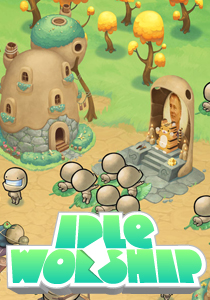
If you were into PC gaming in the early 2000s, you know what Black & White is. Peter Molyneux’s 2001 classic published by EA gave every gamer the role they wanted: God. A new startup is aiming to bring that style of game into the social space. And more broadly, they aim to be the “Pixar of casual games”.

Idle Games is launching today at TechCrunch Disrupt. Their first title is Idle Worship, a Black & White-esque game for Facebook. You play the role of a god, controlling villagers on an island to do certain tasks for you. While that may sound ominous, you can choose to be either good or bad in your actions. And overall, the game is light-hearted and fun. We’ve been playing with a beta version of the game for a few weeks; it’s solid.

This first title by Idle Games, a startup founded by Rick Thompson (a co-founder of Playdom) and Jeffrey Hyman, aims to disrupt the casual gaming market by being an “anti-Zynga” of sorts. They believe social gaming is more about entertainment, interaction, and quality — not just button-mashing or mindless clicking. In many ways, they’re also going after the MMO market too. While the games will start on Facebook, you can imagine that they could quickly spread to other platforms as well.

Like other casual games and MMOs, the emphasis for the business will be on virtual goods. But again, the Idle Games team is determined to create goods of the utmost quality so that users feel compelled to buy them and happy when they do. In this regard, Idle Games’ mission sounds a bit similar to that of Tiny Speck, makers of the soon-to-be-released game MMO Glitch.

The Idle Games team also has a number of pending patents surrounding their particular style of social gameplay, they note. One key is their use of synchronous gameplay (as opposed to other games which typically are asynchronous). You can play alongside other “Gods” in the game, visit their islands, etc. Inside Social Games did a new preview of the game back in April.

“The game must be your wingman and break the ice for you,” Hyman said on stage today, explaining why Idle Worship creates better gaming connections than other endeavors out there.

All told, Idle Worship took the team of about 50 around two years to build. Again, the focus is on quality. They’ve raised roughly $9 million in funding so far.
Expert Judges Q&A Session:

Josh Felser, Freestyle Capital; April Underwood, Twitter; Jim Lanzone, CBS Interactive; Michael Marquez, CODE Advisors

JL: Why this game? There are a ton out there.

A: We think it’s like the entertainment industry. It is a hits-driven business, we’re putting the emphasis on quality. It’s a bit like capturing lightning in a bottle, but we’re leveraging the social graph in unique ways. We think this is the first true social game on Facbeook.

MM: Is this launched?

A: In a few countries so far.

MM: What about use engagement?

A: The initial metrics are blowing away the norms. Over 50 percent are returning after week one.

JF: Can you compare this to Zynga?

A: Absolutely. I don’t know if you read last Friday’s WSJ, but it says on the front page, Zynga is an analytics company masking as a game company. We’re an entertainment and games company. Zynga is a black and white television. Everyone wants it until the color television comes out. That’s us. We care about the entertainment experience.

AU: Your game looks engaging I want to play it. Tell me about the patents.

A: We’ve invest two solid years of engineering to do the tech here. We have five patents filed for this stuff. Rendering engine, etc.

Presentation:

Then you'll ever be.

So you want to, are you going to tonight's after party?

Absolutely, after this.

Let me this to you so you know when it is fantastic thing.

All right please welcome to the stage, he's already here from Idol games, Jeffrey Hymen.

Thank you very much. I'm Jeff Hymen, the CEO and co-founder of Idol games. To my left is AO Shevite, my EVP of engineering. AO wanted me to start this out by telling you we built the first mass distributed simulation platform for a social game. But, I thought that at the best of times it would make your eyes collectively glaze over and since it's after 5:00 pm, I think it's probably best if we get straight to the pretty pictures.

Idol games is created Idol Warship, which is a god gang, technically it's a polytheistic god gang, you're a god buying for the worship of friends, strangers and the rather dim indigenous population that we call muddlings. Artistically and technically we're doing things that haven't been attempted before on Facebook.

When we began think like our competition. We believe social gaming is a form of the entertainment industry. And as such, the only sustainable business plan in the entertainment industry is it's quality. Furthermore you can't have a social game without offering up the ability to play synchronously, meaning playing together with your friends in real time.

But if the same time any viable Facebook game must support both synchronous and asynchronous game play. Finally any game world that we created must be unsharded, which is just a fancy way of saying no matter what server of player is on, everybody plays with everybody. Hopefully as you were watching this obvious that we don't just care about quality we are fanatical about it.

To us quality is found not only in the art and technology but also entertainment experience we provide, here is a little bit about the game, you created muddlings, mudlings want to believe in you but they can't unless you reveal yourself through blessing and curses. How much a muddling believes in you is written on their face.

Your muddlings build idols to Idle Games is also in the virtual goods and micro transaction business. This means we also sell things that don't actually exist. However we believe that if you're going to sell people things that don't actually exist, the least you can actually do is make it look decent and look good.

You can play nice with others and build those people altars. You can even pray to them and ask them for blessings or beg for forgiveness. Right now it should be obvious that my muddlings are train that we are going to win Disrupt, but with all of the news to be in complete honesty, to hedge my bet I also have an altar to Mrs. Huffington.

This is an example of a postcard that Michael can share with his friends. When the recipient clicks on it, he's transported right to the action. Everything you share in our game has iWalls or what we call idle worship urls. Any location in our world can be accessed via a single click All you, you have all the fun and benefits of a massive world, but no need for the wandering and navigating that is endemic in MMO's.

Get in, get godly, get out, that's our goal. You can also play competitively. If Mark Zuckerberg was playing for example, he could position his missionaries on your island to preach his gospel. Or he could curse your mudlings so many times that they choose to believe in the one true god, which is obviously Zuck.

That's a super, super brief look at the game but what's really cool is actually happening underneath the hood. Here's the omnipresent Friends bar, I just can't even comprehend why this exists in every game. It serves absolutely no purposes. Thanks to Facebook we already know who your friends are.

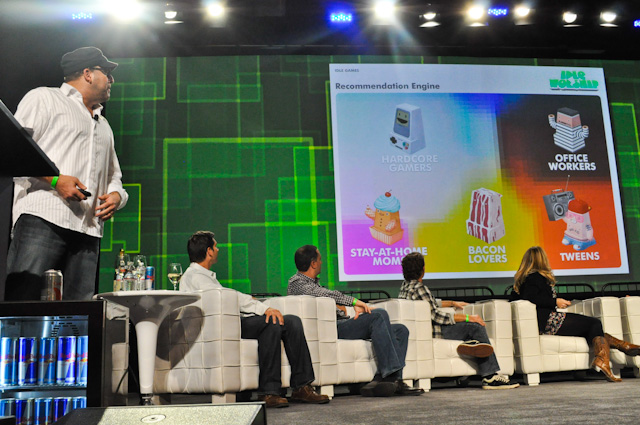
Here's the idol worship game map. You're god, so obviously you should be in the center of the universe. Since we already know what friends we are playing a game. We automatically add them to your map, but that only accounts for a very small part of your map. Here's how we finish populating your map, one part of our tech stack is a unique recommendation engine that uses five different methods to make social connections for you.

The first thing we do when someone installs the game is analyze their Facebook profile. Let me give you an example of how that works. You're looking at ten thousand RGB values. The engine attempts to make sense of this information and classify them in similar groups. So when you're done, you see patterns emerge, yellow, blues, yellow, green, etc.

But for our purposes, replace the names of the colors with archetype of Facebook users, and you kind of get the picture from hardcore gamers, to office workers, to people who love tasty, tasty bacon, it doesn't matter, if it's in your Facebook profile file, it's going to help us classify it.

So, what we do is we take all of that data from the recommendation engine, combine it with business rules And use that to seed every player's initial map. This enables us to bring together people that have a high probability of having fun together. Creating connections is the unrealized promise in social gaming in my opinion, but you're kidding yourself if you think that players are actually going to make those new connections on their own it's not going to happen, the game must be your wing man and break the ice for you either worship achieves this by leveraging the social graph in unique and patty pending methods like this.

Here we see the god power afflictive despair and what happening here is I'm going to your island and flicking off a muddling. As soon as that muddling flies off your island it immediately lands into the game of another on the line player, thereby creating social context between the players. For every action in a game there's a reaction that ripples throughout the Universe.

Allow it feels wonderfully random, it's not. The recipient is determined by a combination of business rules and the recommendation engine. The final thing I would like to share with you is called Relation gravitation. This solves two challenges. First, games with massive worlds are really really massive take far too long to find the action and I worship as you interact with people those people move closer and closer to your focal point.

So anytime you jump into the game, you are surrounded by people you interact with, our game map is not only a dynamic representation of the social graph, it also visualizes the strength of those relationships, the final problem that relation gravitation solves is attrition. Here's the stupid friends bar again.

More times than not your friends bar is filled with people who have abandoned the game. What we can't solve the problem of attrition what we can do is remove the dead body off the welcome mat, so that you don't have to step over it every time you come back to play, so while relation gravitation brings active players closer together, the opposite is also true.

As you interact less and less with people they drift away only to be replaced with new and better matches. Idle Worship is the first game we're launching on the Idle engine working on games two and three all different, but all based on the same core technology. Thank you very much.

Idle Games, everyone! Come visit you. You want to stand over here?

Ya. Please.

Who's talking.

Because I'm going to be in the middle.

Tell him to come visit us in our booth.

Ya. Absolutely.

I'll just stand over here.

We'll be here all week.

All right, who are we going to start? Jim! Why not? Looking right at you.

You guys have made successful games before, correct? Well this is our first game. And it's looking like it's going to be successful.

Well besides the mechanisms obviously, it's a hits business, music quality You know there's a lot of casual social games out there. Why this one?

Why this one?

The mechanisms are what helps it go but you know is a matter of people want to play it in huge levels, why isn't this game. We couldn't agree with you more it is a hit stripping business, our view of the world is that it's the entertainment industry and the entertainment industry is hits driven. And why this one, it comes down to entertainment, why any television show, why any book, why any magazine.

It comes down to something people are going to viscerally enjoy. That's how things get truly viral. My background is in the advertising industry, and there was actually virality before Facebook you just had to create something that people actually wanted to play and really wanted to share. So first of all, it's creating the right thing.

It is a bit like capturing lightning in a bottle, but at the same time what we really do have is leveraging the social graph in completely unique ways. We have literally engineered this game from the ground up to leverage social connections so it's the first truly social game on Facebook.

Michael?

Have you guys already launched this? We've lost in the Philippines as well as we just moved into launching in Australia, New Zealand.

First of all I mean I think the game play is very interesting, I like that you know, obviously the premise of it, and the graphics and everything.

Can you give us some sense of just kind of user engagement and how people are spending time, metrics and things like that.

Oh, absolutely. I mean the initial metrics that we are having on the english speaking countries that we just launched two weeks ago, are blowing away the norms that we have been given by such great analyst companies as equity. We're talking about a rolling week one return rate of over fifty percent.

We're seeing, we're actually seeing so many people play for so many sessions that it's way too much. The game was created to be a casual game, but with all the the benefit of the massive world. And we find that people are going way beyond just playing it casually at three sessions, four sessions, thirty minutes, forty minutes of sessions.

It's suppose to be high fat and high salt, it's like a bag of chips. Sit down, have fun, take a from the spreadsheet you should be looking at, and get back to work.

Josh, can you compare what you've built to Zinga.

Oh absolutely, absolutely and thank you so much for asking that question. I was really hoping someone was going to ask it. I don't know if you read the last Friday's front page of the Wall Street Journal. I should pay you for this by the way, where on the front page of the Wall Street Journal it says about Zinga, were an analytics company mascerating as a game company.

We are an entertainment company, we firmly believe that we are an entertainment company, were also a social games company, Zinga in my opinion it is black and white television. Everybody wants one, everybody really enjoys it until color comes out. And then nobody wants to see it. We are doing something different.

We are doing something highly disruptive, from the poor social mechanics to the underlying technology to the art and animation. We care about the entertainment experience, par none of everybody else out there. Your presentation as well as the game itself looks really engaging, I want to play it and I want to have my own shrines where people could follow me and stuff so I'm excited about tell me, you talked a little bit about the patent that you guys were working on, something you guys have done a lot of work under the covers, and it sounds like that's extensible potentially to other game developers?

Is that something you guys are thinking about and are you seeking to change the quality of games across the abroad or are you really going to focus on your titles and try to get better consumers.

We're seeking to change the quality of all of our games across the board. We've pledged, invested two solid years of engineering to build the underlying platform on here. Yeah, you are correct. We have filed for five different patents covering the unique social mechanisms that you're sort of got to hint at here, from the rendering engine of how we're doing all of this rich animation and artwork.

Just on flash there's no clients. So, no we're not looking to extend that to other developers right now.

Okay we're out of time so a big round of applause for Idle Games.

Thank you very much. OK. So while we dismantle this, for the audience choice, thank you to everyone who voted. Yeah, remind me after this I should tell you about the after party, which I think you're really going to get a kick out of.

Backstage interview:
We're backstage with Idle Games and want to just get some feedback on how their presentation went. So, how did it go?

Well, we couldn't be more pleased with the presentation, with the exception of a little technical snafu in the beginning, but that's what makes things interesting.

So one thing that came out was the question about Zynga games, and you were glad that the judges asked that question. Is there anything you wish that they had asked?

You know, we were really pleased that they had really grok that there is so much more happening underneath the hood on our game. We've invested such a large and significant amount of time and capital in engineering literally from the ground up what we believe is the first truly social game on Facebook and on the social networks.

And for them to understand and really get that there are patterns that we fought on, there are unique social mechanics, we couldn't be more pleased about that.

Give me a thirty second answer on the two year development process.

Well, the two year development process is pretty much akin to the missa, take again there, the myth of Sisyphus. It's a near Herculean challenge to try to create something from nothing. We're literally, you know the other social game companies would always sort of base their previous games or their new games on that which came before it.

To really have tabula rasa, just a blank slate, where we're trying to create something truly disruptive, amazingly unique with no clear person of which to base our next action on. It really is both an inspiring and an overwhelming challenge of which we could only be overcome and could only be surmounted because we have such an amazing group of individuals and leaders at Idle Games.


Company: Idle Games
Website: idle-games.com
Launch Date: November 1, 2009
Funding: $10M

Idle Games has built a 100% cloud based, unsharded, synchronous social gaming platform and that platform’s first game “Idle Worship”. When we started, we had very different ideas about social games than our competitors. Two years latter we haven’t changed any of our ideas, and lucky for us … neither has our competition. We don’t care about quality, we’re fanatical about it. We’re talking “need medication and the care of multiple physicians” fanatical. To us, quality is not only to be...

Learn more
Tags:

Sponsored Ads

Sponsored Ads

Sponsored Ads

Live Disrupt Coverage