Looking to turn yourself (or your show) into a YouTube star but don’t know where to begin? YouTube’s looking to help — the video portal has launched a comprehensive guide outlining how content producers should be approaching the platform and which features they can take advantage of. The 70 page guide has a fitting title: The Creator Playbook.
The new document was discussed today at the VidCon conference in Los Angeles, and is part of YouTube’s broader goal to help creators produce high quality content (YouTube’s recent acquisition Next New Networks is the driving force behind this mission).
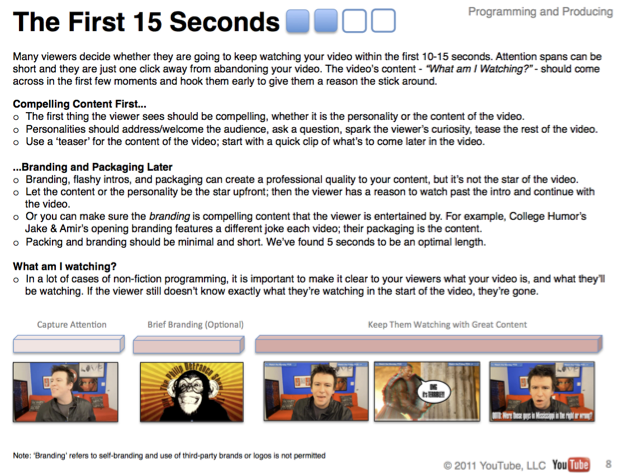
Of course, YouTube is quick to clarify that while this should be a useful guide, there isn’t anything that’s guaranteed. It’s really just a well thought-out set of best practices — if your content isn’t any good, optimizing the first five seconds of your video isn’t going to be much help. From the first page:
The Creator Playbook is not a collection of rules or guaranteed ‘tricks’ to get more views. Instead, it presents best practices, optimization tips, and suggested strategies for building audience and engagement on YouTube.”
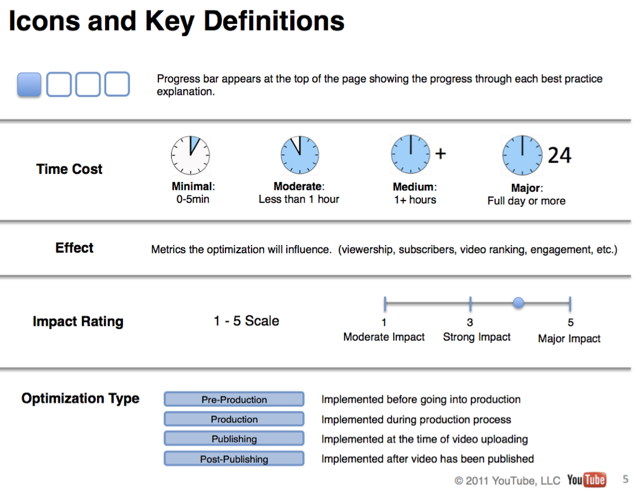
The document is a hefty 70 pages long but isn’t as daunting as you’d think. YouTube has broken each of its miniguides into three sections: Programming & Producing, Publishing & Optimization, Community & Social Media. And each tip within a section gives an at-a-glance overview of how long it will take to implement (the easy ones are five minutes, the harder ones a day or more), which metrics the tip will impact, and how much of an effect content creators should expect.
Some of the topics will be obvious to TechCrunch readers (use Facebook and Twitter a lot!) but it’s unlikely that you’ll already know everything in there. The sections outlining how video metadata can impact your search result rankings is particularly useful — and there’s a checklist at the end you can run through each time you upload a video.
Note that while there’s an entire section dedicated to thumbnail optimization, there’s nothing in there about using a woman’s cleavage as your thumbnail photo, which seems to be a curiously popular strategy on the site.