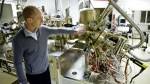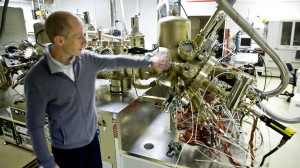
HumansInvent has an interesting piece on a laboratory at Oxford University that can “grow” electronics using a process called Molecular Beam Epitaxy. The system, which uses devices straight out of Dr. Bizarro’s Lab, creates a thin substrate of molecules and then builds it up over time, creating circuit boards, solar panels, and the like with lasers.
The system operates in a complete vacuum and can make almost any piece of electronics, including devices that can’t be made by hand.
James Holland writes:
A laser, for example, requires layers of material to be applied with molecular precision to a wafer, or substrate. It’s the nature of that material which gives the laser its colour, and is the building block for CDs, DVDs, Blu-ray and many other electronics.
Red lasers, like those used in CD and DVD players, are built on top of gallium arsenide wafers, while blue lasers for Blu-ray devices require a sapphire base on which to grow.
You can read more about the system here and check out photos below.