 While hyperlinks are a fundamental backbone of the web, they’re also a bit odd. After all, hyperlinking is for the most part a subjective process. Someone decides if and when to link to something. It nudges the web from a completely open story into more of a choose your own adventure one. But what if we could change that?
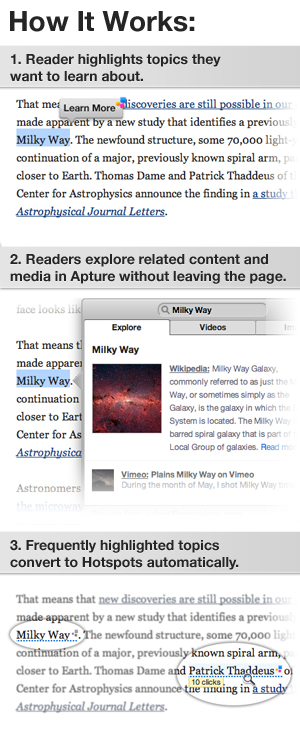
That’s what HotSpots, a new feature from Apture aims to do. Most of you will know Apture as the contextual add-on service that both publishers (through simple JavaScript) and web surfers (through browser extensions) use to augment their web experience with information. What you may not know is that thanks to this service, Apture has access to some really good data. A lot of it. And the key part of that data shows exactly what users highlight when they browse webpages.
In other words, it shows where those users wish there were hyperlinks, taking them to a site to learn more.
With HotSpots, Apture can now populate those hyperlinks on the fly on any page on the web. All publishers have to do is add one line of code and they’re set. Hyperlinks will now magically appear for your readers without you having to link a thing. These links, naturally, will point to Apture overlays which give a range of data to a reader without them having to leave the page: Wikipedia, CrunchBase, search results, maps, etc.
The same thing will occur for anyone who has the Chrome, Firefox, Safari, or IE extensions installed (this will roll out over time).
Apture co-founder Tristan Harris explains that thanks to the 900 million or so collective pageviews they’re seeing across the sites and people using Apture now, they’re able to do something like this. And it points to the core idea behind Apture. “The plan all along wasn’t just a widget for publishers. The end game was always connecting all of this information together,” Harris says.
He notes that if you think of the web as a brain, and each page as a neuron, each link is then like a synapse that connects the pages together and makes everything work. And each click or highlight or search makes these connections stronger. And in turn, the brain gets smarter. With HotSpots, he hopes to make the web smarter by automating part of this process. The feature is quite literally the missing link(s).
So is Apture just going to turn the web into one continuous stream of hyperlinks? No. They’re smart about it. They’re watching what’s hot to determine what should actually be a link and what shouldn’t be. As trends change, links will pop in and out of existence.
Hundreds of publishers like ScientificAmerican.com will be going live with HotSpots today. Others can sign up for the beta on Apture’s site.