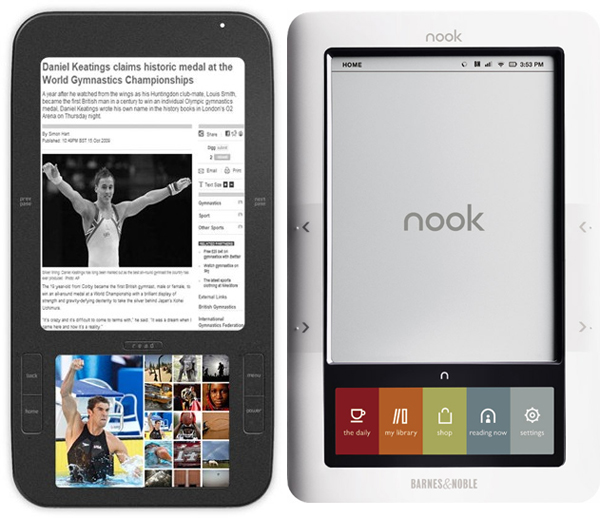
Spring Design’s story so far has been less about its dual-screen ereader and more about a lawsuit against Barnes & Noble. That’s sad. No one wants to go down as a lawsuit troll. B&N eventually agreed to license Spring Design’s patents and the world went on. Today, the company announced that it was awarded another patent, this one dealing specifically with programming between complementary dual displays.
The patent titled “Application Programming Interface for Providing Native and Non-Native Display Utility” seems a lot like what the company used in its Alex e-reader.
Methods for controlling complementary dual displays for use with an electronic device are presented including: receiving an input for display on a non-native display, where the input includes a native user interface (UI) input and a non-native UI input, and where the non-native display is a bistable, low frame rate display; if the input is the native UI input, sending the first native UI input to a corresponding application, processing the native UI input by the corresponding application, calling a non-native API for forwarding the processed native UI input to a non-native display driver, and sending a non-native display signal to the non-native display; receiving another native UI input for display on a native display, where the native display is a refresh-based, high frame rate display; and sending the other native UI input to the corresponding application.
This new patent is part of the firm’s ReadMate technology that’s available for licensing. The dual screens allow for novel control schemes and device such as the Alex or Nook. One screen allows for navigation through a conventional screen while it controls what the patent calls a “bistable, low frame rate display” — like an e-ink screen. If nothing else this patent speaks loud and clear that Spring Design is alive, well, and making it just fine without the Alex.