It’s a fundamental difference between real and virtual keyboards that with one, you rest your fingers on the home row, and with the other, you hover. This means that with the real keyboard, you are typing with muscle memory, and on the virtual keyboard, while that muscle memory helps, you can’t rely on it completely and must augment it with visual confirmation.
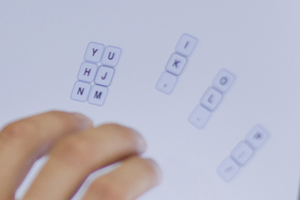 This concept by the University of Technology, Sydney, for a new kind of onscreen keyboard, called LiquidKeyboard, places the letters above wherever your fingers are resting, but still in their original QWERTY positions. From the picture at right, it looks like the keys manifest above your fingers, but if you watch the video, you’ll see they actually appear directly underneath your touch.
The benefit would be more intuitive typing and no need for an intrusive virtual keyboard. Simply place your fingers on the screen and the keys appear. I like the idea, but like most UI ideas, it really needs to be tried in person before anyone can really say yea or nay. With luck it’ll make a splash, like Swype, and we’ll see it in some form on one of the upcoming tablet platforms.
[via Gizmag]