
Facebook just raised $1.5 billion at a $50 billion valuation, having secured just south of $2.4 billion since the company was founded.
Contrast that with The Appleseed Project, which aims to establish an open source, fully distributed and decentralized social networking software suite to rival Facebook.
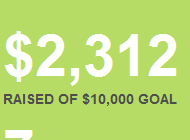
I just got an email from the project’s lead developer, Michael Chisari, prompting me to participate in their crowd-sourced fundraising efforts. So far, they’ve raised about $2,200 in 7 days, so they’re roughly $7,800 short of their $10,000 fundraising goal.
Another project that revolves around building an open source alternative to Facebook, Diaspora, managed to raise $200,000 from some 6,500 backers through Kickstarter.
So why is The Appleseed Project struggling to drum up enough interest to get to $10,000 more rapidly? Is it the choice of the crowdfunding platform (IndieGoGo vd. Kickstarter)?
Are they just really bad at marketing? Is there simply too much choice in ‘web decentralization’ open source projects, causing confusion as to what is more relevant, and which project is in a more advanced stage than the other? Or does it all come down to, simply, bad luck?
For your information: Appleseed, a 100% volunteer project, was started in 2004, while Diaspora was only kicked off around April 2010, so they’re certainly much further ahead of Diaspora in terms of development.
They’re certainly still hopeful:
We’ve released a new version of the Appleseed social networking software, version 0.7.9. If you’re running an Appleseed node, it’s highly recommended that you upgrade, as this release adds significant new features. If you’re a beta tester, you’ve already seen the new features (posting links, journals, nested comments, and more).
Progress continues onward with Appleseed, and we’re proud to be a part of such an ambitious project. The future is looking bright, and in the next few months, we’ll be rounding out all the base features, and then moving into building out the tools that developers can use to extend the software, with mobile apps and more.
We’ll also be working on documentation and refactoring the code in preparation for a 1.0 release sometime in 2011.
My question is: if it indeed took Appleseed from 2004 to this day to get to a point where they still need to raise funds to reach stable 1.0 release, wasn’t the project a little over-ambitious? Is its future really that bright? As always, time will tell.