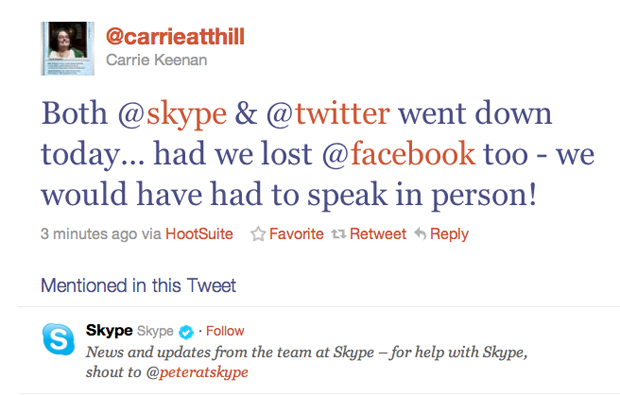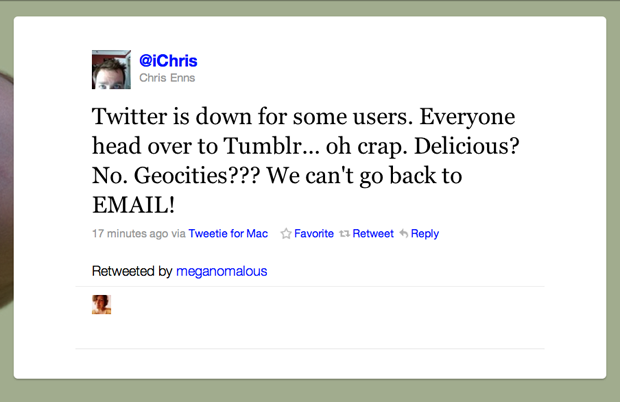
Twitter is down. Skype is down. Tumblr is down. Facebook is down. Twitter is down again.You can base an entire tech reporting career around writing these types of posts. Because if you’re like me and millions of other users right now, you can’t access your Skype account due to a network connection failure. And like electricity or Internet, I need Skype to do my job well.
What usually happens in these cases is that users will migrate to another system of communication, which may or may not cause further issues. Twitter tells us that today’s outage had nothing to do with Skype’s failure (or the fact that it’s raining, or Wednesday), even though complaints about “… is down” are often high frequency on Twitter. So much so that academics have used tweets to measure the downtime of other services like Gmail and Pay Pal.
I took my no Skype-induced anxiety to Quora, where I asked end users of these services the “Why do we panic when things go down?” question. Glen Murphy, design lead for Google Chrome, answered quickly, “Because it feels like the power going out; you’re suddenly cut off from that which you find valuable (even if it’s not objectively valuable).”
Old tech like landlines and television was simply more reliable. Telcom companies in the US hold themselves to the high availability standard of five 9s or %99.999 percent availability. In contrast Internet services like Twitter hover around the three 9s range. Tumblr recently went down for 24 hours, imagine what would happen on Twitter if the entire US lost traditional telephone service for an entire day.
The increasing popularity of distributed offices is also a factor in the collective freak out. At TechCrunch we use Skype and Yammer to consult with each other on posts — I’m pretty handicapped at the moment by not being able to communicate with my colleagues or sources through Skype. I might as well take the day off (MG just Yammered that he will be available through carrier pigeon).
And it’s not just TechCrunch, says theLIFT’s James Touhey on Quora, “In the case of the current Skype outage, our business relies on constant communication (we have talent around the world) and when a company depends heavily on one application service for this, it can cause major problems. The panic sets in when you don’t have a clue when it will be restored.”
In micro-testament to how fundamental Internet communication has become to our lives, there is nothing I want more right now than Skype to be restored and Twitter to stay up for the rest of the day — Judging by the tips@techcrunch inbox and Twitter search lot of you are with me. You don’t know what you’ve got ’til it’s gone, indeed.