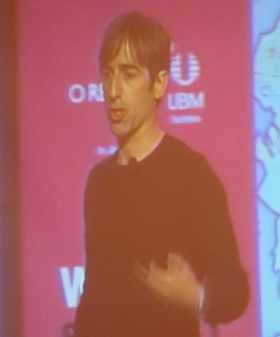
 Today at the Web 2.0 Summit in San Francisco, Zynga CEO Mark Pincus took the stage for about 10 minutes to talk about his fast-rising company. First he quickly rattled off some stats:
- 10 major games
- 1,300 employees
- 13 studios across 6 countries
- 6 acquisitions in the last 6 months
- 320,000,000 million people have engaged with a Zynga game
- 400 people focused on new IP
Pincus also noted that one game, Frontierville, has 650,000 same-sex marriages. “That’s amazing, that’s probably more than any country in the whole world,” he quipped.
Pincus said that his company’s main goal is to convince you that it’s worth it to take a 10 minute break. We don’t have time for full TV shows anymore, but we have time for short, fun games, is his belief.
So what’s next for the company? Pincus talked about something called “Dog Activated” — a more social experience across the entire Zynga network. The core idea is that if you see the Zynga dog (their logo), you know someone is playing a Zynga game.
“We have more than 3 million peak concurrent users,” Pincus said. He also said that at any given point, 4 people you know are playing a Zynga game. Yes, they’re everywhere. Zynga wants to make it easier for all those people to connect both in games and out of games. Expect to hear a lot more about this in the coming months.
Pincus also talked a little bit more about his “dial tone” idea. Facebook is the social dial tone, for example. They’re the underlying current for everything social on the web. Pincus wants Zynga to be the social gaming dial tone.