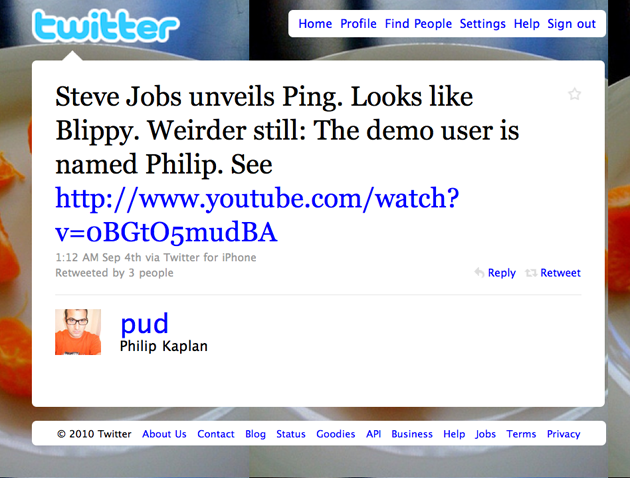
Over the weekend Philip Kaplan, co-founder of social purchasing site Blippy tweeted out a link to Steve Jobs demoing iTunes Ping, with the added sly comment ,“Looks like Blippy.” Curious about what Jobs’ movement into the social sharing space means for Blippy, we brought Kaplan into the TCTV studio and grilled him on what exactly Jobs did or did not copy, how often iTunes purchases were shared on Blippy, and whether or not the concept of social shopping has hit mainstream.
Highlights:
“I’m not saying that anybody copied anybody.”
“If Ping becomes popular, those users will potentially be looking for something like Blippy. I don’t think it’s too much of a threat”
“While lot of people were expecting more from Apple [re: Ping], if you look at the first iPod by today’s standards it’s not so great. If there’s one thing Apple is really good at its improving their products.”
“If iTunes is the only place that you shop, Ping seems like the place to to do it.”
“There’s nothing that drives an entrepreneur more than ‘It can’t be done’ or ‘That’s never going to work,’ Those are the exact things we need to hear. The fact that Apple is now basically in the same business is a double-edged sword.”
Kaplan also reveals that Blippy users have shared over 1 million iTunes purchases thus far, which comprise about 40% of the total purchases shared on Blippy (around 2.5 million). While this proportion may seem high, Kaplan is not worried about Ping as a direct competitor, as iTunes is only one of 250,000 stores on Blippy (0.0004% of total merchants). He explains the 40% statistic thus, “People who buying things from iTunes, buy things from iTunes almost twice as often as they buy things from Amazon, Ebay, Starbucks, and Walmart combined. Not surprising, considering it’s much easier (and cheaper) to buy stuff from iTunes than it is to go to Walmart.”
After privacy scuffles and many naysayers, it seems as though Apple’s foray into transaction sharing platforms is the sincerest form of flattery for Blippy and the burgeoning social shopping space which includes Woot, Swipely, and even behemoth Amazon.
“When we came up with the idea for sharing purchases and launched Blippy, the concept seemed crazy to a lot of people. But we knew that other companies would eventually adopt the model once users saw how powerful and fun it is.”
Ah. The sweet sound of “I told you so.”