
Get Extra Early Bird Tkts to September's Disrupt SF by midnight July 31 »
NSFW: Jimmy Wales Wants Me Dead (The Neutrality Of This Article Is Disputed)
by Paul Carr on Mar 21, 2010

Some weeks, writing this column is easy. All it takes is for an influential person – a politician, a business person, perhaps even a fellow columnist – to say something dumb and I get to spend a thousand words or so explaining precisely why they’re wrong. The “why x is wrong about y” construction is the columnist’s best friend: it’s as old as the hills and even easier to build a house on.

Some weeks though, it’s even easier than that. Someone will say something so breathtakingly wrong – so tracheotomy-cravingly moronic – that I don’t need to explain anything. Simply quoting their words back at them is sufficient to make the point.

Step forward, Jimmy Wales.

Speaking this week at the Guardian’s Guardian Changing Media Summit, Wales – the founder of Wikipedia – uttered the following statement when asked about the future of newspapers…

“I don’t see the added value [of opinion columnists] and question whether a newspaper should be paying large sums of money for them anymore… The best of the political bloggers are easily the equal of the opinion columnists at the New York Times.”

Those words could stand alone as a monument to Wales’ wrongness – a warning for future generations on why we must never heed the advice of a man who calls himself ‘Jimbo’. But the very fact that Wales was invited to opine about the future of news at a major conference despite having no identifiable qualifications to do so compels me to elaborate. If people take his opinion on newspapers seriously enough to ask him to speak on the subject then there’s a terrifying possibility that they’ll take him seriously enough to act on his advice.

And who could blame them? Newspaper owners are terrified – destroyed by madness, starving hysterical naked – and desperately seeking any advice on how to cauterize their bottom line. The cause of their madness is, of course, the Internet and so it’s logical – after a fashion – that they should turn to Wales for answers. After all, he’s The Man From The Internet: surely he has all the answers?

Yeeeeah. Not so much.

For the benefit of those poor befuddled newspapermen, let’s take a few minutes – and a thousand words or so – to break down all the reasons why you shouldn’t listen to Jimmy Wales when he tells you how to run a newspaper.

For a start, let’s consider what Wales actually does for a living. Or rather what he doesn’t do. He doesn’t own, operate or edit a newspaper. He doesn’t employ any journalists, has never sold an advertisement and he doesn’t have a single customer who pays to read the content he relies on volunteers to produce. For those reasons, his lack of understanding of the “added value” that high profile personalities bring to newspapers is understandable – forgivable even. Or at least it would be were it not for the fact that Wikipedia uses Wales’ own high profile personality to encourage its users to donate money in order to ensure its survival.

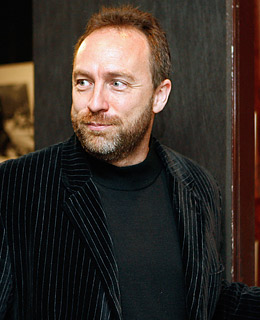
“A message from Jimmy Wales” reads the banner at the top of Wikipedia entries during the site’s regular donation drives. These banners link to a personal appeal for support, written by Jimbo and complete with an above-the-fold photo of his face. Jimmy Wales is the first encyclopedia editor since Alain T. Britannica to build a cult of personality around the gig. Why? Because he knows that personality creates familiarity, which in turn creates loyalty, which in turn creates value. Except, apparently, when it comes to newspapers.

Which takes us to the real nub of Jimmy Wales’ wrongness. No one would argue that the newspaper industry – in print form – is screwed. Speaking at the same Guardian conference, media commentator and Murdoch fanboy Michael Wolff summed the situation up nicely when he said “Every big-city newspaper in the U.S. is either in bankruptcy or will be in bankruptcy in the foreseeable future – that’s 12 months. The newspaper industry in the U.S. is over”.

The future of news is online, but that future brings with it the total commoditisation of facts and the death of straight reporting as a way to drive reader loyalty. Newspapers aren’t just competing with other newspapers, but also with Twitter and Facebook and blogs and thousands of other channels through which facts can be disseminated. If one paper puts its news behind a pay wall, the chances are that same news will be available elsewhere for free. Even with high quality investigative reporting, if the story is big enough then someone will simply rewrite it – perfectly legally – and post it on a blog, where it will then be reblogged and retweeted and aggregated. (The aggregators themselves encourage this: Gabe Rivera told me recently that the best way for a blogger to get content on Techmeme is to paraphrase something that previously appeared behind a pay-wall).

The battle to force people to pay for general news, then, is lost. Likewise, thanks to micro-aggregators like Techmeme and macro-aggregators like Google News, the fight to maintain reader loyalty through news reporting is finished too. Sure, some people may still cling to the BBC or the New York Times out of habit, but the trend towards decentralisation – with readers choosing their news source on a story-by-story basis – is inexorable.

There remains, however, one reason to remain loyal to a single newspaper – or at least to visit that newspaper’s online edition every day. And that’s for its editorial voice: the unique tone with which a publication interprets the basic facts of a news story and helps us form an opinion on it. Which, of course, is where columnists come in.

Columnists – and other opinion-driven journalists – are the heart and soul of a news organisation: they’re what makes us tune in to Fox News (Glenn Beck, Bill O’Reilly) or MSNBC (Keith Olbermann). They’re why we buy the Wall Street Journal (Peggy Noonan) or The New York Times (Maureen Dowd). Newspapers know this of course, which is why when Murdoch desperately (and misguidedly) wanted to protect hard-copy sales of his flagship UK tabloid, The Sun, he removed his big name columnists from the web and confined them to print.

Wales may claim that the best political bloggers are better than their mainstream rivals but he’s wrong about that too. For a start, professional columnists carry with them the weight of their entire publication. Maureen Dowd’s opinion pieces are so powerful because they are packed with insight and fact, much of which stems from the access she enjoys as an internationally recognised columnist. The vast majority of independent political bloggers can only dream of that kind of access and are instead forced to rely on second-hand reporting for the basis of their writing. But even if a political blogger does manage to deliver the goods, it’s only a matter of time before they’re snapped up by the mainstream media. I don’t care what crap they spout while they’re struggling to make it, every political blogger in the world would kill their own puppy to write for a nationally – or internationally – recognised publication. The first thing Nate Silver did when FiveThirtyEight went stellar? Take a gig at the New Republic.

This symbiosis – columnistists clamouring to write for newspapers, and newspapers needing great columnists to define their voice – is where the real key to the survival of newspapers lies. Rival papers, and bloggers and Twitterers may summarise and rewrite your news scoops, depriving you of readers, but they can’t do the same with your columnists. Personality is simply not reproducible – there’s only one Maureen Dowd and there will only ever be one Glenn Beck (inshallah) so if readers want to hear what they have to say, they have to go to the source. Moreover, while news ages rapidly, opinion doesn’t. A story published online by the New York Times is dated the moment it appears and people begin tweeting out the key facts, but a well-crafted opinion column has an infinite shelf life.

For all of these reasons, only the most imbecilicly terrified newspaper editor would heed Jimmy Wales’ advice and fire their most valuable assets. For all the others, there’s actually a compelling argument to do precisely the opposite. It’s comment and opinion, not news, that really adds value to newspapers in the Internet age – and as such the really smart editors will get rid of all their costly reporters and use the money instead to fill their pages with nothing but highly paid opinion columnists. Only then can newspapers be assured of their survival.

I know it sounds scary, newspaper owners, but you’ll just have to trust me on this one. After all, I’m The Man From The Internet and I have all the answers.

Advertisement
Advertisement

Comments rss icon

  • Nice ending you put in there Paul. :)

  • I’m with Wales on this. There is no need for newspapers or pundits really. I haven’t watched TV news in over a year, and haven’t picked up a newspaper (unless it was thrown at me in the metro) in two years. I care not for some journalist’s opinion, just for the hardcore results or evidence, and from there I’ll come to my own conclusion.

    I follow all the major news organizations on RSS or Twitter, but I do not read their Op-Eds. Just want to know what’s going on in the world (hence I read the same piece from multiple organizations).

    The days of paper media are gone.

    • Yes, I agree. I think its now near to impossible to force paid content for the big newspapers. Everybody is used to it that news are free. All the big players got in the net for free (many years ago), to test the waters. They missed it to get paid for their content and now its to late.

    • @sabint

      Hopefully, you’re not referring to this?

      A new light:

      News example:

      March 22, 2010: One of TC’s writer wrote a column about Jimmy Wales

      Another News example:

      Today, TC ditches ‘jimbo’ on his utterly-idiotic speech about running your own newspaper mill.

      Me? I prefer the latter — the news with some compelling ‘comment’ running down the sentences, never fails to spur some thoughts on the reader’s mind.

      What you’re saying is just an objective experience, basing from your experience only.

    • “..no identifiable qualifications”

      And Paul Carr’s qualifications are? I guess being a Wikipedia/Wales hater.

      • I think the journalism degree would probably count.

      • I am very thankful for what I have learned from ‘unqualified’ people over the years.

      • Actually, Paul’s qualifications are as a columnist and author, and a very good one at that!

        I understand your desire to defend Jimbo, but this article is not character assassination. Paul simply doesn’t think Jimmy Wales is right in saying amateur bloggers will put all the professionals out of business. “Many” will be looking for work, but not the best and most popular!

        Case in point: after reading Paul Carr’s free-e-published book “Bringing Nothing to the Party” I have come to believe his unique voice and insights ARE worth following, AND worth paying for.

        Paul’s ability to make these quality insights are a mix of his writing prowess, intellect and a privilege of the position & contacts he has.

        From that perspective, I hope the incentive remains for people like Paul to come to prominence, and be remunerated for it!

  • How is this NSFW? Stop using that tag to drive traffic, dammit!

    Other than that, Paul, I appreciate your point, but I think your vitriol against Wales is misdirected. He’s neccesarily interested in the cause of neutrality and non-opinionated writing- he spends all his days trying to fend off academics attempting to dismantle his not-for-profit project on the basis of supposed systemic bias.

  • Good article!

    And I guess it’s true, I come to TC not for the news, but rather for all the commenting that goes around it.

    Keep it up TC!

  • Marc Andreesen “doesn’t own, operate or edit a newspaper.” Should we ignore his opinion on newspapers too?

    • I get the sense Paul feels a little bit threatened!!!…..

      • Since he has a job at a website, I don’t think he is.

        • I mean he feels threatened from the standpoint of a columist…….when jimbo makes comments like…”I don’t see the added value [of opinion columnists]”

          you see…with citizen journalism and crowd sourced news avenues….you get the real news, pure and factual…..not thru the eyes of people like Paul Carr…..who knows what benefits might accrue to him if he even soo much as twist the story line a little bit!!

          Paul, I am sorry but, this is your job…and when a person is paid to do something………

          • Citizen journalism? Give me a fucking break. Most citizens do not have the breadth and depth of knowledge, the time, energy or commitment to investigate, analyse and report a story. The ones that do we pay and call them “journalists”. All the half-assed thinly-veiled plagiarism on “aggregator” sites or Twitter or MyFaceBuzz or whatever does not compare.

            Furthermore “citizens” are not all objective, impartial, clinical observers with no political leanings, no bias/prejudice/opinion etc. So your retarded claim that you get pure facts from your friends and neighbours is staggering in its naivete.

            I highly respect newspapers like The New York Times, The Guardian, The Independent etc. Yes, they have an editorial slant – that’s fine with me. It gives me something to argue against. They make their money, like this site, by adding their insights, opinions and personality to the reports; and making it worth your money (or page views).

    • Yes, if he’s claiming to know simeting as an expert. If it’s just a personal opinion, who really cares what he thinks about newspapers?

  • One point you may wish to consider, Paul. If you have a job that thousands of people could do just as well as you can, and they would, in your colorful phrase, “kill their own puppy” to do it – you may wish to rethink your view on the economics here.

    The New York Times tested your theory – that people find value in the opinion columnists – TimesSelect. We all know how that ended.

    • @Jimmy have you come across this thing called politics (with a little p) a columnist in the gruniad, times or NYT has far more influence where it really counts. Do you have any idea how powerful and the lobbying pull that Murdoch and the Barclays bros have. Media moguls don’t buy big newspapers for altruistic motives.

      The fact that the days of city newspapers are numbered yeah so what? the fact that USA should have consolidated into national papers (you know like the rest of the world did last century) is neither here nor there.

      A lot of people in the web2.0 industry shouldn’t be let out side with out minders I sometimes think, look at the howlers coming out of Google is Matt Cutts the only person in google who knows anything about politics.

      I think what we have hear in is an example of Unconscious Incompetence

      • Based on your total destruction of the English language in one single post, please refrain from commenting on anything involving words, sentences or really anything more complicated than a photograph with lots of lens flare.

        • Thanks mate but after living with dyslexia for a while now I get used to the tossers like you .

          Ok so I missed a couple of .’s out Big fucking deal the sense of what I was saying is perfectly clear to anyone who has an IQ greater than 90.

          Its a fracking comment not a oxbridge fucking essay.

    • Jimmy, I’m curious: for a newspaper, do you see anything worth keeping ‘in-house’ in terms of content creation?

      I’m wondering if this is the bigger issue here.

      • Yes. Thanks for asking. What I said at the conference, contrary to Paul’s comical misunderstanding, is that we know that communities can and are doing some things quite well, and that communities – at least so far – aren’t doing other things. A smart newspaper would take note of the changing landscape and understand that the things that can only or best be done in-house with paid staff should be done by paid staff, while things that the community can do should be done by community. Getting the balance right is going to be hard, and there are no easy answers.

    • Thanks for the comment, Jimmy.

      I guess whether my economics are wrong depends on whether you’re right about there being thousands of people who could do what I do just as well as I do. If that’s true then why am I well paid for my work when at least some of those thousands would probably be willing to work for free just to get their words on TechCrunch? Am I just lucky? Is Arrington in the middle of some Brewster’s Millions-style quest to get rid of his millions? Or are you wrong?

      Taking opinion columnists as a whole, my argument is that the highly paid ones who write for newspapers are highly paid because they are the best at what they do. Or at least that no one else could do what they do in the way that they do it. That includes political bloggers – if they’re really better than Maureen Dowd or Glenn Beck then they’d be hired by the New York Times or Fox News.

      If the value they add to their outlet wasn’t greater than the salary they receive then they’d be fired – that’s basic economics. Pointing to TimesSelect just shows that people won’t pay directly for comment, not that it doesn’t have any overall value. There’s almost nothing in newspapers that readers will pay for directly online (although back in the UK I used to buy the print edition of the Guardian at the weekend just for Charlie Brooker’s column) – the question is whether that content brings enough value to advertisers so as to justify the high salary.

      I’m pretty sure most people would balk at paying a subscription fee to access Wikipedia – but does that mean its content doesn’t have value. Are there thousands of sites doing what it does?

      • Consider that there are countless thousands if not more people who would have been just as qualified if not more so than Hitler to wreak madness and destruction. The dynamics of the system was simply that by definition, there could only be one Hitler, and at the end of the day, of all the qualified candidates, the person who gets the job gets it based on dumb luck… If candidate X and Y are both equally qualified, but candidate X happens to beat out candidate Y for the job of editor of the high school paper based on a coin toss, then the law of increasing returns kicks in and pretty soon candidate X might parlay that high school paper editor gig into increasingly powerful resume fodder, while candidate Y might spiral into a life of poverty, all on the basis of that one coin toss. It’s the butterfly theory, and it’s been proven mathematically to be real.

        The point is that the rules of the game are changing. The dynamics of the system are changing. Where before there were only a few job openings for qualified columnists, and each columnist had hundreds of thousands or even millions of followers, we’re slipping now into a future where there will be far more columnists, each with quite a few less followers. This change is coming about because the dynamics of how information flows through society are fundamentally changing…

      • I don’t know if the NYT would replace Dowd with a more talented columnist at this point. Clearly there are aspects besides talent that would go into that equation. The NYT has invested a lot into the brand of Dowd and would likely ride out that investment. Dowd, like many others in similar positions, probably had the three Ts of talent, tenacity, and timing work out in her favor. The fourth T is already kicking in: Tired. Dowd’s work has become tired and probably Dowd’s fan base is becoming tired.

        I think a real test to the editorial opinion columnist question will come from the NYT: will they invest in creating a new generation of opinion columnists or is the current batch the end of the line for them

      • “That includes political bloggers – if they’re really better than Maureen Dowd or Glenn Beck then they’d be hired by the New York Times or Fox News.”

        Unless those are legacy positions in a negative-growth area of journalistic content, in which case mediocrity isn’t a reason to expect turnover.

        Not to say those two don’t bring eyes to the screen. It’s just hard to credit their work as irreplaceable. Do you actually believe Dowd (who mindlessly lifted a Josh Marshall ‘graph last year) and Beck in particular produce higher quality editorial opinion than top-tier political bloggers, or are you just being colourful?

      • As Wales suggests above, most people do not perceive value in the opinion of famous columnists, for better or for worse. Turn the WWW upside down and you get MMM, or Mashup Mediocrity Monster.

        Speaking of the NYT, one may want to read this Sunday’s “Texts WIthout Context” at http://www.nytimes.com/2010/03/21/books/21mash.html

      • Janet Rae-Dupree - March 21st, 2010 at 5:24 pm UTC

        Actually, Paul, I suspect that first marginally-literate response to Jimbo’s comment here proved your point, as do the various trolls and dimwits that regularly appear in comments. It is a rare writer who can regularly produce high-quality commentary on demand. That’s why the professional pundits get the big bucks. Anyone who contends that “thousands” of others could do just as well clearly aren’t exposed to raw copy on a regular basis. Or they aren’t reading the comments sections under blogs. Same problem.

      • Okay, I’m seeing Paul Carr being fired by Arrington

      • Why are you well paid for your work? That is the million dollar question. Personally I think Arrington was on a major philanthropic endeavour when he hired you Paul. All you really have to trade on is your failure from your past.

        Opinions don’t interest me, because it’s just one person’s opinion, which doesn’t mean it’s even based on fact, which, like your column, I don’t think is worth sh*t.

        The only reason people read the drivel your write is because it’s posted up on this site, and even then, half the people who could be bothered to comment, remark on the NSFW title.

      • ” That includes political bloggers – if they’re really better than Maureen Dowd or Glenn Beck then they’d be hired by the New York Times or Fox News.”

        This argument is based on the idea that all writers of worth WANT to work for big name publishers, with big time editors that have the final say.

    • Newspapers won’t be dead in the next 12 months, any more than the TV news networks will go away.

      There’s still a large population who don’t read blogs, subscribe to twitter, RSS or think that MySpace is the font of all knowledge.

      And those people actually continue to have a fairly big influence in, oh, federal elections and buying soap powder so they’ll continue to spend advertising dollars to keep the medium alive (and both sides of the political fence)

      I’m not sure that getting all my news from random third parties online is any better than politically motivated big media but does anyone really think that Techmeme and Huffington Post are actually going to provide the sort of reach and insight that the current players provide.

      I would love to the big media take back the role of the Fourth Estate and actually become a viable force for social good again – questioning and digging in the interest of their readers rather than touting press releases as news

  • While I’m still unsure why you’re a better source than Jimbo, I like the overall idea of the article. Do opinions have their place and time? Yes. Should OPINIONS replace FACTS as you seem to suggest? No. I don’t want one skewed view or another I want the hard numbers and verifiable information. I can mkae my own opinions and, personally, would die a little bit inside if NYT or LAT became all opinion and no fact. Is the idea that opinion columnists be fired absurd? Yes. Is the idea that they should be the only writers for a paper equally absurd? Yes.

  • “There remains, however, one reason to remain loyal to a single newspaper – or at least to visit that newspaper’s online edition every day. And that’s for its editorial voice: the unique tone with which a publication interprets the basic facts of a news story and helps us form an opinion on it.”

    I somewhat disagree with both Jim and Paul.

    Wales overlooks the real value of editorials, which Paul succinctly illustrates. However, Paul, one thing I think you’ve overlooked is investigative journalism.

    I think burgeoning crowd-sourced local news method is going to grow, because it presents a new (and likely cheaper) model for investigative journalism. Facts are facts, but we want the dirty details uncovered. IMHO, newspapers can get a lot of traction by harvesting these emergent local news devices.

    Personally, I’d pass on a tone if I could get a assortment of insightful and diligent investigations. In fact, I’d most like a number of in-depth investigations presented with dueling editorials.

    • See, the problem with this is that while newspapers can dig and find the -good- details, all it takes it one tweet summarizing it, or a blog post paraphrasing it, and that’s traffic lost from the newspaper.

    • I have read through the article and all the comments and feel that Mark hit the nail on the head. Investigative journalism not celebrity opinion writing is the source of our trust in the brand of any newspaper (i.e. publishers online and offline of news). It’s not the tone but the shared values that the editorial captures and transforms into loyal readers. Needless to say, many newspapers lost this popular role long before the web. In its stead, classified advertising was encouraged as the answer to this loss of traditional media’s role as the fourth estate. While Craiglist and other online services have destroyed the classified revenue stream, newspapers are now having to face the problem they have avoided for decades. Namely, what is the added value created by news publishing?
      Newspapers have steadily eroded the role of the investigative reporter. In lieu of hard facts and persistent digging, the newsdesks have more and more promoted hacks to regurgitate copy from the wires alongside various efforts to paper over the dereliction of fact-finding reporting (these vapid “strategies” included a McFlurry of campaigning journalism, lifestyle features and the opinion pages). The problem is that Techmeme and Google now perform this role better than the newspaper industry.
      I personally think that news publishing is an activity looking for a new online solution. There will always be a need for news, and it is hoped that there will be a solution that re-captures the spirit of investigation and expertise. Techcrunch is trusted because the editorial bias promotes a niche filter of expert tech writers to mediate. This works well in niche reportage. It is more difficult in general news and current affairs.
      This is where I think @anywhere has passed under the radar. As a news junkie, I use only Google Reader and Twitter. I think @anywhere may provide the mechanism to keep eyeballs on the pages of the originating news publisher, fusing the power of social commenting and distribution. More importantly, I think it promises to protect news publishers and blogs. Maybe it won’t be @anywhere that encourages publishers to create newsworthy stories (including opinion and features), and most importantly breaking news and expert analysis. News desks should concentrate on reinvigorating good journailstic copy for when @anywhere or something else work out how to recreate news as value-added content.

  • Agree with nearly everything Paul has written, except for the inevtability of aggregation as a primary news source–that’s only true for a small percentage who live on a diet of tweets, pokes, and breathless friend feeds. Most Internet users don’t.

    What is unfortunate is that Jimmy Wales gets so much coverage about his non-relevant opinions. It’s like when Tom Clancy, a novelist, started being quoted as a military strategist or expert on global politics. Create yourself as a brand and people will listen to you like you’re an oracle.

  • Wales has a point, in that most opinions being READ are now those of influential bloggers and blog sites. But the lines are blurring. When do we get to the point that all news is basically found on blogs, and there is a heirarchy of blogs depending on ‘circulation’ or the new term for that, page views. Popular blog sites are becoming much like newspaper sites, while newspapers are rapidly becoming web services, in which case they are really just morphing into formal and elaborate blogs. Entire sections of these newspapers (such as the LA Times Tech page) are being replaced online by a team blog format. So the best bloggers actually get paid more. I don’t really see a big difference between a popular blogger and a columnist.

    Oh and by the way, the photo of Jimmy wales is distorted. Looks like it’s been stretched to fit into a square box. Why? Many of the photos accompanying stories on Techcrunch are similarly distorted and stretched It’s wrong and it makes your site look amateurish. You wouldn’t see that in a newspaper. :)

  • I’ve never bought a newspaper for a columnist. I hardly ever buy newspapers anyway. Perhaps that’s the problem. Maybe the people who do buy newspapers do buy them for the columnists but that isn’t appealing to the vast numbers of people who don’t buy newspapers.

  • So… Wales was not talking about paychecks ?

    Seems he was.

    As the quote is published here in this post, I can’t see anything wrong with it.

  • I see an aggregation service like Techmeme as keyword driven and a quality news service like Techcrunch as commentator based. If I know specifically what topic I want to read i head for Techmeme or Google and use keywords. But if I want my daily read it’s Techcrunch. I rely on TC to feed me news they perceive as important because I developed a strong trust in them.

  • George Washington - March 21st, 2010 at 10:30 am UTC

    One thing is true for both mediums:

    The people whose opinion would actually be worth anything are the least likely to express it.

    This was always so in print and is turning out to be more so in bytes.

  • Hmmmmm….. not with you on this one.

    In fact, he’s indirectly promoting what you do for a living.

  • Lol, entertaining as always.

  • Hang on how on earth is this NSFW????

  • Needless to say Paul you either already have a column in a major newspaper or you’re gunning for one. I for one don’t see anything wrong in Wales’ opinion.

    The days when people followed a newspaper for a particular columnist are either gone or fading. Besides, News broadcasters like BBC & CNN offer all their content for free online – I’d see much more interest in people wanting to follow TV News personalities and their op. And Free.

    • @Shailesh Banta

      Commercial websites are driven by ad revenue (events etc) and need as many eyeballs and views as they can get.

      I would say online columnists often favor a stronger or biased opinion rather than a close examination of both sides of an issue so they can get more comments and audience participation and pageviews… hence a lot of online content behaving essentially like link bait.

      What’s even sicker… is we like it that way :)

  • I think this post is fairly silly. While I disagree with Wales, I think it is a legitimate point to argue, certainly not “breathtakingly wrong – so tracheotomy-cravingly moronic.” Carr’s logic is broken in several areas. For example, though Wikipedia doesn’t make any money selling ads, that is not a reflection of Wales’ inability to create valuable content & drive traffic, it’s a reflection of principled stance he has taken.

    • Well, I think, and I’m sure this may annoy Paul much more than anything I said at the conference the other day, that there may very well be some economic value in writing outrageous and inflammatory schlock that insults and doesn’t make sense. If you’re really good at it, you can help drive traffic to the platform.

      So he may have a point – in the short run the worst and most bombastic columnists may actually get paid to do it, while the most thoughtful commentators who actually move a the global conversation forward may do it as a labor of love on blogs that become popular but never quite achieve financial success.

      This provides an opportunity for a serious newspaper to build brand. Get rid of the kind of columnists who write the sort of thing you quote above, replace them with people who are willing to engage in nuanced and thoughtful argument – and give up some short term pageviews in favor of building a serious brand with longterm value.

      • Sorry, Jimmy, that doesn’t work. I can tell you from personal experience, nuanced and thoughtful argument does not pay. You may find this amusing in an ironic way – a while back, several Wikipedia critics had a long discussion about why mainstream Wikipedia coverage was so poor (ironic in that I know you’ve bemoaned the same problem). I made the point that there’s no incentive to get it right. The naive argument is that the person who gets it right then is “building a serious brand with longterm value.”. But while that sounds nice, it’s wishful thinking. The argument in fact begs the question, by assuming the conclusion that such brand value is significant in the first place. Much as it might metapsychically offend someone of Objectivist leanings, accuracy is very much a non-market quality, needing support from other social institutions.

        This whole discussion has a flawed premise because it presumes “opinion columnist” is something like “investigative journalist”, whereas at the top level it’s more akin to “talk show host”. Why do some TV talkers get big bucks, when there are many people who would do that job just for the celebrity itself? Well, it has to do with complex network effects and similar issues. The shibboleths about bloggers are just confusion.

        • Some things are more important than bottom lines.

          While I consider both Techcrunch and Wikipedia to be excellent resources, the loss of Wikipedia would leave a far deeper scar on humanity. For Paul to outright dismiss Jimmy’s journalistic credentials is a very childish defense mechanism. I doubt Paul would be ashamed to have ‘creator of Wikipedia’ on his resume.

  • I agree with Jimmy Wales. Newspaper op-ed writers aren’t as important or influential as they used to be. They no longer warrant higher than average salaries.

    Don’t know why you got your panties in a bunch over this one. Equating a TV personality like Glenn Beck to a newspaper personality like Maureen Dowd is completely apples and oranges. Maureen adds value to NYT, but incidental value. I would never buy a newspaper simply because of one columnist and bet the majority (over 90%) of readers feel the same.

  • Sorry, I think Wales got this one right.

  • I trust opinion columns/editorials in making my intake of the daily news barrage slightly more palatable. But nothing like bringing in some good old facts to weigh in on an argument. In this case for instance, quoting (or conducting) a survey showing a breakdown of reader/viewer preference for opinions versus plain old news would have been more effective than trashing Jimmy Wales’ point of view.

  • Still reading this a second time but I’b pretty sure I disagree with most of your argument Paul. Some of these old school columnists make big, big dollars, and an awful lot of them have already been let go. Sure they bring a ton of value, but when there is suddenly a minor league system of bloggers competing with them, they don’t look quite so special. Maybe the market will eventually bear a couple of hundred thousand dollars a year for someone really good. But a million dollars? Dunno.

    • There’s nothing wrong with disagreeing with your colleagues in public, but you should have your position straight before taking the dissent outside house.

      If Paul’s primary point is that Jimmy Wales shouldn’t stick a fork in a given industry simply because Wales couldn’t possibly have the experience to make that call or even have supporting data at hand; then Paul is probably right. The question posed in this article isn’t whether or not old media is dead.

      Rather, the article asks whether or not the opinion of every Tom, Dick and Harry with a successful Web site; should be taken as gospel.

  • Hi Paul,

    Didn’t you get fired for having an opinion at a national newspaper…. now that’s ironic!

    Great read again :)

  • One point he misses is that its very possible for high key columnissts to go away from their newspapaer and start bloging (its not impossible to live from this). So I think newspaper are in a big mess (their own guilt).

  • This is a brilliant article. The ideas it expresses may be (and should be) ripped off by countless others, but I don’t think that these ideas can be expressed any better, any more succinctly and elegantly than you’ve expressed them here Paul.

    As if driving home your point, as much as I like the clarity you bring to this much discussed and much misunderstood topic, the thing I like best about this article isn’t the soundness of your logic, but the style on display in this cute little snarky comment: “there will only ever be one Glenn Beck (inshallah).” It’s this that got me clicking on your name and wondering “who is this guy, and what other stuff has he written?” Tech Crunch would do well to heed your advice and to place a picture of you above the fold of this page, Paul Carr.

    Looking forward beyond the immediate future, I would say that decentralization and specialization is going to manifest it’s self in more than just readers choosing their news source on a story-by-story basis, it’s going to also manifest in readers forming more ‘personal’ connections with ‘columnists.’ These sorts of ‘personal connections’ don’t scale as well as the Orwellian hysteria of fame and fortune which, ironically, has served as the bedrock for skyscraper institutions such as the New York Times — and why should they. Can it ever be sane, or safe, for a single person to have a loyal following of tens of millions of people? Yes, the future portends many more columnists, each with a small following, and many fewer ‘journalists.’ The journalist of the future will be supported by these columnists, and the journalist of the future will have to report on more than just bland facts that any of these columnists can dig up… the journalist of the future will have to dig up truly original material, and sell it to the columnists, like so many gaga images of Jackson in the ambulance.

  • “But the very fact that Wales was invited to opine about the future of news at a major conference despite having no identifiable qualifications to do so compels me to elaborate.”

    I find it terribly ironic that Mr Carr chooses to question Mr Wales qualifications. The very columnists that Mr Carr is defending (and worse yet newspaper editorial boards) routinely publish columns and editorials on complex scientific, economic and other issues that they rarely have the scientific or economic education to properly understand and evaluate.

  • This is an awesome piece of writing buddy.

    I too am sick of Jimmy Wales’s smugness :O

  • “Maureen Dowd’s opinion pieces are so powerful because they are packed with insight and fact, much of which stems from the access she enjoys as an internationally recognised columnist. The vast majority of independent political bloggers can only dream of that kind of access and are instead forced to rely on second-hand reporting for the basis of their writing.”

    While it’s true that the clout of writing for the New York Times virtually guarantees returned phone calls from high-placed sources, I think you could have picked a better example than Maureen Dowd of a columnist who uses that clout to do first-hand, in-depth reporting.

    • She was just the first Pulitzer Prize winner that I thought of.

      • Not a problem, but she won the Pulitzer for distinguished commentary for a series of columns about the Lewinsky affair. She’s certainly not the only person whose Times column sometimes feels phoned in, with more flash than substance, but you’d probably strengthen your argument by choosing an opinion columnist who does actual first-hand reporting — of the substantive kind rather than (a la Thomas Friedman) talking to friends and cabbies.

        There’s certainly a debate to be had here about what “opinion columnist” really means. I’d think to more clearly distinguish between themselves and the “independent political bloggers … forced to rely on second-hand reporting for the basis of their writing,” mainstream columnists really ought to prove their worth via original reportage. That seems a finite resource, while the supply of “acerbic attitude” appears inexhaustible.

    • Agreed 100% I find Maureen Down’s columns silly to the point of being almost unbearable (there are occasional good ones, I know). As a writer, as someone with wry wit, as someone with insight, etc. she doesn’t hold a candle to Frank Rich or Krugman. I suppose it’s irrational, but the repeated holding up of Maureen Dowd as a shining example of a columnist detracts from the overall point – I’d pay to have her column replaced by someone else, anyone else :-) Of course I’m only one reader, so no need to take this with more than a grain of salt. I just found her to be a really weird choice here.

Leave Comment

Trackback URL
Short URL
Advertisement