 I’ll say this about Brazilian startups—they’re certainly not dominated by Web copycats. Perhaps it’s because there aren’t a huge number of Brazilians who’ve made it big in the Valley transmuting the local way of doing things back home or because there’s not a lot of US venture capital flooding into the country. Perhaps it’s the country’s noted isolationist streak, or perhaps it was just the startups I lucked into meeting.
But whatever the reason I saw fewer “We’re-the-fill-in-the-blank-Web-company-of-Brazil” ventures than I have in any other market to which I’ve traveled in the last few years. Many Brazilians I spoke with said it’s just part of their nature, that they’re not competitive (tell that to fans of opposing soccer teams), and that they’d rather chase “green field” – or, as they say, “blue ocean” – opportunities. See, they don’t even use the same color to describe opportunities.
No matter the reason, after nearly 30 weeks of emerging market travel it was refreshing to go to a country and see things that are unequivocally new, even if risky and a bit, well, wacky. To make the point, here are three of my favorites: Companies that make bugs, houses and diamonds.
The World’s Ickiest Factory: Bug is one of most aptly-named companies in the world. This company makes bugs. No really, I saw the factory: Millions of eggs, and jars and jars of larvae and cocoons. There’s a “cook” on staff who makes up the peanut-buttery solution these bugs feed on and each room is kept at an optimal temperature for that stage of bug development. Like something out of a sci-fi movie, the company is growing natural predators for common agricultural pests, so that farmers can move away from pesticides in accordance with a growing wave of worldwide safety regulations and the organic food movement. It’s combating a caterpillar with a wasp—like nature intended– but rather than selling live wasps, it sells wasp-infected caterpillar eggs and cocoons. Think of them like thousands of little Trojan horses being dropped into Brazil’s sugar cane, tomato, and soybean fields.
Brazil is the second largest agricultural country in terms of exports and the largest pesticide user in the world, recently overtaking the United States. The company is only doing a few million in revenues but is hugely profitable. That’s the good thing about growing something found in nature—it’s pretty cheap once you figure out the optimal way to do it.
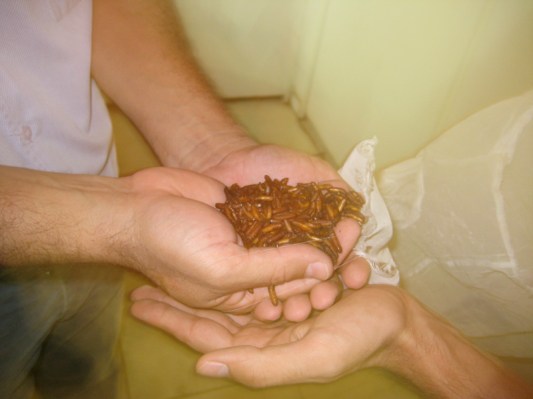
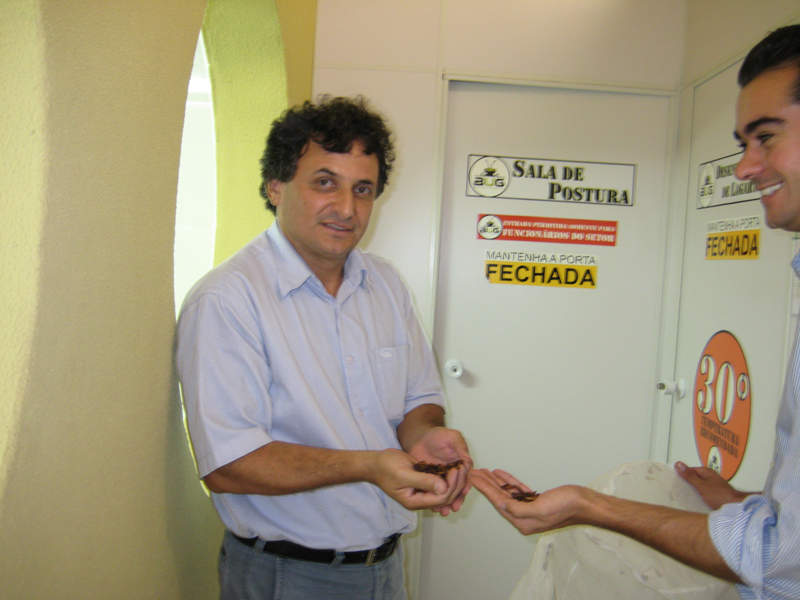
But even without all that, I would love this story because Heraldo Negri, one of the co-founders, is just obsessed with bugs. Since he was 19-years-old he’s photographed pictures of bugs in every stage of life. He has albums and albums of them and even started a niche publishing house to produce his bug books for the masses. He doesn’t seem to think this is weird at all. When he handed me a stack of his books on bugs he exclaimed, “Your husband will love these!” (Note: My husband has a horrible fear of spiders.) That’s Negri above, standing on the left. What you can’t see from the picture is that he’s holding two fistfuls of larvae. Here’s a close-up….
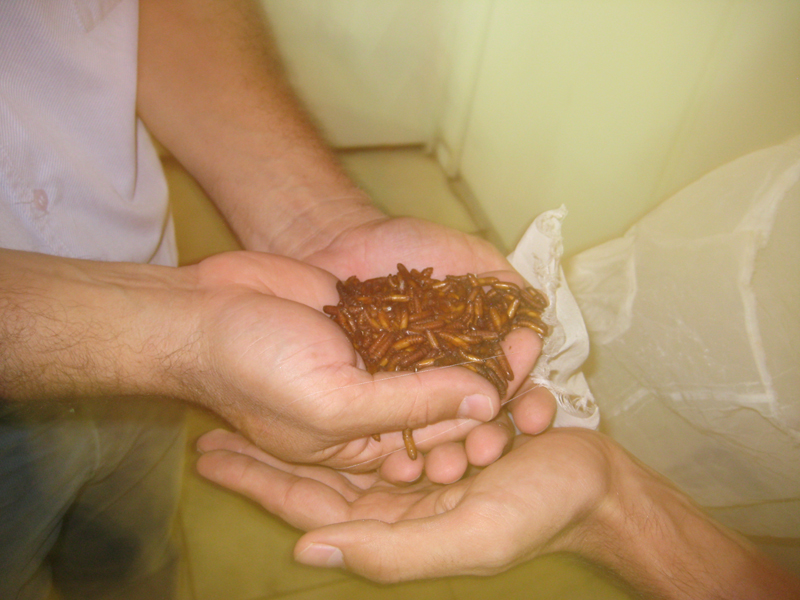
Negri—a former college professor who lives several hours outside of Sao Paulo— always wanted to be an entrepreneur but says he never quite had the guts to take the plunge. But the sheer obsession with the idea and technology drove him to take a sabbatical (which he intends to be permanent) from his university teaching job to run this company full-time.
Bug is funded by Fundo Criatec, a government-sponsored venture fund. It’s one of its hottest companies and Francisco Jardim (standing to the right in the main photo), who’s in charge of the fund’s deals throughout the state of Sao Paulo, drives out to Piracicaba meet with them several times a month.
Bug was a risky investment deal in a country that doesn’t take a ton of venture risk. The technology was there, but several VCs walked from negotiations because the company didn’t yet have local certification to sell to farmers. Now, it is one of the only ones that does, and its biggest problem is meeting demand, so it’s investing in better, larger bug-growing facilities. (Right now they’re largely using a series of houses and an old supermarket.) Certification is a process that takes several years, and tellingly, some big multinationals and other upstarts recently applied for certification, Jardim says.
How to Build a House in One Day: It doesn’t take much travel to see that millions of people in the emerging world need better housing—hell, you could just watch “City of God,” “Slumdog Millionaire,” or earthquake footage from Haiti. Or just visit 16th and Mission in San Francisco. Much of the emerging world is living in makeshift structures that are missing walls, doors or decent ceilings. That’s what makes BS Construtora so potentially exciting not only for Brazil but the entire emerging world.
BS Construtora was started 14 years ago and for many years was just a small business known in agriculture sectors for its ability to build structures 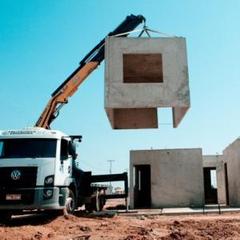 such as silos faster than the competition. 2006 was a bad year for agriculture in Brazil, and the company had to look around for other customers. The founder Sidnei Borges dos Santos, a former brick layer, was looking at a shoebox when he had the idea for how to build a prefab house quicker than the competition. Rather than pre-make parts and assemble them wall-by-wall and beam-by-bean, what if he made a mold that could lay the concrete for the whole room in one big piece, add the shutters, paint it and throw it on a truck? The molds leave room for plumbing and lighting and plop the houses on the ground just like the inspiration–an upside-down shoebox.
Today the company can build a house in 24 hours. It’s currently building a whole city complete with 1,600 houses, electricity, phone lines, Internet access, schools, a hospital, a police station, a fire station and a shopping mall in the Amazon for a crew building a hydroelectric dam. The photo of the village I saw looked eerily like where “The Others” live in Lost, but a house built on the cheap in 24 hours isn’t for show—it’s for necessity and speed. And there’s a ton of need in the world for this product. The company is meeting with governments of South Africa, Ghana, other parts of Latin America and Asia to talk about expansion.
The problem is thin margins. So far BS Construtora has been financing itself mostly through working capital while trying to dramatically increase capacity. It can build 20,000 houses in a year and CEO Marcelo Miranda wants that up to 30,000. In another year, the company will start looking at raising some funding to help grow faster, he says. For now, he wants to give the valuation some time to build, given all the growth the company is seeing. The houses go for between $15,000 and $140,000, for nicer-non-Lost-like models. The company is also developing some new four-story models to get farther into the commercial market.
BS Construtora gets a few big corporate or government funded projects like the village described above—a $120 million-plus project—but the bulk are developed and sold on the real estate market. The former is likely lower margin but less volatile, and the latter is the opposite. Between the two, though, the company generated an impressive $100 million in revenues last year – made all the more impressive by the fact that this is a startup that hasn’t received any external funding, operating in an emerging market.
In a decline-of-America-side-note, Miranda recently completed Stanford’s Sloan Program for management which is like a mini-one-year MBA. He got 13 other job offers upon graduation, including some impressive ones to head up multi-national divisions in Brazil. (He asked me not to disclose specifics.) He gutsily chose to take this rather uncertain post at BS Construtora last year—at nearly half the pay he was offered elsewhere– despite the fact it was mostly an idea with little execution.
Why’d Miranda go back to Brazil? Part of it was a desire to build something in his homeland. Part of it was when he interviewed at companies in the US they intimated that there was pressure to hire only Americans. “It was the wrong time to be there,” he says. “The feelings were not good for a foreigner like me.” Looks like that brain drain isn’t limited to India and China.
Drilling Your Teeth the P-Diddy Way: Another Fundo Criatec investment is CVD. (I know, it’s not nearly as well named as Bug.) This company makes man-made, multi-crystal diamonds, with technology spun-off from the Brazilian equivalent of NASA, INPE. Aeronautics was big during the dictator days and there was a need for super-hard materials that were durable and wouldn’t corrode, so it started experimenting with growing diamonds and using them in space. Much like the early days of NASA gave American things like the EKG and Tang, Vladimir Airoldi (left) is working to make this diamond technology applicable to everyday life.
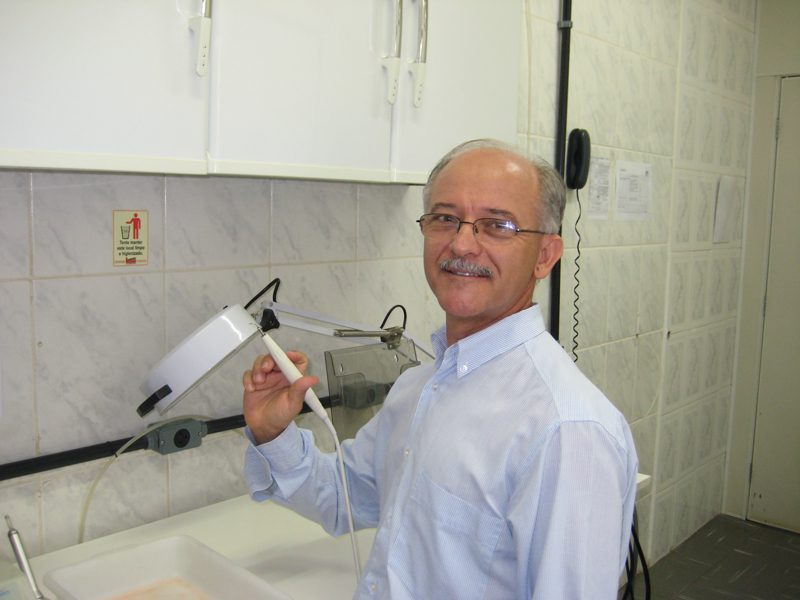 The key to CVD’s edge isn’t so much the diamond itself, it’s the way it preps the diamond to be adhered to another surface. The first product is tips of dentist drills. Diamond powder is already used on drills, but it doesn’t stay on well. Because CVD’s adhesives are so much stronger it can drill with an ultra-sonic, not rotational motion, which means no pain, no bleeding and no anesthetic, the company says. Early adoption has been a challenge. Dentists are trained a certain way and don’t like to deviate. So far just 5,000 dentists in Brazil have tried it and 3,000 are still using it. Another early use is drilling into the earth. CVD did a pilot-sale of some diamond-adhered drill tips to Petrobras a few months ago.
The hope is to turn CVD into a platform company that can spin out lots of these ideas, and partner with others to take them to market. Obviously, the challenge here will be the latter. The technology is there, and Airoldi, a CalPoly grad who got his ideas about tech transfer from his experience in California, can come up with dozens of use cases off the top of his head. Focus is going to be a key for this company.
But, like Bug and BS Construtora, CVD is trying to introduce new technology into industries that many other entrepreneurs have forgotten about. If that’s going to be the new green field – or blue ocean—opportunity, Brazil is a good place to bet.