Get Extra Early Bird Tkts to September's Disrupt SF by midnight July 31 »
Google’s Chief Economist: “Newspapers Have Never Made Much Money From News”
by Erick Schonfeld on Mar 9, 2010

Earlier today, Google chief economist Hal Varian gave a presentation to an FTC workshop on the changing economics of the newspaper industry. We all know that newspaper ad revenues have been falling off a cliff for years. Many media companies blame Google and are trying to put the genie back in the bottle with partial metered models for online news.

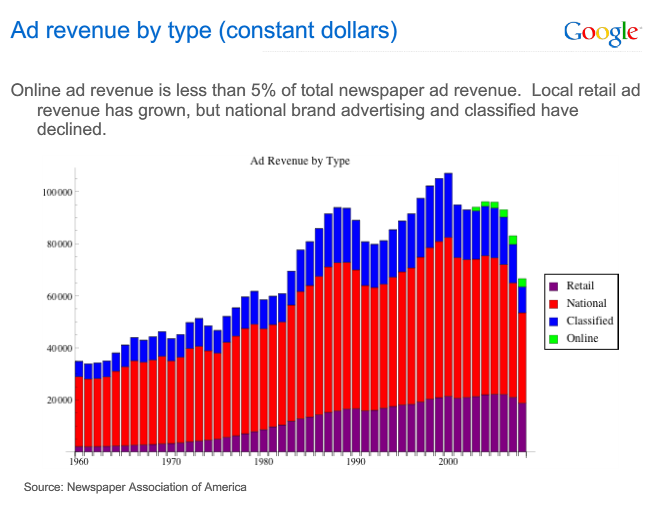
Google is understandably on the defensive, trotting out Varian to paint an unemotional picture with as much data as he can muster. But the picture he paints is a dour one for print media.  For instance, the chart above shows the decline of overall newspaper ad revenues.  Newspapers have taken huge hits in classifieds advertising (in blue) and national brand advertising (in red).  The online portion (green) is still too small to make much of a difference.

The collapse in print ad revenues is coming from two places: the overall ad recession of the past couple years and the shift to online news consumption.  Here are some telling stats from Varian’s presentation, which is also embedded below:

  • About 40% of internet users say read news on the Web every day.
  • Time spent on online news sites is only about 70 seconds per day, compared to 25 minutes spent reading a print edition.
  • Online news readers tend to read at work, not for leisure, so they don’t have much time to stick around and are thus worth less to advertisers.
  • Overall, less than 5 percent of newspaper ad revenues come from the online editions.
  • Search engines account for 35 to 40 percent of “traffic to major U.S. news sites,” according to comScore.
  • The cost of printing and distributing print editions, makes up about half the cost, while editorial operations only make up 15 percent.

Varian concludes: “Newspapers could save a lot of money if the primary access to news was via the internet.”  It sounds like he agrees with Netscape founder and investor Marc Andreessen, who recommends that newspapers “burn the boats” carrying their dying print businesses.

“The fact of the matter is that newspapers have never made much money from news,” says Varian.  They make money from “special interest sections on topics such as Automotive, Travel, Home & Garden, Food & Drink,, and so on.”  The problem is that on the Web, other niche sites which cater to those categories are a click away, leaving the newspapers with sections which are harder to sell ads against, such as sports, news, and local.

So what are they supposed to do?  He doesn’t really have a good answer, but ignoring the realities of consumer shifts in reading behavior and news consumption is not it.

Advertisement
Advertisement

Responses

Comments rss icon

  • ““The fact of the matter is that newspapers have never made much money from news,” says Varian. They make money from “special interest sections on topics such as Automotive, Travel, Home & Garden, Food & Drink,, and so on.” The problem is that on the Web, other niche sites which cater to those categories are a click away”

    That’s the exact case against Google News. Without Google News, people would go to their favorite news main page to read their news – be it NYT, WaPo etc. And in doing so might browse into the more lucrative sections of the publications.

    With Google News, people never hit the main page that shows the user all the options, they just selectively hit the specific article that the user found on Google News, hence robbing the publications ability to generate revenue.

    Sure, news publications have never made much money online. But with aggregators like Google News and Business Insider, news publications will be guaranteed they’d never make money online.

    To use Andressen’s metaphor, its like burning your boats and then finding out that the beach is littered with mines and moats filled with lava.

    • “That’s the exact case against Google News. Without Google News, people would go to their favorite news main page to read their news – be it NYT, WaPo etc. And in doing so might browse into the more lucrative sections of the publications.”

      Interesting point. But wouldn’t that be an argument for newspapers to treat each story as the main landing page, trying to tug readers to the niche parts of the paper, rather than just eliminating the news aggregaters?

      • “But wouldn’t that be an argument for newspapers to treat each story as the main landing page”

        Thats true, but the readers will be in “sniping mode”… they’re there just to read a specific piece of content and not in “exploring mode” as they would be if they just launched their browser into the main NYT home page and figuring out what news to read for the day.

        • … in fact, that’s probably Google’s plan with Google News all along — that is to shift users “exploring mode” time from the publication’s main page to the Google News page and monetizing that when the user “explores” outside News by searching on the main Google.com site and clicking on sponsored ads there.

          • Personally I do not go to Google for news.

            But I also would NEVER visit NY Time or any of the large papers.

            Sites like Craigslist and other similar sites will not go away.

            Portal sites like you propose are already deep into the market place.

            The fact is Newspapers are dead. Sad to say.

            The only way to get out of the hole is to innovate. This means get some good ideas.

            Personally if I was CEO of NY Times I would build or purchase a large web development firm. I would create services that fund the cost of running the development office. Then I would build out many innovative, new sites, apps, services, etc. Almost like a movie studio in the traditional sense. Creating a few hundred HIT mobile apps and sites a year. Using the print medium as a vehicle to grow these apps, sites, services and subscriptions.

            But the current method of complaining and pointing fingers at Google and others is just lame. It actually makes me sick to hear the big News Print companies complaining. It is 100% their own fault that they do not innovate!!

            Get up, stand up and fight for your right to be in a competitive world.

          • The problem is not Google its the nature of the internet; with so many of them often writing about the same things, you have to be in ‘exploring mode’.

        • I don’t think most of the “sniping mode” traffic comes from google. It’s just how the web works using urls, people link to stories in blogs, tweets, facebook updates, etc. You’d have to forbid deep linking to avoid “sniping mode” traffic. That would really kill the web.

      • I won’t be sure about that, now that the e-book/ news wars will ready to brawl at the 3rd quarter of this year.

  • So the decline is due to the Advertisers shifing Money — not where the news is delivered — wonder whether the Advertisers are now spending? Maybe at Google — so they are still to “blame” for for different reasons.

  • “The fact of the matter is that newspapers have never made much money from news,”

    This is true but a newspapers mission was to get the info out there believing that people needed to know even if they weren’t really that interested.

    They could do this before by subsidizing costs with classifieds and car sales. This stuff went to craigs list, cars.com and other niches.

    The needs are still the same though, just no immediately visible way to finance it now.

  • Google is right. News sites wouldn’t make a whole lot of money from advertising.

  • Newspapers need to give it up. Their time has passed.

  • Makes sense. Silly to think about printing all those dirty ink papers and shipping them all over the place just so someone can read it for 25 minutes and then throw it away. It’s absurd. The newspaper companies need to get a damn grip on reality.

    Do ya hear me Rupert?

  • Varian said newspapers should “Experiment, experiment, experiment…” If he can’t see the answer, with all his stats and revenue numbers, the newspapers don’t have a ghost of a chance to survive.

  • “The problem is that on the Web, other niche sites which cater to those categories are a click away…”

    Big media companies need to become aggregate, instead of producing their own content.

  • Am I the only one who sees something else in these graphs? I see it is not Google News that is causing the fall but Craigslist, eBay, Monster, and CareerBuilder.

    Retail: Steady – These are your local stores advertising sales. Makes sense. It reaches a local audience to the people most likely to look for sales(over 40).

    Online: Increasing – Makes sense. This is your younger demographic. This will only increase as more tech oriented people become interested in the news.

    Classifieds: Falling – Here is the impact of the internet. Jobs are being posted online. Junk is being sold online. It works better online.

    Brands: Falling – I was at a loss to explain this, but then I noticed something about this line. It trends almost exactly with the state of the economy. It dips in the dotcom/9-11 bust. It dips in the early 90s recession. It fails to climb during the 1980 recession. If I had the time, I would overlay the Dow Jones and link it. It matches nearly perfectly(I would overlay GDP, but I couldn’t find a graph version. It feels like it matches better). National companies are cutting advertising when times are tough. It is that simple.

    Conclusion: Overall advertising is tied to the GDP. Classifieds are being lost to online specialty sites that do the job better. Newspapers will need to replace the classifieds, but other than that, they seem in decent shape as long as they can keep subscriber rates up and better monetize the online content.

    • That. Is. Brilliant.

      I’d love to see those overlays if you ever create them.

      • It never was Google. Google just happened to be making money, more so than those companies you mentioned.

        Advertising-wise, there is something called measurement that all those crazy companies are requesting. They actually want to know which half they are wasting! What a bummer.

        Publishers are 90% about moving stuff around, all of them. If you can tell me how a publisher who still prints stuff is going to both print stuff and create the electronic products that all the kids want, while making a profit, well, you are a liar. They cannot.

    • @Matthew: That is the case. I have conducted that exact analysis while I worked at a major Danish news daily (Berlingske), comparing GDP growth and advertising revenues. The historical data from 1990s-2004 indicated that fluctuations in Denmark’s GDP growth/contraction explained as much as 80% of fluctuations in the newspaper industry’s advertising revenues (both display and classifieds).

      The main problem for newspapers is that their classifieds advertising now has migrated online – but with focused online players like eBay, Craigslist etc. in the dominant market positions.

  • I would say the demise of traditional newspapers and their relationship with the Internet has less to do with aggregators as it does with the nature of the Internet in itself. The Internet provides users with the ability to be dynamic about choosing their sources. The NYT, may appeal to a user for certain news stories, while a local paper appeals for local stories, and technology sources come from someplace different.

    The challenge for news sources is to provide incentives for readers to stick to their content as much as possible. Unfortunately, these big news corporations have not been very forward thinking.

  • Agree with Matthew. I was on the news side as a journalist and understood from the ad gurus that classified advertising was the cash cow. Before the web (and Craigslist) people interested in jobs in other cities would subscribe to that town’s paper. Long gone.

    On newspapers not making money from news, it actually takes good content to attract readers, which in turn generates interest from advertisers who want to reach those readers. Newspapers and magazines are making it easier to reach specific demographic targets by offering zoned and regional editions. More customization may be ahead to aggregate news for increasing localized and specialized audiences, or both.

  • As a normal reader I prefer aggregator portals like google that allow me to view or tailor a feed of stories that interest me from across the web.

    If I’m looking for a story to read, I looking specificly for stories, NOT for a specific news organization like the NYT, and frankly with every news org carrying the same damn story with a few words shifted around I could care less where I read it if I don’t go straight to the associated press anyway.

    As has been said before, general news and content is a comodity, there’s no real value to any of it as long as there’s hundreds of sites willing to regurgitate and print the same thing.

    The only thing I saw lately that might prompt me to give one of these companies a little money is very cheap apps, like a $2 lifetime “NY Times” news app for my iphone. Still, i’ve already got that for free and its laden with advertising. I just don’t see paid apps balancing out the loss of free app downloads with advertising revenue tho.

  • My bet: niche related publications have a good chance online, the rest will have to work/melt together in order to attract sufficient mass to attract enough ad spends. So bye bye to the online mainstream we-all-deliver-the-same newspapers. They are eating from the same small cake… One small cake can be big enough for one company though… hmmm better start sacking personnel.

  • i am sorry, but how seriously can i take a story where just after glancing over the bullets something already doesn’t make sense?

    “Online news readers tend to read at work, not for leisure, so they don’t have much time to stick around and are thus worth less to advertisers.”

    only because people read news at work, that does not mean they don’t do it for leisure. just walk around your office either in the morning or especially during lunch time and look at how many people spend quite a bit of time reading news as they eat their lunches. judging by the amount of sports pages up on screen i would say that is leisure reading and not work related.

    i checked the presentation and that one makes a bit more of a difference so i assume it was sloppy writing on techcrunch’s side. but it would be helpful if a site that is targeted at people that read the material not just for leisure but for business would have a bit higher quality standard.

    • Replying to the statement, ““The fact of the matter is that newspapers have never made much money from news,” says Varian. They make money from “special interest sections on topics such as Automotive, Travel, Home & Garden, Food & Drink,, and so on.”

      While this may the case online, it is not the case with print newspapers. The section of the newspaper with not just the most ads, but also generating the most revenue, is and has been the Main News or A Section, followed by Local News, or the B Section. Special sections and even niche sections have generally been more difficult for newspaper sales groups to sale. Most all major non-automotive, non-classified advertisers attempt to secure annual deals in Main News. Right or wrong rationale, this is because Main News has the highest reach/readership.

  • There’s something strange about the graph that is reprinted from Varian’s presentation. It’s inconsistent with the NAA numbers from which it’s sourced.

    It looks to me as if they included “Print Total” in place of the “National” category. According to the NAA data, in 2008 “Print and Online Total” was about $38 billion (not $60+ billion) of which more than half was “Retail”.

    If you’re interested in US newspaper circulation data, go here. For US newspaper ad data, go here.

Leave Comment

Trackback URL
Short URL
Advertisement