Placecast Debuts Location-Based Mobile Marketing Technology ShopAlerts
Leena Rao
Feb 25, 2010


For brick and mortar retail shops, the biggest challenge right now is actually getting foot traffic in their stores. Earlier this week, The New York Times reported that retailer North Face is attempting to bring people into their stores by sending them text messages when they get near their retail outlets. That technology, called ShopAlerts, is powered by location-based advertising startup Placecast and is launching today as a full-fledged marketing service for retailers.

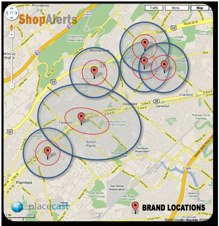
Here’s how ShopAlerts works. Consumers can opt-in to receiving text messages in a variety of ways—at the store, online, via text-message, mobile websites or on Facebook. Once the technology has been activated, consumers will be alerted when they are near a location that they are interested in or when the brand is offering sales and specials. ShopAlerts’ technology uses “geo-fences,” which are virtual boundaries that can be targeted via location-based marketing. Retailers can customize alerts to fit their brand and strategy. On the consumer side, ShopAlerts will only send maximum number of 3 messages within a given week from a retailer. And users can opt out of the program by texting “stop” back to a text message.

One of the benefits of ShopAlerts is that it works on both smartphones and non-smartphones, making it a compelling source of marketing and advertising for the 196 million Americans who do not own smartphones but may be interested in shopping alerts. Since September 2009, the ShopAlerts service has run pilot programs across the U.S. with several major retailers including North Face, American Eagle Outfitters, and REI.

Based on a survey of consumer participants in the program, 60% of participants found the location-triggered messages to be innovative, 79% said it increased their likelihood to visit a store, 65% made a purchase as a result of a ShopAlerts message and 73% of participants would definitely or probably use the service in the future. Of course the biggest barrier to ShopAlerts gaining serious traction is if consumers choose not to opt-in to receive alerts via SMS.

Launched in 2005, Placecast has raised $5 million in funding. The startup also offers a location-based advertising platform that weaves together location information and other data from audiences across the web, mobile, and email. Placecast will analyze inventory, segments audiences and targets ads for maximum relevance for advertisers and publishers.

Advertisement
  • Related Topics
Advertisement
  • http://www.techn0logy.com/placecast-debuts-location-based-mobile-marketing-technology-shopalerts-techcrunch Placecast Debuts Location-Based Mobile Marketing Technology ShopAlerts (TechCrunch) | Techn0logy

    [...] Read this article: Placecast Debuts Location-Based Mobile Marketing Technology ShopAlerts (TechCrunch) [...]

  • Shayne

    How are they getting the geo data?

  • http://www.goosegrade.com/edit/2331744 TimothyW sent a grammar edit. | gooseGrade

    [...] Earlier this week, The New York Times reported that retailer North FaceStatus: PendingReport Abusehttp://techcrunch.com/2010/02/25/placecast-debuts-location-based-mobile-marketing-technology-shopale… [...]

  • http://www.aegismobile.com Kevin Lenane

    NAVTEQ most likely… More importantly is that conversion rate. 65% is incredible…

  • http://www.facebook.com/profile.php?id=555956123 Casey Edwinson

    What locations currently can use this service?

  • Shayne

    What I meant was where are they getting the location data from? Since it works on non smart phones without GPS chips. Would they have agreements with cell phone companies?

  • coldbrew

    I’m glad someone else had the same question. I guess the answer is, “They just do.”

  • http://www.facebook.com/profile.php?id=1167157376 Jon Soderberg

    I read a sci-fi book that took this to an extreme…. the concept of geo based marketing is here… Im sure the android will incorporate this feature…perhaps user defined, filtered marketing, google geo-adsense

    you get an alert about a sale 3 blocks away…
    you acknowledge that this is of interest..
    navigator gives you voice directions…
    the sales person already has the shoe in your correct size ready to try on…

    or your hungry… search burritos… closest store… menu… order… walk.. pickup …already deducted from you debit account…

    need motel…. 4 star… hotels bid for your business… hotel sends taxi/limo… auto check in… wake up call… room service… all through the phone

  • Pierre Bureau

    Who the hell would opt-in to be spamed with Ads by text messages???

    This is beyond my understanding of life, the universe, and everything else…

  • MyLocator ®

    would be nice to find a good yardsale or a homeowner that is selling his vintage 1976 honda gullwing. alert locator services are the future of LBS offerings. where is the craigslist of LBS?

  • Tim

    That is my initial response too.

    “Consumers can opt-in to receiving text
    messages in a variety of ways—at the store,
    online, via text-message, mobile websites
    or on Facebook.”

    ^^ That ^^ seems to be a great challenge for retailers.

    It might be the initial carrot of a coupon and then a long, obstacle-filled OPT OUT procedure that gets consumers to subscribe for text spam. They could also be relying on the apathy of people, similar to paypal subscriptions.

    Come on now…you know you’ve neglected at least one paypal subscription.

  • cease

    i agree, how can this work.. I know that loopt signed some deal with the carriers to find out where you are based on cell phone signal, and I imagine this works in the same way..

  • Richard C

    They can’t locate 196M phones. They need to get location data from carriers. Only 2 have opened up – Sprint (through Wavemarket and uLocate) and AT&T (just through Wavemarket). And i just saw some press by Waterfall Mobile & Wavemarket which seems like the real thing. http://www.symbianone.com/content/view/6789/108/

    This is just a product announcement, locating all those phones is the hard part.

  • http://coupious.com Michael Pastko

    First of all, what a fluff piece. Second, Shayne asks a good question – how does a non-smartphone know when it has crossed a retailer’s “geo-fence”? My assumption is the carrier is reporting coarse position to Placecast, with the user’s permission.

    65% conversion rate sounds impressive on the surface, but think about it. That’s 65% of people who *already opted-in*. That means 1) they are receptive to text ads, and 2) they like the brand that is marketing to them. Basically, 65% of participants participated.

  • http://coupious.com Michael Pastko

    Opting-out is simple, as the article states. The Mobile Marketing Association has guidelines in place for opt-in and opt-out procedures. Not sure if Placecast is a MMA member, but they are well established enough to follow best practices.

  • http://www.Backtype.com/MichaelADeBose Michael A. De Bose

    The proximity benefit of GPS is just one way to provide this benefit. The way I see this question is, its Friday and I’m about to get off from work. Why can’t I just select my route and be made aware of all sales and deals along my route for vendors or items I’m interested in. It would look the same on a Saturday and I’m heading out. I might change my route if one of my preferred vendors sent me a compelling coupon, because I or the wife tend to frequent them on Saturdays.

    VR seems a better fit for this solution as I see it. Text is inefficient. An overlay of the city with beacons showing items and vendors of my interest makes more sense. I only see info relevant to a specific beacon if I click/point/hover unless my preferences automatically display them. For a store with different types of items, hieroglyphs help patrons decide if they need to investigate further. If an establishment has nothing going on, then the beacon becomes faded.

    Text doesn’t make sense. A video game like overlay on a Google or Brightkite (hello) map that displays vendor incentives based on my individual preferences for each, totally gets past the proximity thing. What matters most is the interest. Let me decide if I want to come.

    Like this idea or just need a really good visionary and idea man? I’m available for hire.

  • http://www.aegismobile.com Kevin Lenane

    For any phone you can access location in different ways using location aggregators like Loc-aid and others. There is of course a cost through the carriers but you can get locations through a-gps or celltri given you are willing to ask user for info like a phone number.

  • Kevin

    and yes those aggregators have agreements with the carriers….

  • anon

    As others have mentioned, the main problem with this technology is spam. I know it’s opt-in, but still, if this takes off in any way, every single retailer in the world will be blasting out incentives and it will become annoying quickly. For someone like myself, who lives in a dense city (NYC), this will be hell. I already wake up in the morning to find tons of emails from retailers offering me incentives. Most of those get sent to spam or trash with nothing more than a cursory glance at the title.

    I think geo-based advertising has a huge future, but the reason you haven’t seen more services like this is due to the spam issue outlined above, and other privacy concerns. Someone will find the sweet spot, but this does not seem to be it.

  • Shayne

    If you opt-in at the retailer level and not the global Placecast level then I don’t see this as a problem.

    The article states: “consumers will be alerted when they are near a location that they are interested in”

    To me that means retailer level. So you opt-in for deals at BurgerPalace and Victoria Secret but nowhere else. I don’t see that being a problem even in NYC.

  • http://www.aegismobile.com/blog Kevin Lenane

    I would – think about it. You are interested in comic books and you are in a New York City – you pass near a store offering 50% off the first comic you buy and the store is around the corner. Youd never have known about the sale save for you mobile device that can target you based on your behavior and location. The key is to make the content appreciable to the consumer – then you have a strategy where all three parties involved ‘win’

  • http://www.aegismobile.com/blog Kevin Lenane

    Exactly – you can opt in usually by genre too. So “Fast Food” etc… You can get pretty granular and this is by design so consumer stay opted in without being bothered. I really think this is the best kind of advertising and wildly efficient in terms of conversion rate.

  • http://www.waterfallmobile.com Matt Silk

    As Richard C noted, just this week my company Waterfall Mobile announced a strategic partnership with WaveMarket to power location-enabled messaging.

    We did so for a number of reasons, but chief among them is the reach WaveMarket offers through its Veriplace location aggregation platform and the privacy controls. Veriplace can access the location of all 125 million phones on the AT&T and Sprint networks.

    This story references “the 196 million Americans who do not own smartphones but may be interested in shopping alerts.”

    I would love some clarity here on their reach and who they are using to power this? Also regarding geofencing…how often are you locating me in order to trigger the messages?

  • anon

    Well, opt-in by genre is total spam – “fast food” – really? I would get hundreds of annoying offers a day.

    Shayne is saying opt-in by retailer which is better, but still I think it would be spammy. As I said, I already receive tons of daily emails from retailers I frequent and most of them get marked as spam or deleted. The reason I don’t opt-out is because every now and then I may look at one of those messages and act, but it’s much easier to manage that sort of thing from my inbox than via txt. The decision to go with txt is a disaster.

  • Shayne

    I’m wondering the same thing, just how often does the location refresh? and secondly how wide are the fences?

  • http://www.financialeyesandears.com/2010/02/25/what-founders-forget/ What Founders Forget- Financial Eyes & Ears

    [...] retail stores have a new trick up their sleeves to lure customers, according to an article by TechCrunch. Location-based advertising start-up Placecast has launched a technology called ShopAlerts, which [...]

  • http://www.mobileinc.co.uk Murat

    3 messages a week from a clothes retailer? Trying to extract that much money out of people will soon wear thin.

    I wrote a post on why location based ads won’t work using SMS

    http://mobileinc.co.uk/2009/12/why-location-based-couponingadvertising-wont-work-in-its-current-form/

  • http://www.xtify.com Josh Schiffman

    Placecast has an interesting model for business and consumers – we are excited about the press and excitement they are generating.

    Xtify offers a complementary solution for application developers and publishers to deliver location-triggered promotions directly to the device without the cost – creating a new information, marketing and advertising channel.

    Developers and publishers can incorporate the Xtify SDK directly into their smartphone applications – eliminating the need the need to pay AT&T, Sprint, etc for access to expensive location data and SMS distribution.

    Check us out! (www.xtify.com)

  • Rude One

    You’re right… those dummies are played around with coupons and don’t know what they opt in for…???
    Unlike us, the smart ones who prefer going though each store to find out what’s on discount but allow google to read our e-mails and target advertising based on this! Or Facebook apps to use our PERSONAL PICTURES and FRIENDLIST to serve advertising…?

    I have opted in knowing how many text messages i may receive!

  • http://www.facebook.com/profile.php?id=1009220 Joel Grossman

    Hi all. A few folks have referenced us here and asked some technology questions that I might be able to shed some light on. I run Product Management and Marketing for WaveMarket, which offers the Veriplace Cloud Location Aggregation Service.

    Self-plug aside, here is the state of affairs: the Tier 1 carriers in the US all have the technology to locate nearly all devices on their network (a result of the e911 mandate years ago). Accuracy levels will vary, though an increasing number of devices (including non-smartphones) are locatable with GPS accuracy (indeed, on the CDMA carriers, nearly all of the devices can be located with GPS accuracy). Additionally, other technologies (triangulation, CellID, etc) provide fallback for non-GPS capable phones and for indoor situations or other cases where GPS may not work.

    For privacy and security reasons, the carriers have been extremely cautious in leveraging this technology and exposing it to 3rd parties, understandably. However, developments in the marketplace have revealed that customers clearly WANT location based services (in fact, the current thirst seems almost insatiable!) A large percentage of applications, including some of the most popular, on the non-carrier controlled app stores are LBS applications that customers love. And customers are demanding more. The carriers are listening…

    For that reason, the industry is moving in a direction to deliver customers what they want: location-enhanced services that protect consumer privacy and security. As Matt from Waterfall and others have mentioned, this is exactly what Veriplace does: it is a cloud location service that can provide access to location for developers via a web services API. At the same time, it provides end users with rich tools to control their location on a per-application basis. Location is never shared with an application without the user’s explicit opt-in. And there are many ways to opt out of location sharing with an individual app (or completely) at any time.

    And, of course, the industry as a whole is moving in this direction as well as a matter of policy. In addition to the MMA guidelines referenced earlier, there are also CTIA Best Practices for location solutions.

    What has the demand been like? Well, we’ve publicly announced launches with two Tier 1 carriers and more than 1500 developers have signed up for a developer account. And I have more public announcements coming in the next few weeks… Much more info (including coverage, API documentation, architecture, etc) are available at http://developer.veriplace.com/

    As for the article, I found some of the statements in this slightly confusing. Indeed, nearly 200M Americans don’t have smartphones, and there are solutions, such as Veriplace, that can locate many of them. However, I believe that Veriplace offers the broadest coverage (having publicly launched with multiple Tier 1 carriers) and we are not at 200M non-smartphone devices (YET!–again, more announcements coming soon!) If you include our smartphone coverage, then we’re over 200M…

    Anyway, I hope that was helpful. I’ll keep an eye on this thread if there are any other questions I may be able to help with. It is definitely an exciting time for LBS!

  • Shayne

    Thanks for the very thorough response.

    With a service like Veriplace. Could a scenario like this exist:

    Customer X walks in the door to my restaurant, my restaurant is made aware that Customer X walked in and I look up his favourite meal in my database because he registered on my website and gave me his/her mobile number. My server brings out his favourite meal that he told us during his registration.

    I guess what I’m getting at is, is the data completely anonymous? And if it is does it have to be, even if the customer clearly wants to be provided this service?

    Thanks in advance.

  • http://www.facebook.com/profile.php?id=1009220 Joel Grossman

    No, if the customer explicitly opts-in to sharing his/her location with a service (the ultimate restaurant hosting service, in this case), then it does not need to be anonymous at all.

    Indeed, we have partners who are testing scenarios exactly like what you are describing…

  • http://excapite.wordpress.com/2010/02/27/browsing-with-you-but-buying-from-them/ Browsing with you but buying from them « excapite

    [...] What we are seeing now is an explosion of permission based mobile marketing solutions. All aimed at monitoring the customer’s location and purchasing behavior so that a preemptive strike can be triggered to prevent the Browse with Us, Shop with Them scenario. [...]

  • http://www.analoged.com/blog/2010/03/location-based-advertising/ bits and pieces » Blog Archive » location based advertising

    [...] There are a few different platforms for location based advertising.  Here’s another one. [...]

  • http://fonegigsblog.com/2010/05/06/%e2%80%9cgeo-fence-marketing%e2%80%9d-%e2%80%93-advertising-that-works/ “Geo-fence Marketing” – Advertising that Works « All about Mobile Advertising

    [...] These ‘shop alerts’ use “geo-fences”, which are virtual boundaries. These shop alerts can work both on smartphones and non-smartphones. So far the results of the pilot program that ran across several major retailers in 2009 are promising. 79% of respondents said it increased the likelihood to visit a store and 65% made a purchase as a result of a ShopAlert message. See more results at Techcrunch. [...]

  • http://intensedebate.com/profiles/nusret1 yuregininsesi

    Opting-out is simple, as the article states. The Mobile Marketing Association has guidelines in place for opt-in and opt-out procedures. Not sure if Placecast is a MMA member, but they are well established enough to follow best practices.

  • John Adams

    ShopAlerts by Placecast, was powered by LOC-AID Technologies for this North Face campaign early this year.

    http://www.loc-aid.com/

  • http://www.loc-aid.com/ Alfred Martin

    LOC-AID location-enabled the North Face campaign early this year, by providing the location-finding technology for ShopAlerts. http://www.loc-aid.com.

blog comments powered by Disqus
Advertisement
Got a tip? Building a startup? Tell us