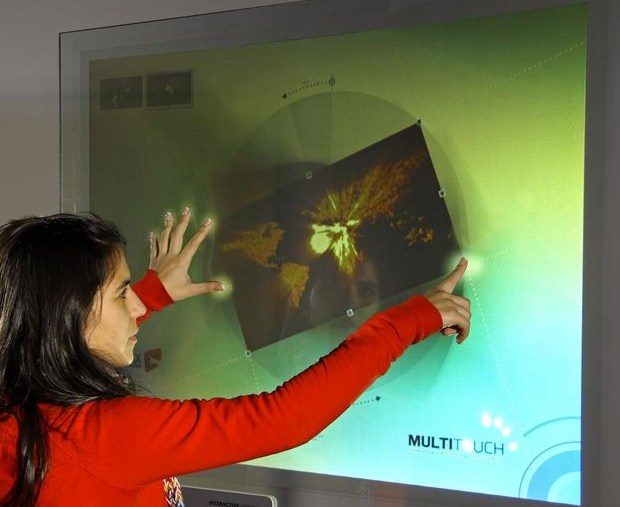
Last year’s CES found us at the booth of the iTable, which was an overlay for LCDs and TVs of any size that turned them into a multi-touch surface. We thought it was awesome, and the possibilities were many and various. Now we find that someone has one-upped the iTable, creating a multi-touch surface that’s thinner than a sheet of paper and can just be rolled onto any surface. How cool is that?!
It’s called DISPLAX, and I can’t describe it any better than Physorg did:
Based on patent-pending projected capacitive technology, DISPLAX Multitouch Technology uses a controller that works by processing multiple input signals it receives from a grid of nanowires embedded in the film attached to the enabled surface. Each time a finger is placed on the screen or a user blows on the surface, a small electrical disturbance is caused. The micro-processor controller analyses this data and decodes the location of each input on that grid to track the finger and air-flow movements.
I don’t know if you caught that, but it detects change in air flow. You can blow on it! Note that this is just a touch-sensitive surface; it still requires a display behind it and all that. As long as it just outputs some tagged XY coordinates, it should be a breeze, though.
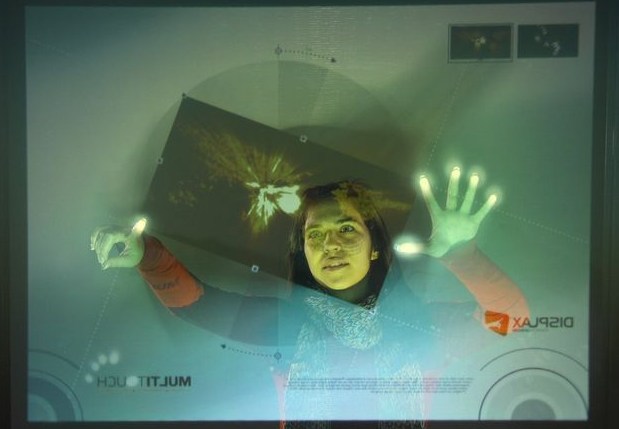
It detects up to 16 touches at once, which probably has something to do with the power-of-two number of nanowires embedded in the stuff, but it’s not clear how precise it is. The IR solution of the iTable was very precise and could have basically as many inputs as you could throw at it, like the Surface. The benefit of DISPLAX, of course, is that it’s microscopically thin and very flexible. I’m looking forward to hearing more about this technology. They’re supposed to start shipping this July.