
Google’s event today was supposed to be about one device, the Nexus One. Instead, we heard a lot of: “more devices,” more manufacturers,” “more carriers,” “this is just the beginning.” Today was not about one device, it was about Google’s first step in helping to reshape the mobile landscape in the U.S. And thanks to the groundwork laid by Apple, it just might work.
Think about your cellphone and cellular service five years ago. Both were likely horrible. But you were content in your misery, because you didn’t know any better. Then came the iPhone. It was a mobile device that was so good, people were willing to ditch their existing service providers en masse (I did) to go to the only one that had it: AT&T. And while you might think that would be a big plus for AT&T, it actually shifted a massive amount of industry power to Apple. They had the device that everyone wanted. And they used that leverage to renegotiate their exclusive deal with AT&T to pay out a huge amount of money for each device sold.
Sure, there were hot selling mobile devices before it — the Motorola RAZR, for example, was the best selling phone for many years in a row — but the iPhone had two advantages: 1) Thanks to Apple’s complete control over the device, including, maybe most importantly, its software, they created a user experience that the RAZR never could. 2) Thanks to the App Store, there is some amount of lock-in to the device because users are spending a ton of money on apps and if they switch phones, those all go away.
With the iPhone, Apple has created a device that all the other U.S. carriers lust after. And that, in turn, has allowed Google to come along with Android. When the G1 launched a little over a year ago, it was the first of many devices to be heralded as a “iPhone killer.” It wasn’t. But Google didn’t care about that. All that mattered to them at the time was getting their foot in the door of an industry that they, like Apple, had not at all been a part of leading up to that first device. It worked. The carriers were so desperate for an “iPhone killer” that they seemed willing and ready to negotiate with Google to get as many devices out there as possible to ride the Internet-enabled smartphone tsunami that the iPhone earthquake started.
As time went on, and Apple’s exclusivity with AT&T remained intact, Google honed their skills, and improved their software. Their manufacturing partners got better too, culminating in Motorola’s Droid, released late last year. Also not an “iPhone killer,” as I wrote that the time, that device too, was never about that from Google’s perspective (though it was from Verizon’s). It was about continuing to inundate the market with their devices and gain partnerships. With some 20 Android devices now out there, the time was right for what Google did today, which is launch their own agenda to blow up mobile industry as we know it in the U.S.
Now, that may sound a bit extreme, but just look at what Google did today. They launched an unlocked phone that you can buy directly from them. Now, this first device may not have much of an impact because it’s too expensive ($529.00) for its limitations (it will only fully work on T-Mobile in the U.S.), but it’s a first step. More importantly, look at the page pictured below. Is there any question what Google is doing here? They’re taking the traditional mobile model in this country, where you first choose your carrier, and then choose your phone, and turning it upside down. It’s what Apple started with the iPhone. But Google goes farther, because they already have multiple carriers (in this case, T-Mobile and Verizon, coming this Spring).
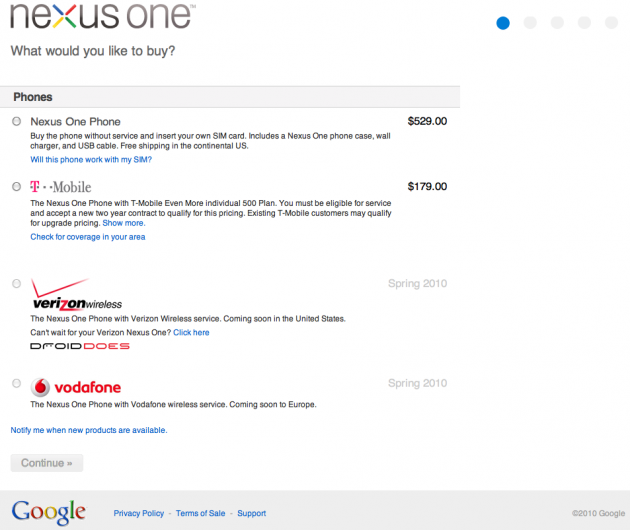
So why on Earth are the carriers playing ball with this? Well, they really don’t have a choice. Every carrier not named AT&T does not have the iPhone, but wants it. Since they can’t have it (not yet, anyways), they’ll settle for the next best thing, which are now more clearly than ever these Android devices. Google, of course, controls those — and increasingly so, now that they’re dictating hardware specs and features to manufacturers.
And who did Google have on stage today at the event? Two CEOs of two manufacturers: HTC and Motorola. Google has these guys in their pockets because it’s not like they’re going to team up with Apple to make a device (Motorola tried, and failed). And other partners, like Microsoft, are proving to be less than ideal in an iPhone world. So with the manufacturers on its side, Google has all the leverage it needs over the carriers. And that’s why we’re seeing them fall in line with the new mobile world order. So far, it is just T-Mobile and Verizon in the U.S., but Google alluded to the fact that they’re talking to the other ones as well. That means Sprint and likely even AT&T, for the inevitable day that they do lose the iPhone exclusivity.
It’s not hard to imagine going to a website for a phone one day in the near future and seeing a list of all the carriers. And it will be even less of an issue when CDMA and GSM are replaced by LTE, which will allow for more universal devices. Google set this in motion today. And it’s a model Apple is likely to follow when the iPhone gets to more U.S. carriers. Undoubtedly, the other big players, BlackBerry and maybe even Palm would like to do this too, but they haven’t had either the leverage, or the gall, to stand up to the carriers in this country the way Apple and Google have. Maybe they will in the future. But to the victors go the spoils.


I was completely unimpressed by today’s Nexus One story. It is nothing more than an unlocked Droid.
Many historic points to today’s move by Google.
The biggest is that they are the first to release a new device with an option to aquire unlocked so you can use whatever carrier you want.
but you can’t. you can pick tmobile or att, that’s it. That’s not groundbreaking at all.
I understand the underlying notions of what is happening, but it all feels like it’s big talk for nothing. I’ve seen too much of that to get too excited about it.
If you look at the image in the article you can buy an unlocked phone. Just because they are the only two supported US carriers doesn’t make it useless. Worldwide many more carriers support it. The US isn’t the only market.
quite right.
Nothing revolutionary in that. Nokia has been selling unlocked phone with little success in US. Stop being google puppet
nokia, really? sorry, but i prefer to do more than play snake when i’m riding the train.
This would have had more impact if they launched it worldwide on day 1. It’s useless to try this type of strategy because there are only 4 wireless carriers in the US. 2 of the carriers use CDMA, and 2 of the carriers use GSM and have different bands. There is no freedom to use a phone in the United States because we don’t have that many carriers that use similar technology – like UK which has 4 GSM carriers utilizing the same technology.
Quite honestly as far as the device is concerned I was excited until I saw the browser test on engadget, and was surprised that my iPhone 3Gs completely blew away the superfast superphone in terms of speed. Even simple scrolling on the Nexus was laggin. Plus no multi-touch??? No Exchange ??? Lame. Lame. Lame.
Hem… more than 10 years ago… in Europe it was DEFAULT to buy a phone UNLOCKED that could be used with ANY carrier as long as you had a SIM card. Nothing new… at least for countries which had been using GSM standards since the beginning.
Google is quite smart to make it looks like something new and never heard of.
No multi touch… lame!!
At this price it almost the same thing as the Buy.com Hong Kong factory unlocked iPhone you can buy. If that is legal and Buy.com is able to get away with that and you can buy a 3G sim card and stick it in and it will work already, then why is this so groundbreaking??
Is that because this is easier and more mainstream and advertised on Google.com?
This is the link for proof – http://www.buy.com/prod/apple-iphone-3g-16gb-never-locked-w-full-apple-warranty/q/loc/12435/210461450.html
Actually I bought an unlocked G1 phone over a year ago, you just had to register as a developer and pay $25. The phone was only $400 though, so the Nexus One is even more expensive.
Exactly, Amazon is currently selling 564 unlocked phones in their section “Unlocked Cell Phones”.
I like the Nexus One and all but Google fanboyism is starting to look alot like Apple fanboyism from a few years ago. And just the same as then they’re not really breaking any new ground, just making a pretty version with a big name of an idea that has been around for a while.
You are all missing the point. It is not that Google is the first company to sell an unlocked phone. It is that it is making deals with multiple carriers, and the carriers are fighting over the newest “superphone.”
This is not the first phone you can buy unlocked, but it is one of the first mainstream smartphones being sold unlocked by the company that makes them (in the U.S.). This now makes it harder for the carriers to leverage their pricing based on the exclusivity of the phones they have (once Apple ends its exclusivity with AT&T).
Point: now people will choose their phone first and carrier second. So they will pick the carrier with the most attractive pricing hopefully forcing the prices down because the carriers are trying to get the most people who are interested in the “(NEXT BIG PHONE)” to have service with them.
Example: If the iPhone were able to be activated for all carriers and was at the time still the phone to get. How are the companies going to lure people who want the iPhone over to their company?
Eh?
Virtually every phone released by Nokia, Samsung, LG, RIM and others over more than the last decade has an unlocked version.
Google released …*drumroll*… another Androif phone. Awesome.
um, true … only if you live in the US.
i for one am pretty used to buying an unlocked phone online at amazon. (EU)
more screenies, purported from endgadget.
Seeing google releasing their Nexus One to multiple carriers is just a dream come true, and now it not only on a GSM unlock but to CDMA too? This is sweet.
Although the rumors that Nexus One will be open for AT&T didn’t push through (oups for ATT) Carrier Details: http://bit.ly/nexus-one-on-multiple-carriers-details
No multitouch or copy and paste? Next please.
huh? if that’s your standard for a smartphone then I guess you should go back to year 2009 and live with your iPhone bubble.
oh btw, multitouch will be available to Nexus One, it’s just a software lack not some sort of hardware insufficiency.
Now for the copy and paste… Seriously?
Go find a vtech baby laptop. you know the one used by toddlers,
hello .. Copy and paste is not a big thing .. even we have this feature in sony erricson phones .. and stop bieng Google Puppet ( I read it somewhere here in the comments .. so I thought this was the right place to say it .. lol)
Best,
Daina
There’s no copy & paste? Wow…so it was worse then I originally thought.
Stop being an iphone biiiiiitch…..
Several phones support copy/paste. Don’t troll unless you know what you’re doing.
seems hardware and os *have* multi-touch, but built-in apps don’t yet support it. legal threat from apple?
http://www.engadget.com/2010/01/05/rubin-on-adding-multitouch-to-the-nexus-one-well-consider-it/
Milestone multitouch browser ported to the Droid by a user-made patch (video)
http://www.engadget.com/2010/01/04/milestone-multitouch-browser-ported-to-the-droid-by-a-user-made/
whatever gives you the idea there is no copy&paste?!
rofl
It does have both multitouch and copy/paste. What the hell are you talking about?
Come on. The world is more than the U.S. More unlocked cell phones are being sold in the world . Even the Chinese don’t have to live in the tyranny of carriers in terms of buying cell phones.
I see the replay of Mac v.s. PC war. Steve Jobs opened the world’s eyes with a revolutionary product, but, as Moore’s law plays out, Apple’s lead erodes, and the open platform supported by all initial losers eventually ends the dominance of Apple. The margin in hardware keeps getting squeezed and the final winner will be the guy whose revenue comes from somewhere else. Last time was Microsoft by selling software, This time will be Google with Ads.
You are an idiot. Geezus, I drove over my iphone after getting the Nexus One. And don’t even talk about how Blackberry’s are awesome – it’s not 2004.
And you obviously don’t interact with your fellow human beings enough. Get out of your mother’s basement, play some sport, go to a bar (if you are old enough) then you may learn that opening with “You are an idiot” is not a great way to go.
Wake up people !!!… Android is a means to take the full controll over every web services. Google is a software company and Android a means to defeat tweeter, facebook and every other web services they weren’t able to win untill now.. included you, if you are a developers..
The strategy is very simple, just adding step by step more services as part of the next Android releases .. like Microsoft defeated Netscape if you have a little of memory…
I, for one, cannot wait till this is the norm.
When I first loaded that ordering page and saw a list of carriers, lined up for the same phone like that, I had the biggest smile on my face. I just hope that this is only the beginning.
“Think about your cellphone and cellular service five years ago. Both were likely horrible. But you were content in your misery, because you didn’t know any better. Then came the iPhone.”
….and now my service is even worse!
Well worded article. It is important to note that these companies are trying to foster the customer relationship with the platform manufacturer and not just the carrier it is attached to.
In doing so it we (the consumer) win in a very big way because we not only get much better products, but carriers become a commodity and will drive down price. This is great for Apple because it would allow them to sell more devices (hardware and software profits), but even better Google who sites behind the wheel of advertising (more screens, higher adoption = more money).
thanks. good addition.
Wish I had proof read my comment before posting though – doh!
Just a comment here…in Europe the relatively new thing is SIM only deals where you get a SIM only and BYO-Phone, this is more profitable to the carrier since they dont have to subsidize a device and as a bonus there is no broken device fraud. So indeed the carrier wins here…and the consumer gets to pay more for their phone.
+1 for the Hart Foundation!
Another +1 for the Hart Foundation, which is especially timely with Bret’s return to WWE yesterday.
I thought he’d never return. thanks for letting me know he’s back. just read the news on the shenanigans on his comeback show. wonder if it was staged.
This has an undercurrent for the MVNO model as well.
That “pick your carrier” doesn’t have to be a short page… it could be a page with regional players, metro players… or imagine a Walmart phone service (i.e. TracFone) or having a Ford/BurgerKing phone service…
If you’ve ever seen a graph of consumer price index against actual market costs [ i.e. the < graph ] … yes, this could get interesting [ i.e. the \_ graph ].
yeah for sure. if only others could get control of the spectrum for more true openness.
Mark Cuban has banging that spectrum drum again lately as well. I say bang harder.
But why by regions? I actually think that the mobile-equivalent of MFJ should happen on infrastructure level: unbundling & separating the hard assets from operational management (the term ‘BabyCells’ has a nice ring to it).
Oh, I didn’t mean -limit- to regions but there is an obvious draw for “buy local” to consider and for work forces that never leave a town for example.
Structural separation in the US would create an entirely new economy. Huge. Massive.
Write to those in ‘power’ and let them know.
Funny that people didn’t notice something – in the end if Google can do the hard work of cracking open the carrier subsidised US cellphone market, it benefits Nokia (someone who knows how to play the unsubsidised game quite well but has been unsuccessful in US mainly because of that). However, I will be skeptical of the success of this strategy involving selling unlocked cellphones in the US market….it has been done before. Unless something game changing happens where the cost of the hardware can be brought down by other means, Google’s latest move is not that revolutionary despite Siegler gushing all over it.
Using ads to bring down hardware cost is not very obvious to me unless ad revenue rises beyond a certain limit. Also the current Google model for giving our free software wont work becoz unlike software, every unit of hardware shipped costs money at every stage of the process.
I don’t think Google cares much about eliminating the subsidies. More important is that their platforms are unencumbered by the carriers. The Nexus One is more about Google taking control of the distribution channel, and turning the carrier into an al-a-carte menu option.
I agree.
Think about the gVoice/iPhone fiasco, that’s the story here. Google wants its open services to be available to as many devices as possible & it’s willing to go to significant lengths to get it done.
To think that it was really Apple who squashed gV on the iPhone is laughable… what do they care!? They’re covering for T who most definitely did not want the service enabled…
Bottom line: The carriers, once again, will be completely marginalized. They transport bits, that’s it.
This is already happening in Canada, thanks to Apple. In Canada, after Bell and Telus built a GSM network, the iPhone appeared on every major carrier. Although the phone is still locked into the carrier, the initial choice is still the consumers’.
Already happening in Australia, but our carriers have had GSM networks for quite some time, so the iPhone 3G was available on every major carrier on launch.
Even better is that the carrier I’m with, Optus, unlocked my iPhone at my request :)
“because it’s not like their going to team up” should be “”because it’s not like *they’re* going to team up”
“And thanks to the groundwork laid by Apple, it just might work.”
Of course it did because you thing Apple is going to now keep their prized iPhone franchise to just 1 carrier after this Google move?
Expect some huge news at the Appler event in terms of iPhone!
I suspect they were already planning that months ago. Negotiating a carrier deal doesn’t take just 2.5 weeks to complete.
In a perfect world yes, Google could be percieved as starting to change the way we purchase phones in the US. However, I think we all need to see through the hype and realize it’s only as revolutionary as the amount of units it can move.
It’s increasingly annoying to for everyone to keep crediting Google with creating these phones. Did they have a direct input in them? Yes, but I think a lot credit needs to go to HTC which has quickly become one of the most popular mobile phone-makers in the USA.
Not only that but isn’t Nexus One merely a platform that anyone can create as long as it makes Google’s “standard”. This will just bring animosity to the mobile industry as Google forces them to cut back on support for other OS in favor or Android or risk not making to the Nexus One Platform.
Or… I could be completely wrong :) ahh the joy of speculating the future!
I always had a soft spot for the Hart Foundation
+1
I was always a Bushwackers fan…
I just don’t see it. Our carrier choice is pretty limited. You have t-mobile/att or verizon/sprint. Two different technologies, which means you still have too much market segregation.
Unless of course, they start making completely universal phones. In which I can *truly* take my phone to any carrier I want. Otherwise, this choice is really pointless. It might be a start, but I won’t get excited until the mold is actually broken. I’ve been able to buy a non-contracted phone that works on att/tmobile for a long time.
Agreed 100% If the Nexus One could have been used on ALL providers in the US then I would have thought this event was a massive statement, but in reality if you don’t use it with T-Mobile then you won’t even get any 3G on AT&T, and the Verizon phone won’t be out until Spring, and Google won’t officially support Sprint – so where is my freedom? My choice is T-Mobile and … ? Oh yeah, T-Mobile.
Great comment! The U.S. market is splint b/c two of the major carriers (and some of the less popular) support CDMA. I am a T-Mobile customer and was glad to hear that it supported 3G, but if I was with AT&T and didn’t want to leave, I would be stuck with EDGE. But what REALLY sucks is that even though I am a T-Mobile customer (and had been for the past 4 years), I still have to pay $530 as opposed to $180 b/c I have a family plan. This, in my opinion, is a first step but definitely not a groundbreaking move on Google’s part. Google is just testing the waters in my opinion. They had to do this with an attractive phone in order to compete with the iPhone, but I say wait to see what they do as far as Verizon is concerned is a bigger question. Are the GSM Nexus different from the CDMA Nexus (no SIM card slot perhaps). Wait and see, is what I say.
I think the idea is that you decide you like a certain phone, its apps, whatever.
Then you look at which carriers support it, what are the subsidies and how much do the plans cost.
At that point the competition kicks in, and in order to bring you in they will offer competitive prices.
When you chose your provider, you buy the version of the phone compatible with that network, but maybe you can not take it to another network in two months. It is not necessary that a single device really supports every network.
If you apply this on iphone, it would be quite beneficial for the consumer if it were available on all networks, and you could simply choose the one with the best balance of price/network coverage for your particular needs.
Nick – I agree with this statement “If you apply this on iphone, it would be quite beneficial for the consumer if it were available on all networks”, but neither the iPhone or the Nexus One can work on more then 1 network currently. The only thing “special” is that this phone will eventually work on a Verizon network…the same is actually true for the iPhone it will “eventually” work on another network.
Many people nowadays consider the phone 1st and the network 2nd. When it’s time to renew the contract they look at what is the best phone and move to a new carrier if they want. Before the iPhone I chose Sprint specifically because of the Palm Treo, and I moved to AT&T specifically for the iPhone. Most consumers that care about smart phones does this – except of course businesses which is a different story.
When I spend $500/- plus on a devise, devise portability does matter. You will appreciate it when you experience it.
However, making different versions of the phone for different carriers is an improvement over current iPhone/AT&T partnership model.
Yawn – keep dreaming MG. I can bet the TMo subbed Nexus will outsell the “unlocked” one. Consumers are conditioned to lower cost devices. iPhone had pitiful sales prior to the sub at&t kicked in.
I’ll say this carriers are changing when they REDUCE data plan prices, if anything forcing them out of the handset revenue pie will make then recoup that money other ways .. higher data cost, tiered data etc. Do you honestly think carriers will become a broadband connection? Come on get real. Just like Apple and digitial downloads was going to lower the cost of cd’s.
And I’ll say it again – Apple will not be cross carrier for years. LTE nationwide is still 2 years away. We’ll be lucky to have a couple major metro’s lite up this year .. every carrier has plans for broadband LTE MODEMS by Nov 2010 .. no word at all about smartphones so stop all this dreaming.
Carries invest billions and have deep pockets – they aren’t going anywhere so unless Apple / Walmart start buying spectrum it’s their way or no wireless access.
of course it will, it’s hundreds of dollars cheaper. the real interesting stuff starts happening with the verizon one goes on sale. which one moves more, etc.
btw, i seem to recall CDs being about $17 when I was growing up. now they’re more like $9. not saying that’s all because of itunes and the like, but it doesn’t hurt.
Where do you find new CDs for $9 bucks? Is there some secret shop I am unaware of?
Target, Amazon.
FYE
Because it is an Android device, expect much interesting hackery on this Nexus One, one of which will be unlocking!
CD prices were artificially kept high by Minimum Advertised Pricing in the late 1990s, and prices started lowering after the largest producers and retailers had to pay millions in price-fixing lawsuits.
Even so, CD prices at physical retail outlets are in the $12 to $17 range today, with some discounted to $9.
As to the main subject – I can only hope that control eventually is given to the consumer to buy a phone and then pick a carrier, like they do in many parts of the world, as opposed to buying a plan and picking a phone. Regarding the Nexus, I’m not so impressed.
MG – Time to wake up.
This changes nothing. Carries control the spectrum and until I see data plans on a fire sale nothing has changed.
Nice story, but you’ve missed the elephant in the room: Google’s $500M investment in Sprin/Cleaewire’s 4G Wimax network.
It’s already rolled out in 19 US Cities, just attracted more Mega-Capital. For 29.95/mo in Portland, Boise, Las Vegas, Baltimore (etc) its all the 4G you can use (no cap).
Who will need an expensive cellular carrier with a big voice plan and ‘lockin’ in 5 years? Maybe half of us, vs today.
Clear user here and quite happy. Plus you can go month to month, no contract. Hard to beat.
Google wrote off that investment a few quarters ago
I find it so weird… Here on Brazil most phones are locked (there’s one carrier who only sell unlocked devices), but they have to be unlocked for free BY LAW if you go to any store. Still, they’re expensive as hell, but we are used to paying a lot already.
This is the first time Google is putting much of their brand capital front-and-center in the consumer electronics space. I think of this event as similar to the launch of the iPod for Apple (although that MP3 player market was much smaller and Apple carefully entered the market).
I was really surprised at how Google decided to spend their brand capital today – they have the balls to call the Nexus One a “superphone” – a whole new class of smartphone because it’s an open platform and because the consumer has choice of carrier. Anything I miss about why it’s so super? They’re telling us about all this choice that we’re going to have with an unlocked phone. What choice?? CDMA and GSM phones are not portable across networks – and admittedly the Verizon version is subsidized. Unless you give up 3G (ha!), GSM phones are not portable across T-Mobile and AT&T. And as some of us have learned the hard way, taking devices between Sprint and Verizon’s CDMA networks is just not supported by either carrier (and also alluded to by the Google folks in today’s Q&A).
So I really hope the Nexus One solves the climate change crisis, brings peace to the Middle East, or desires the Legion of Doom – because so far I haven’t seen much super about this superphone.
Meant to add: LTE is still pie in the sky,Sprint is 3-4 years ahead of them.
Factor in running Google Voice…. GOOG’s@long-term aim is to replace the cellular networks with cheap, ubuiquitous (4G) broadband dataaccess (aka wireless broadband).
MG,
While The Hart Foundation were a great team, please select from the list below the next time you need a “tag team” graphic:
In order of my favorites (top to bottom)
Demolition
Legion of Doom
The Rockers
Money Inc – Ted DiBiase and Irwin R Shyster (I.R.S.)
The Bushwackers
fair enough. always a hard choice.
I’m wondering if AT&T will play ball too and jump on the bandwagon along with other carriers; because for all practical purposes, Nexus One has rubbed off Apple at every edge that it had this far in the mobile industry. AT&T’s reputation doesn’t help it’s cause either. They are going to have an uphill battle from this point on finding new users. At least till Apple launches it’s iPhone 4G. And what is to say they won’t play Google’s heretical game!
They can’t afford one more decent smart phone on reportedly, already strangled 3G network.
What are “spoils” anyway?
Finally an article from MG today. I was wondering when he would come out of the corner whimpering.
Of course, he had to put in a “Next is the second best” comment, but that’s ok — it must have been a horrible day for him.
I was thinking the same thing. I don’t think I’ve read one story from him without an Apple twist. I would even venture to say that he regularly drinks appletinis, also with an apple twist.
MG likes them apples, MA doesn’t as much. It’s all balanced out here at TC.
what of it?
Q: If the carriers’ monthly rate is the same for both subsidized and un-subsidized phones, what advantage does an unlocked phone offer? Your total net cost for 24 months of usage will be much higher with an unlocked phone, contract or not. Planning on changing carriers after 12 months? Limited choices to move to at best. If one spends $500+ on an unlocked handset, and gives up the $300 in subsidies, all for the privilege of changing carriers within the next 2 years then you are penny-wise and pound foolish. Until the rate plans reflect the elimination of the subsidy, we have no incentive to avoid playing the “loan me the money to buy the handset” game. If you buy the unlocked phone, you will still be using some TBD carrier, you will be purchasing minutes and data, and you will be spending “X” per month. Will the carriers reduce the rate plans by the amount of the subsidies they pay? No evidence of that so far. Until the price war breaks out, you may as well sign the contract and take the bribe. Chicken and Egg.
It gives you the freedom to choose your plan as well as your provider. $15 less per month and you end up saving money over 24 months.
There is a structural reason why unlocked phones dont work in the US, and it has to do with two things
that carriers control. These control levers are not going away anywhere soon.
1) no portability – phones dont work across carriers, and the leaders have no incentive to change that.
2) subsidies – Your total cost of ownership of a smartphone is 80% for the service and 20% for the phone. The service provider has all the leverage to structure their subsidies in manners that benefit them.
Unless the day WiMAX arrives, you aren’t going to see fundamental changes in this structural setup.
It’s not WiMAX you need to be on the lookout for – it’s LTE.
Only one operator in the US is building a WiMAX network, everyone else is going to LTE as their “4G” technology. Theoretically, the unification happens there (although the devil is in the details & I’m not certain its just that simple).
T-Mobile is doing interesting things by having their unlocked plans for cheaper than subsidized one
you save $480 over 2 years as unsubsidized phone has $20/mo cheaper plans. Both phones are unlocked though, which can make a difference if you go abroad, and buy a prepaid sim to use while traveling.
Yes exactly!
I travel very often to India, China, Japan and back to USA so an unlocked phone is KEY!
Well said but you don’t place a high enough value on the satisfaction of disrupting their system. To me it would be worth potentially wasting money to know I could dump the company without contract exit fees when they piss me off. That’s me though, most people wouldn’t value this very highly.
Apple and Google are pretty much the best at everything.
Competition is always good for the consumer– I wholeheartedly am looking forward to Google and Apple finally giving Microsoft a run for their money.
Is anyone else not able to purchase the Nexus One through T-Mobile yet? It keeps telling me it can’t serve my request and that I should try back in a few minutes.
Try clearing your cookies and see if that works.
I ate them will that work?
It will be interesting to watch what the biggest drivers of consumer choice are once the hardware is no longer a factor.
Today, many are able to minimize legitimate concerns over coverage or pricing with a specific carrier in order to get a specific phone. Once that choice factor is removed- what factors become the most important?
I remember calling T-Mobile from china to unlock my MDA and for that they charged me $30.
I also remember taking my phone to a shady cellphone dealer in LA to unlock it for me.
Regardless of which carrier gets on board, an unlocked phone is an unlocked phone. Just because there are only two carriers you can go to here in US, it doesn’t mean the phone won’t work with the open-minded carriers out there in the rest of the world.
“They’re taking the traditional mobile model in this country, where you first choose your carrier, and then choose your phone, and turning it upside down.”
Welcome to how the rest of the world works; it’s about time, the way your mobile phone industry works truly perplexes us ;)
Yawn. Not sure what’s the big deal. Most of current GSM phones can be unlocked by spending max. of $30. Even ATT & TMobile unlock phones after 90 days. I have been buying phones in US (quad band) and unlocking them for use in other countries for more than five years.
As far as CDMA/GSM phone goes, htc touch pro 2 for sprint or verizon has both CDMA and GSM capabilities. I successfully used my htc TP2 (sprint) in other countries by inserting local GSM SIM card. In US sprint locks the GSM function but there are ways to break the lock and use the phone on ATT/TMobile or any other GSM carrier.
Hey Nexus One. Please come to India..